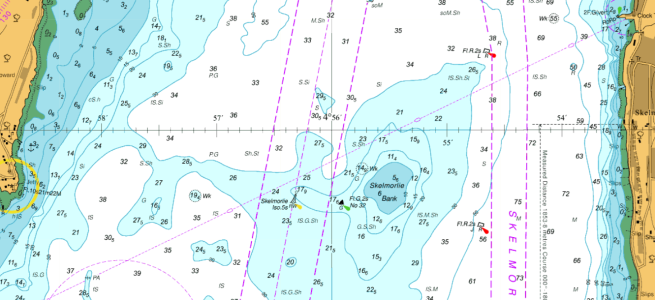
Sunken yacht in Solent

Because, after 52 years of anchoring in thousands of anchorages worldwide I can think of any number of things (from checking the set, to taking bearings, to checking the swinging room, and getting a weather forecast for the intended length of stay etc. etc.) that I would prioritise over hoisting a little plastic ball to avoid collision.
And whilst I was doing all those other things, I would by definition be delaying the hoisting of said ball and therefore be in default of the colregs.
I would be happy with my prioritisation however as I have yet to hear of any collision incurred due to lack of a ball but I have witnessed many an incident from the other examples I give.
Some may choose to prioritise the ball, I do not. (y)
I have heard that a boat got hit whilst at anchor and one of the questions asked by the insurers was "did you have an anchor ball on display".
 
I think realistically it depends where a boat is anchored - in some rivers it may be ambiguous, particularly due to flowing water, so a an anchor ball is useful. Also if doing a temporary anchor in an unusual place - perhaps waiting for a tide or similar.
But yes where I generally sail, if a boat is in a bay that is a recognised anchorage, and has no thorough passage, it is pretty obvious that a boat is liable to be anchored.
Because, after 52 years of anchoring in thousands of anchorages worldwide I can think of any number of things (from checking the set, to taking bearings, to checking the swinging room, and getting a weather forecast for the intended length of stay etc. etc.) that I would prioritise over hoisting a little plastic ball to avoid collision.
And whilst I was doing all those other things, I would by definition be delaying the hoisting of said ball and therefore be in default of the colregs.
I would be happy with my prioritisation however as I have yet to hear of any collision incurred due to lack of a ball but I have witnessed many an incident from the other examples I give.
Some may choose to prioritise the ball, I do not. (y)
I am the keeper of one of dunedin's 5 balls in Scotland ;-) and it almost always gets hoisted after anchoring. I recognise all that people say about the low chance that anyone would think otherwise, but it just seems like the proper thing to do. It lives in the anchor locker and part of the job of the anchor person is to clip it to the deck and spinnaker halyard and hoist it. It probably takes 15 seconds. If I appear to be moving without taking it down it might be a clue to others that I am dragging. There are many things we do that actually 99% of the time probably make no difference (at least in home waters) - Q flag, an Ensign, completing a log, displaying courtesy flags - so it seems peculiar that more people don't bother. My intention this winter is to fit a waterproof connector for my anchor light on the deck and hoist that at the same time - that takes longer than the ball.

I will confess though that my motoring cone gets considerably less action, although even that comes out if I think there's ambiguity.

If people look at me and think I must be a noob or on an RYA course then that's fine they won't be judging me for all the other sins I am probably committing. What I notice is that if I am first in an achorage and put my ball up there's a 50/50 chance anyone joining me follows suit, whilst if the majority don't have a ball up when I arrive, then almost nobody bothers after me. The definite exception is the small cruise ships (12pax+crew) that ply their trade on the west coast - they ALWAYS put a ball up - and if they have to, I don't see why I shouldn't.
 
I am the keeper of one of dunedin's 5 balls in Scotland ;-) and it almost always gets hoisted after anchoring. I recognise all that people say about the low chance that anyone would think otherwise, but it just seems like the proper thing to do. It lives in the anchor locker and part of the job of the anchor person is to clip it to the deck and spinnaker halyard and hoist it. It probably takes 15 seconds. If I appear to be moving without taking it down it might be a clue to others that I am dragging. There are many things we do that actually 99% of the time probably make no difference (at least in home waters) - Q flag, an Ensign, completing a log, displaying courtesy flags - so it seems peculiar that more people don't bother. My intention this winter is to fit a waterproof connector for my anchor light on the deck and hoist that at the same time - that takes longer than the ball.

I will confess though that my motoring cone gets considerably less action, although even that comes out if I think there's ambiguity.

If people look at me and think I must be a noob or on an RYA course then that's fine they won't be judging me for all the other sins I am probably committing. What I notice is that if I am first in an achorage and put my ball up there's a 50/50 chance anyone joining me follows suit, whilst if the majority don't have a ball up when I arrive, then almost nobody bothers after me. The definite exception is the small cruise ships (12pax+crew) that ply their trade on the west coast - they ALWAYS put a ball up - and if they have to, I don't see why I shouldn't.
Agreed. We have ball no. 2. 👍
 
What a load of anchors!


spherical-tank.png
 
I am firmly in sado territory, I have NUC lights that can be hoisted, but not day shapes.

It's always been my ambition to have a set, having been caught out on a couple of occasions when it would have reduced stress (e.g becalmed, engine failed, at night, large tug and tow heading straight towards us), but contriving such an arrangement is still some way down on the 'to-do' list.

That said, I was once chuffed to be able to have a sufficient combination of lights on my Hurley 22 to be able to display proper towing lights when I rescued, in the dark, a broken down unlit motorboat which was just about to be swept by the strong ebb tide across the nasties between Drake's Island and the western shore at Plymouth. While trying to get them in tow I was in the same danger, so I was initially holding in my hand the end, taken once round a cleat, of an uncomfortably short length of scrappy polyurathene rope they'd passed me, while steering with the other (I was single-handed at the time). I towed them like that into the deep water of the main channel between the island and the town, where I could stop to arrange a more practical tow line. While doing that a disco boat passed uncomfortably close and one of the crew yelled something I didn't catch, but certainly didn't sound very friendly. Obviously my towing lights were to no avail!
 
Are the Torpoint and other chain ferries 'at anchor'? Should they be displaying black balls?


chain-propelled-passenger-car-ferry-linking-devonport-plymouth-torpoint-cornwall-single-deck-roll-off-ramps-either-end-168236236.jpg

I don't believe they are, even under the ColRegs, but I think the ColRegs are in any case typically over-ridden by local regulations prescribing the relevant lights and shapes, and e.g. in the case of the Torpoint ferries makes them the stand-on vessel when crossing.
 
I don't believe they are, even under the ColRegs, but I think the ColRegs are in any case typically over-ridden by local regulations prescribing the relevant lights and shapes, and e.g. in the case of the Torpoint ferries makes them the stand-on vessel when crossing.
I can work out when to pass through when only two of them operating but when they press the third one into service, it's more of a challenge timing them.
 
I don't believe they are, even under the ColRegs, but I think the ColRegs are in any case typically over-ridden by local regulations prescribing the relevant lights and shapes, and e.g. in the case of the Torpoint ferries makes them the stand-on vessel when crossing.
I actually agree with you - it's common sense that they (chain ferries) are not classed as 'under anchor' - but strictly speaking, I cannot see how they are not anchored as they are permanently attached to a chain which is itself embedded in a waterside lump of concrete. I don't see that a black ball would clarify or improve the situation one way or the other. In the OP photo, no sails up. no exhaust, no wake, no bow wave, nobody on deck would have registered with me way before the 'correct signal'.
I would get no comfort from a black ball whatever. If a vessel was displaying the 'correct signal' but had broken free of her anchor she would still be showing the precious 'black ball' - but to be honest I would pay more heed to the fact that she was careering through the moorings on an ebb flow to decide my course of action.

As to those quoting Colregs and Insurance, I ask a simple question, if you saw a vessel approaching you, at say 6 knots, with a clear bow wave and stern wake, and on a potential collision course with you - what would determine your actions - the wake, the bow wave and the and the fact that she was fast approaching, or the black ball that she was displaying having forgotten to take it down? What justification would you put to the inquiry or insurers for not taking evasive measures?

Ps. For those thinking that I am being overly pedantic, you are correct. It's a wet, windy Tuesday and I have cabin fever when I should be up on deck doing some jobs. I might have to grab a coat and go to the pub unless the debate improves.
 
Last edited:
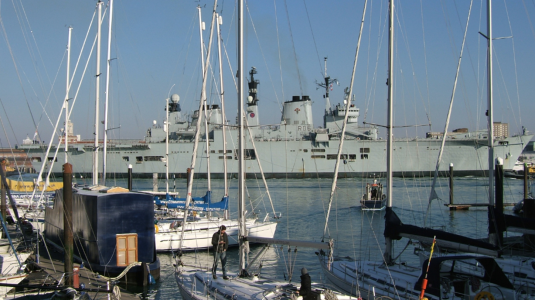
Spot the anchor ball on Ark Royal

There is no more effective anti-collision technique than vaporising anything that comes close.

(I have no idea if AR had that capability, it might not have been her turn to have the ammunition that week!)
 
I actually agree with you - it's common sense that they (chain ferries) are not classed as 'under anchor' - but strictly speaking, I cannot see how they are not anchored as they are permanently attached to a chain which is itself embedded in a waterside lump of concrete.

I understand your thinking, but don't think that just because a chain is involved it constitutes anchoring. I imagine there is case law effectively narrowing what the definition might include, but I'm not familiar with it.

The other thing that strikes me as somewhat ambiguous, but I very much doubt it would count as anchoring, is drudging, where a ship deploys an anchor on a short scope and drags that along while proceeding astern, to keep the bow of the ship under control in a narrow channel. I seem to recall they sometimes do that (or used to) in Fowey. (I hear something similar has lately become popular in the Baltic. ;))
 
Top