
Sunday evening physics question - prop thrust

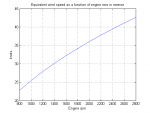
This is for my boat. Of course it's different for every boat (force vs wind speed), engine and gearbox (prop shaft speed vs engine rpm) and prop (mine's a symmetrical Gori 18" dia 3-blade). Assumes steady wind, no snatching or serious waves.
range_under_pwr_6.png
 
Last edited:
i quite like testing it before its dark wet raining and very windy :-) but then i am a paranoid android

interesting links above, thanks.

and interesting original post/question
 
A key, or a realistic approach is in Thinweater's post. It is not the holding capacity, or lack of, nor the holding of the seabed (except very, very poor holding - but the movement of the yacht, yawing and hobby horsing that causes an anchor to drag.

A 15kg Delta will hold 1t in a decent seabed - and 1t of tension would be horrendous - and anyone with any sense would never have exposed themselves to winds generating that force. But you don't get wind and no chop nor no yawing - and it is the continuous movement of the yacht - directly transmitted down the rode to the anchor that cause the anchor to drag. Any movement of the chain reduces the shear strength of the seabed. If you have chain on the seabed the effects of movement of the yacht will be reduced - but at 5:1 scope and 30m of rode deployed - all the chain will be off the seabed at 20 knots (and it will 'look' bar tight at 30 knots).

Most anchors have been tested for holding capacity - some have not. There are plenty around that have been tested - why risk buying one with no performance data. Some anchors do not dive very deeply (those first t generation models, CQR, Bruce, Delta and some second generation anchors are not much different (look at that video of the Mantus M2)

If you yaw and hobby horse then the chain is constantly tensioning the anchor from left to right and up and down.

If you don't believe this - make up some concrete and wriggle the spade in the concrete - note that the concrete in close proximity to the spade goes watery - same with the seabed round your anchor.

A more deeply set anchor suffers less - because shear strength increases with square of depth - and deep set anchor has buried chain. Using a swivel, especially a large swivel, a large shackle, over sized chain will all reduce the ability of the anchor to set deeply. The ideal, not recommended, is a wire stop leader - but swages are a big issue.

Power setting an anchor, as mentioned, ensures the anchor is set or setting (as clearly articulated by LW395) - increased wind will or may set it further - but yacht movement will negate some of the positive effect of the wind. You can reduce, markedly, the effects of veering and hobby horsing by using a snubber (with a decent amount of elasticity - think boat length) and reduce veering by anchoring in a 'V', riding sail (as has been mentioned by NormanS), etc.

Jonathan

edit

If you want to investigate more detail of 'catenary' and tension look at the current thread on Cruisers Forum

http://www.cruisersforum.com/forums/f118/g70-chain-vs-g4-225019-3.html

and an even earlier thread, also on CF, commenced by Dockhead, to which he links.

The data in the CF thread can be looked at in conjunction with the graph above provided by jdc (though some extrapolation might be necessary).

As Thinwater says - this is a complex subject, though Dockhead made a pretty professional attempt to keep his thread on track, and deserves at least a chapter - or a series of articles in PBO.
 
Last edited:
What would we do without anchor threads?:D
Jonathan, there are several points arising. You say, "anyone with any sense would never have exposed themselves to winds such as........" So what do you do if you are "off piste" and such winds occur? I've tried the "Beam me up Scottie" and "Get me out of here" procedures, but they don't work for me. If we get 60 or 70 knot winds, that's what we get, so I do have some experience in anchoring in less than pleasant conditions. Fortunately, we are blessed with anchorages which though exposed to wind, are completely sheltered from the sea. So we don't normally experience your "hobbyhorsing".

I know that you view catenary with disdain, but you anchor with lavvy chain, while we use relatively heavy chain. There is a world of difference. I accept that in absolutely extreme conditions, the benefit of catenary reduces. Will you also please admit that in similar conditions, the stretch in your snubber also reaches its limit?

Disregarding the effect of waves, I think you will probably agree that the ultimate load on the anchoring system, is not just the direct windage of the boat, but is magnified greatly by the boat's yawing and surging from side to side, before being stopped short by the rode, thus generating a shock load. To my mind an ordinary snubber is only dealing with the symptoms and not the cause. I know that with your catamaran, your bridle snubber arrangement will help, as anything that will encourage the boat to lie quietly head to wind, will greatly reduce the load, and prevent shock loads. That's why we, even with the reduced tendency to yaw, by virtue of the mizzen mast and its associated clobber, will rig our anchor/riding sail to prevent yawing. We deal with the cause, rather than the affect.

I'm intrigued by the fact that you lump together CQR, Bruce, and Delta anchors, since there are basic design differences. CQR and Delta are convex, while the Bruce is concave. Fashion in anchors comes and goes, but successful anchoring has more to do with where you put it, and how you deal with it, than fancy marketing and advertising.

Anyway, this should be your time for heading away down to sunny Tasmania, instead of sitting at a keyboard.

Happy anchoring. Norman.
 
Its still a bit chilly for sunny Tasmania but we are sitting in the cockpit, all rugged up - Josephine is focussed, temporarily at least, on mulloway. I'm at the keyboard, its 10 pm here. Gorgeous night, sky ablaze.

The reason to lump CQR, Delta and Bruce together is simply because they have been awarded a Classification Society performance rating of High Holding Power anchors and some more recent models have gained Super High Holding Power ratings. The 2 ratings are different by a factor of 2. It has nothing to do with fashion, marketing nor even convex, concave nor plate.

Of course our snubbers have finite abilities, that's why we carry spares (we have broken 2 in 20 years). If they are not 'snubbing' they are probably too large a diameter - and 'snubbing' reduces life (of the snubber). Snubbers are bit like sails - they have a finite life. Because they have a finite life we have a fall back, the chain lock.

Its more about compromises.

We might be better (in terms of anchoring) with a 10mm anchor chain (of 100m) but 100m of 10mm chain will add 200kg to our anchor locker (near the bow) and on a 7t yacht this will have a detrimental impact on performance. We will also need a bigger windlass, larger power cables and possibly a larger battery bank - and all of this will impact my wife's wallet (which is a concept, being a kept man, that I really don't want to address).

but slightly more seriously :)

Its horses for courses - for us 6mm offers the best balance of compromises - I fully accept that for others our decisions seem extraordinary (but something for others to conjure with)

We also accept that sometime we, all, get it wrong and the forecast wind is but a shadow of reality (been there done that) - it is after all a forecast, not a guarantee. As you say - we all make the best of what we have got (and are here - on this forum - proving we are resilient and resourceful. We have the advantage that though we virtually always anchor in around 5m - we can chicken out and move toward the beach (and greater shelter) as we draw 1m. We are also wimps and seek shelter when 70 knots is forecast (and Tasmania though enjoying its fair share of Storms, in the summer - 1 per month, - still has trees)

We don't 'rely' on snubbers - we use a conventional bridle and, as you might deploy a riding sail, we will anchor in a 'V' (one reason to carry spare anchors and a complete spare rode. So we address veering - in the same way you do (remove, or minimise the cause). We have extended this to look at hobby horsing. in chop, and in the fullness of time (in the next few months) hope to be able to describe an 'answer',

Anchoring practices evolve, as yachts have evolved. There is no one correct answer and the state of the art of 20 or 50 years ago is not necessarily the only answer for today's yacht - it might be, but it might not

Jonathan
 
... Anchoring practices evolve, as yachts have evolved. There is no one correct answer and the state of the art of 20 or 50 years ago is not necessarily the only answer for today's yacht - it might be, but it might not

Jonathan

Now look here, this sort of considered reasonableness is quite out of place in an anchor thread. I've a good mind to report you to the moderator.
 
Our normal setting procedure is to gradually build up the engine revolutions in reverse and finish with full reverse for about 30 seconds.

When this setting procedure is done and I observe the anchor underwater it will not set any deeper until about 25-30 knots of wind is reached. Wind greater than about this level will typically result in the anchor burying further.

However, I am not sure the forces are necessarily the same. When observing the anchor underwater while adopting this setting procedure, the anchor is continuing to dig further down while the reverse thrust is applied. In other words we do not reach an equilibrium with this force for only 30 seconds. If the same reverse force is kept on for a longer period the anchor will dive deeper.
 
What would we do without anchor threads?:D
Jonathan, there are several points arising. You say, "anyone with any sense would never have exposed themselves to winds such as........" So what do you do if you are "off piste" and such winds occur? I've tried the "Beam me up Scottie" and "Get me out of here" procedures, but they don't work for me. If we get 60 or 70 knot winds, that's what we get, so I do have some experience in anchoring in less than pleasant conditions. Fortunately, we are blessed with anchorages which though exposed to wind, are completely sheltered from the sea. So we don't normally experience your "hobbyhorsing".

I know that you view catenary with disdain, but you anchor with lavvy chain, while we use relatively heavy chain. There is a world of difference. I accept that in absolutely extreme conditions, the benefit of catenary reduces. Will you also please admit that in similar conditions, the stretch in your snubber also reaches its limit?

Disregarding the effect of waves, I think you will probably agree that the ultimate load on the anchoring system, is not just the direct windage of the boat, but is magnified greatly by the boat's yawing and surging from side to side, before being stopped short by the rode, thus generating a shock load. To my mind an ordinary snubber is only dealing with the symptoms and not the cause. I know that with your catamaran, your bridle snubber arrangement will help, as anything that will encourage the boat to lie quietly head to wind, will greatly reduce the load, and prevent shock loads. That's why we, even with the reduced tendency to yaw, by virtue of the mizzen mast and its associated clobber, will rig our anchor/riding sail to prevent yawing. We deal with the cause, rather than the affect.

I'm intrigued by the fact that you lump together CQR, Bruce, and Delta anchors, since there are basic design differences. CQR and Delta are convex, while the Bruce is concave. Fashion in anchors comes and goes, but successful anchoring has more to do with where you put it, and how you deal with it, than fancy marketing and advertising.

Anyway, this should be your time for heading away down to sunny Tasmania, instead of sitting at a keyboard.

Happy anchoring. Norman.

No, snubber stretch does not reach its limit. Unless the snubber is undersized for the conditions, it should be at its working load limit, in which case stretch is roughly proportional to load. Fatigue and chaff are issues, stretch reaching a limit is not. This is where nylon and chain are very different.

Yes, a snubber is dealing with symptoms. On my last boat I had an all-chain rode and used a nylon bridle (cat). On my current boat I used a mixed rode and use a Dyneema bridle (tri). The bridle is first and foremost to combat yawing. Snubbing is a valuable function with all chain, but is secondary in most cases.

I think you implied (I could be wrong) that controlling yawing is more important than a snubber. I agree and have published on this. A yawing boat can be 50-80% less secure, depending on the extent (anchor wiggle plus increased rode tension). I've measured this.
* Riding sails. The V-type are best. Also mizzens.
* Hammer lock.
* Bridles for some boats (multihulls for certain).
* Anchors in a V. Certain drawbacks in some situations.
* Lift rudder if applicable.
* Take the dinghy off the bow. Like a riding sail on the wrong end.
* Remove reachers from furlers. Same thing.
* Drogue on rode. Fenders, bucket, etc. Some say it works, I've found it far less effective than other changes. It only applies force if the boat is already going pretty bad!
 
Last edited:
I am intrigued by the talk of symptoms and cause. I am not convinced that the rode and the vessel can be treated as separate systems. The motion of the vessel is influenced by current, waves, wind, vortex shedding and most significantly, the rode. Once you have a dynamic 3D situation, ie the boat starts to move and yaw/sway, the rate and magnitude of yaw is going to be heavily influenced by the tension in the rode. It strikes me that in extreme conditions you need to reduce the propensity to yaw in the first place as suggested, but having a more elastic or rather a rode with a smooth force extension relationship will also reduce yawing by virtue or reducing out of plane accelerations.

So in other words, i would venture that anchoring in extreme conditions require a multifaceted approach which of course must start a long time before it happens!
 
I am intrigued by the talk of symptoms and cause. I am not convinced that the rode and the vessel can be treated as separate systems. The motion of the vessel is influenced by current, waves, wind, vortex shedding and most significantly, the rode. Once you have a dynamic 3D situation, ie the boat starts to move and yaw/sway, the rate and magnitude of yaw is going to be heavily influenced by the tension in the rode. It strikes me that in extreme conditions you need to reduce the propensity to yaw in the first place as suggested, but having a more elastic or rather a rode with a smooth force extension relationship will also reduce yawing by virtue or reducing out of plane accelerations.

So in other words, i would venture that anchoring in extreme conditions require a multifaceted approach which of course must start a long time before it happens!

I have often intentionally anchored in the open in a good breeze for the sole purpose of observing behavior as I change things and measuring yaw and rode tension. Right out in the open in areas of steep chop. Nasty. Just as people practice reefing, anchoring in the open, when you don't have to, can be very educational. Pick a safe place and learn all you can.
 
Yawing can be caused by the anchorage itself.

In some anchorages with valleys, clefts in the cliff, wooded and unwooded areas the variation in the wind as it seeks out these irregularities will cause the wind direction to change markedly - in the extreme through 180 degrees. the wind from these gusts can be much stronger than the average - but the gusts might be transitory.

A riding sail (and some other remedies) will possibly make yawing worse.

In such situations shore lines become invaluable.

There is no one simple answer, no one size fits all.

Jonathan
 
Maybe I should have posted this link earlier.

https://www.practical-sailor.com/issues/37_17/features/anchor_testing_rode_loads_10784-1.html

These are actual snatch loads on our cat, 38' x 22'6" 7t at various scope (8mm chain). No snubber, dyneema bridle (I wanted worst case). The snatch loads are possibly 50% more than the average - you need to work out which is important to you, average or snatch.

Our cat has the windage of a 45' Bav, I measured them both. I'm not going to speculate on the different 'form' of the windage, the underwater profiles and different weight of each yacht - you make your own judgements.

In terms of the OP - we have found that the basic rule of 10hp generates about 100kg of tension in the rode is 'about right' - measured with a load cell.

You make the extrapolations for your own yacht.

You are never going to achieve an exact answer - you can only arrive at orders of magnitude - there are simply too many variables. Hopefully this is better than a guess :)

Jonathan
 
When power setting your anchor ensure that the tension is not on the windlass, use a chain lock or inextensible strop taking the tension to a strong point.

Do not use your snubbers - some of the the energy developed by the engine will be focussed at stretching the snubber (and you are thus wasting, some, of your time (and diesel).

Jonathan
 
...You make the extrapolations for your own yacht.

You are never going to achieve an exact answer - you can only arrive at orders of magnitude - there are simply too many variables. Hopefully this is better than a guess :)...

While there are quite a few variables I agree, I think one can get a lot closer than just an order of magnitude - actually I think within about a factor of 1.2 rather than 10.

I use surface area above the WL, the prop dia and pitch and efficiency and gearbox ratio (in reverse). I have calibrated this reasonably well with measurements of the drag on the boat as a function of wind speed. It's true that yawing generates some peak loads, but as you measured with your cat, they aren't as large as all that: at least not for my rather heavy and traditional hull shape. So my graph is actually really quite accurate for me: perhaps within 20% for the subset of points I've measured.

I did it for forward propulsion really, but the reverse one fell out as a trivial case. I wrote it up (aka vanity publishing) at https://awelina.com/hull_drag/fuel_consumption2.pdf
 
While there are quite a few variables I agree, I think one can get a lot closer than just an order of magnitude - actually I think within about a factor of 1.2 rather than 10.

I use surface area above the WL, the prop dia and pitch and efficiency and gearbox ratio (in reverse). I have calibrated this reasonably well with measurements of the drag on the boat as a function of wind speed. It's true that yawing generates some peak loads, but as you measured with your cat, they aren't as large as all that: at least not for my rather heavy and traditional hull shape. So my graph is actually really quite accurate for me: perhaps within 20% for the subset of points I've measured.

I did it for forward propulsion really, but the reverse one fell out as a trivial case. I wrote it up (aka vanity publishing) at https://awelina.com/hull_drag/fuel_consumption2.pdf
Nice one. It would be interesting to see the effect of wind and other drag factors charted for different wind speeds and angles and whilst sailing or motoring just to complete the picture.

By the way you write about motoring very slowly. You may well know, but you shouldn’t run your engine at low power settings continually, or better still not at all. Cummins recommend max 8 hours at 10% to 30% power then half an hour at over 50%. Mitsubishi say 1 hour max at below 25% then half an hour at over 60%. It causes all kinds of problems otherwise including bore glazing and high wear.
 
Seems to me there is some confusion here. A snubber just absorbs the shock in the chain as all the scope is pulled tight. The total loading is the same because the other end of the snubber is connected to the anchor. It just applies it to the anchor more gently but can still pull the anchor out. In some case it makes it easier to dislodge because you get a kinetic action taking place. In effect you end up catapulting the anchor out of the sea bed.
Of cause non of this would happen if we anchored properly in the first place. Its the chain that should hold you in position, the anchor on the end is incidental.
 
Top