... Anchoring practices evolve, as yachts have evolved. There is no one correct answer and the state of the art of 20 or 50 years ago is not necessarily the only answer for today's yacht - it might be, but it might not
Jonathan
What would we do without anchor threads?
Jonathan, there are several points arising. You say, "anyone with any sense would never have exposed themselves to winds such as........" So what do you do if you are "off piste" and such winds occur? I've tried the "Beam me up Scottie" and "Get me out of here" procedures, but they don't work for me. If we get 60 or 70 knot winds, that's what we get, so I do have some experience in anchoring in less than pleasant conditions. Fortunately, we are blessed with anchorages which though exposed to wind, are completely sheltered from the sea. So we don't normally experience your "hobbyhorsing".
I know that you view catenary with disdain, but you anchor with lavvy chain, while we use relatively heavy chain. There is a world of difference. I accept that in absolutely extreme conditions, the benefit of catenary reduces. Will you also please admit that in similar conditions, the stretch in your snubber also reaches its limit?
Disregarding the effect of waves, I think you will probably agree that the ultimate load on the anchoring system, is not just the direct windage of the boat, but is magnified greatly by the boat's yawing and surging from side to side, before being stopped short by the rode, thus generating a shock load. To my mind an ordinary snubber is only dealing with the symptoms and not the cause. I know that with your catamaran, your bridle snubber arrangement will help, as anything that will encourage the boat to lie quietly head to wind, will greatly reduce the load, and prevent shock loads. That's why we, even with the reduced tendency to yaw, by virtue of the mizzen mast and its associated clobber, will rig our anchor/riding sail to prevent yawing. We deal with the cause, rather than the affect.
I'm intrigued by the fact that you lump together CQR, Bruce, and Delta anchors, since there are basic design differences. CQR and Delta are convex, while the Bruce is concave. Fashion in anchors comes and goes, but successful anchoring has more to do with where you put it, and how you deal with it, than fancy marketing and advertising.
Anyway, this should be your time for heading away down to sunny Tasmania, instead of sitting at a keyboard.
Happy anchoring. Norman.
I am intrigued by the talk of symptoms and cause. I am not convinced that the rode and the vessel can be treated as separate systems. The motion of the vessel is influenced by current, waves, wind, vortex shedding and most significantly, the rode. Once you have a dynamic 3D situation, ie the boat starts to move and yaw/sway, the rate and magnitude of yaw is going to be heavily influenced by the tension in the rode. It strikes me that in extreme conditions you need to reduce the propensity to yaw in the first place as suggested, but having a more elastic or rather a rode with a smooth force extension relationship will also reduce yawing by virtue or reducing out of plane accelerations.
So in other words, i would venture that anchoring in extreme conditions require a multifaceted approach which of course must start a long time before it happens!
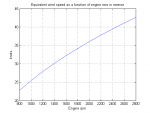
31.274 knots I reckon.
...You make the extrapolations for your own yacht.
You are never going to achieve an exact answer - you can only arrive at orders of magnitude - there are simply too many variables. Hopefully this is better than a guess...
Nice one. It would be interesting to see the effect of wind and other drag factors charted for different wind speeds and angles and whilst sailing or motoring just to complete the picture.While there are quite a few variables I agree, I think one can get a lot closer than just an order of magnitude - actually I think within about a factor of 1.2 rather than 10.
I use surface area above the WL, the prop dia and pitch and efficiency and gearbox ratio (in reverse). I have calibrated this reasonably well with measurements of the drag on the boat as a function of wind speed. It's true that yawing generates some peak loads, but as you measured with your cat, they aren't as large as all that: at least not for my rather heavy and traditional hull shape. So my graph is actually really quite accurate for me: perhaps within 20% for the subset of points I've measured.
I did it for forward propulsion really, but the reverse one fell out as a trivial case. I wrote it up (aka vanity publishing) at https://awelina.com/hull_drag/fuel_consumption2.pdf