Stupidly used OAT coolant for 6 years in a MD2020

John_Clarke

Well-Known Member
Joined
2 Jun 2001
Messages
274
Location
Cambridge
Visit site
About six years ago I started using organic acid technology coolant in my Volvo MD2020 because the container in Halfords said it only needs to be changed every 5 years. I have just read in the ‘Which antifreeze?’ thread that this can cause damage to the engine as it is not compatible with copper and brass. The heat exchanger and pump are brass and the calorifier is probably copper. I have also read on the web that it could damage gaskets and seals.

I plan to drain the coolant and flush it out a couple of times with water (running the engine until it is hot to get the thermostat to open). Then I will check the brass heat exchanger tubes for damage before refilling with traditional coolant.

Does anyone have any idea how much damage may have already been caused?

Do you have any further suggestions to minimise problems?

What symptoms of damage should I look out for?
 
it really depends on the formula. What's the trade name of the product please ?

Halfords say it's OK for all vehciles after 1998 and that it has advanced corrosion protection.


Shell say that it should not be used with Zinc or galvanised products.

I think you need to ask Halfords directly.

http://www.halfords.com/webapp/wcs/..._productId_701304_langId_-1_categoryId_173014

It is Halfords Advanced Anti-Freeze and Coolant. As you say it says it is for vehicles built after 1998 and our engine was built in 1999 but the design of the MD2020 must be much older than that. I understand from the internet that you should only use OAT coolant if the engine manufacturer specifically says you should. Volvo Penta now have some engines which use this type of coolant but the MD2020 is unfortunately not one of them.
 
here are some answers to Halfords customer questions about the AFreeze.

http://answers.halfords.com/answers/4028/product/147777/questions.htm?expandquestion=907009.


Can you withdraw any brass or copper part , and inspect it internally with a borescope or similar ? That might give a clue from which you could infer possible damage to less accessible parts.

Thanks for the link to the Halfords Q&A - not much help though and I would not trust their answer for a marine engine.

Yes. I intend to take the heat exchanger apart and examine the fine brass tubes. The seawater flows though the tubes which are surrounded on the outside by coolant. I will scrub them clean and examine them under a magnifying glass.
 
If it was going to eat through the heat exchanger it would likely have done it by now. I would revert to good old ethylene glycol and worry about something else.

Worse that happens if you do have a penetration in the heat exchanger is that the fresh system fills with seawater and coolant is forced out the pressure cap, which is given away by coolant coloured bilge water. Seawater itself won't harm your engine for a few days or even a few weeks exposure. This happened to one of my 26 year old exchangers last year. The painful bit was the cost of the new matrix from VP, and they really took the p155. A thorough flush and refill with 50% EG with the new matrix and all sorted.
 
If it was going to eat through the heat exchanger it would likely have done it by now. I would revert to good old ethylene glycol and worry about something else.

The antifreeze the OP has used is ethylene glycol based. Almost all readily available antifreezes in the UK are. He has mistakenly used one with "Organic acid technology" corrosion inhibitors, having been seduced by its long life, instead of one with conventional inhibitors, which should be changed every year.
 
Thanks for the link to the Halfords Q&A - not much help though and I would not trust their answer for a marine engine.

Yes. I intend to take the heat exchanger apart and examine the fine brass tubes. The seawater flows though the tubes which are surrounded on the outside by coolant. I will scrub them clean and examine them under a magnifying glass.

This is the results of five minutes on Google, so I may be wholly mistaken but, it looks to me that the problem is not that the organic acids attack brass and/or copper, it's rather that they don't work as corrosion inhibitors on brass and copper. For a heat exchanger, I would have thought that the raw water side is much more likely to suffer from corrosion than the freshwater side anyway, and that's got no protection from inhibitors at all.

What does the panel think?
 
This is the results of five minutes on Google, so I may be wholly mistaken but, it looks to me that the problem is not that the organic acids attack brass and/or copper, it's rather that they don't work as corrosion inhibitors on brass and copper. For a heat exchanger, I would have thought that the raw water side is much more likely to suffer from corrosion than the freshwater side anyway, and that's got no protection from inhibitors at all.

What does the panel think?

That would be good - I hope you are right! I plan to go to the boat at the weekend and will be able to compare the inside and outsides of the brass tubes.

I have now had time to do a bit of Googling myself and found the following information:

“OAT corrosion inhibitors may not be the best choice for older cooling systems that have copper/brass radiators and heater cores, especially the lead solder used in them.” I will also check any solder joints in the heat exchanger.

“OAT will cause precipitation of silicates in the green type and corrosion protection is greatly reduced.” I will change the coolant now to IAT type (inorganic acid technology) and change it again in the autumn.

Someone has used OAT in his Landrover for 12 years without a problem – this sounds like it is not too bad a mistake and hopefully I haven’t damaged the engine.

“OAT is incompatible with silicone rubber and Nylon 66” – probably neither of these in my Volvo.
 
Does your hot water smell of anti freeze? If not I suspect your calorifier is fine, if your lub oil coolers gone you will have oil in your header tank. If your Jacket water cooler has gone you'll be topping it up like there's no tomorrow. If all seems fine then I would go with the marine engineering term, "She'll be reet."

Change it back to the proper stuff when you can. I would always advise you to get specs for oil,grease, coolant etc from the engine manufacturer and not places like Halfords or alternatively speak to your local oil major wholesaler as many of the big oil companies work closely with the manufacturers and in all likelyhood they are the ones making the stuff. Many wholesalers are more than happy to supply small quantities.
 
Does your hot water smell of anti freeze? If not I suspect your calorifier is fine, if your lub oil coolers gone you will have oil in your header tank. If your Jacket water cooler has gone you'll be topping it up like there's no tomorrow. If all seems fine then I would go with the marine engineering term, "She'll be reet."

Change it back to the proper stuff when you can. I would always advise you to get specs for oil,grease, coolant etc from the engine manufacturer and not places like Halfords or alternatively speak to your local oil major wholesaler as many of the big oil companies work closely with the manufacturers and in all likelyhood they are the ones making the stuff. Many wholesalers are more than happy to supply small quantities.

All the things you mention (but no lub oil cooler on the MD2020 I think) are fine so that is reassuring. Thank you! I will stick with the engine manufacturer's specifications from now on.
 
I also note the nonsense that states ethylene glycol has to be changed annually. IMHO this is absolute tosh. And I do not have to look it up on google to give this opinion. A C&G in Marine Diesels (driving 1.5 MW generators) with an associated BTEC 4 in Electro Mechanical Marine Engineering allows me to have some say on this one.

Ask the typical lorry firm how often they change their engine coolant (which will be EG as its cheaper) and they will look at you like your stupid. The only time this ever gets changed is if the coolant is drained for other reasons.
 
I also note the nonsense that states ethylene glycol has to be changed annually. IMHO this is absolute tosh. And I do not have to look it up on google to give this opinion. A C&G in Marine Diesels (driving 1.5 MW generators) with an associated BTEC 4 in Electro Mechanical Marine Engineering allows me to have some say on this one.

Ask the typical lorry firm how often they change their engine coolant (which will be EG as its cheaper) and they will look at you like your stupid. The only time this ever gets changed is if the coolant is drained for other reasons.

In the UK practically all antifreeze is ethylene glycol based. "OAT" type or conventional "IAT" type

The type recommended by the engine manufacturer should be used.
As well as freeze protection and compatibility with system materials there are other factors such as wet liner cavitation erosion to consider.

Where it can/ should be used the extended service life of the OAT type will more than compensate for the marginal difference in cost.
 
Last edited:
All the things you mention (but no lub oil cooler on the MD2020 I think) are fine so that is reassuring. Thank you! I will stick with the engine manufacturer's specifications from now on.

While researching the different types, I discovered a Volvo Penta bulletin that stated you needed to flush with oxalic acid if going from conventional to OAT. Not sure about the other way around.

http://www.google.co.uk/url?sa=t&rc...2XNIUmcw51owYSA&bvm=bv.47534661,d.ZWU&cad=rjt
 
Thanks for posting the thread.......................you're not on your own!!.

I've a pre2000 model year Lancing Marinised Ford Transit engine in mine with heat exchangers, calorifiers etc and I've only just replaced mine with OAT anti-freeze thinking the extra extended life from 2 to 5 years was worth paying extra for......clearly not as I'm sure the heat exchanger etc has copper tubes.

Looks like I've another job now, oh well, great engineering hobby this yachting stuff!
 
There is really no nead to recharge any system annually. You can test the coolant either by chemical tests or more simply with a turkey baster type tester available from many tool stores. If your system is testing a bit low for the correct chemical levels just give it a shot in the arm with a small dose of fresh antifreeze. The modern habit of complete recharges is aimed at car drivers who pay zero attention to their engine. If you make it part of your regular tests then your fine. Some people I know just have regime of every second or third time they top up the system they do it with pure antifreeze instead of water and thats enough to keep the chemical levels in check.
 
There is really no nead to recharge any system annually. You can test the coolant either by chemical tests or more simply with a turkey baster type tester available from many tool stores. If your system is testing a bit low for the correct chemical levels just give it a shot in the arm with a small dose of fresh antifreeze. The modern habit of complete recharges is aimed at car drivers who pay zero attention to their engine. If you make it part of your regular tests then your fine. Some people I know just have regime of every second or third time they top up the system they do it with pure antifreeze instead of water and thats enough to keep the chemical levels in check.

You can easily test for the correct concentration of ethylene glycol by using a simple hydrometer . However if any losses from the system are always made good with an antifreeze solution of the correct concentration there should be no effective decrease in ethylene glycol concentration.

What chemical tests are you suggesting, that are available to owners, for checking that the corrosion inhibitor system is still effective?
 
Last edited:
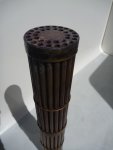
I have been to the boat today and the good news is that the heat exchanger appears to be undamaged by the 6 years of using OAT coolant.

MD2020 heat exchanger.jpg

As Moonshining suggested, the raw water side (the end cap with the holes) appears to be more corroded than the areas in contact with the coolant (the tubes).

I drained the engine, the calorifier and the pipes to and from the calorifier but I think there must be a quantity of coolant which does not drain out. I filled the engine with 25% IAT blue coloured coolant and ran the engine until it was hot and then redrained the coolant. It came out a mauve colour which suggests to me that the blue IAT coolant was quite contaminated with orange OAT coolant. Hopefully it will now be quite diluted with the second 50% coolant filling.

It was lovely and warm on the boat but it would have been nicer to go for a sail. It is amazing how long it takes to do a job like this and clean up afterwards!

Thank all of you for your input which I have really appreciated and in particular VicS thank you for sharing your technical knowledge and keeping us all right.

Grahama - I am glad that this thread has helped you too. I find the wealth of knowledge on this forum is brilliant.
 
Last edited:
What chemical tests are you suggesting, that are available to owners, for checking that the corrosion inhibitor system is still effective?

http://wssproducts.wilhelmsen.com/m...pment/nalfleet-test-kits/motor-ship-test-kit/

I don't know how easy they are to purchase for Joe Bloggs and I doubt they are economical to buy privately but as I mentioned the turkey baster hydrometer will be fine for the leisure boaters needs. There are also labs you can send samples to for analysis if your worried about the state of the engine internals.
 
http://wssproducts.wilhelmsen.com/m...pment/nalfleet-test-kits/motor-ship-test-kit/

I don't know how easy they are to purchase for Joe Bloggs and I doubt they are economical to buy privately but as I mentioned the turkey baster hydrometer will be fine for the leisure boaters needs. There are also labs you can send samples to for analysis if your worried about the state of the engine internals.

Thanks, but very definitely over the top for the private small boat owner.
I've been looking at what might be available. Test strips such as these or similar would be more appropriate. http://www.radstrips.com/ if they can be obtained at an economic price.
As I already said a hydrometer type of tester only gives you an indication of the glycol concentration. It tells you nothing about the state of the inhibitor.
Sending samples from a small boat engine to a lab for testing also OTT.

The simple, economic and sensible option for the private small boat owner is to make up any coolant loses with diluted antifreeze, thereby maintaining the glycol concentration and freeze protection level, and to change the coolant at the recommended service intervals.
 
Top