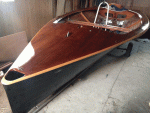
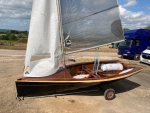
Student restores 1986 Merlin Rocket

Lovely work. It's nice to see that some people still care about the craftsmanship that went into these boats.
I've noticed a tendency amongst some of my club's younger members to treat boats simply a "commodities". They just step out of them and dump them in the dinghy park and expect them to be ready to sail next time they fancy a go.
 
Lovely work. It's nice to see that some people still care about the craftsmanship that went into these boats.
I've noticed a tendency amongst some of my club's younger members to treat boats simply a "commodities". They just step out of them and dump them in the dinghy park and expect them to be ready to sail next time they fancy a go.
Thank you.

This one was abandoned in a dinghy park, nose down and full of water. Some of the planks had sprung at the front, and a lot of the glue joints had gone under the decks and in the bulkheads, so quite a bit of proper restoration (not just a re-paint and re-varnish job). I haven't had a chance to get it back in the water yet, maybe next year.
 
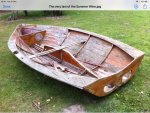
It seems that Corin is also restoring another Phil Morrison boat, Summer Wine. Here it is as it was found, pic courtesy of Phil (who sent a box of matches to the person who found it!)
It will be interesting to see the end result.

BC93026F-9038-4EDA-A939-F9898C3126BE.jpg
 
It seems that Corin is also restoring another Phil Morrison boat, Summer Wine. Here it is as it was found, pic courtesy of Phil (who sent a box of matches to the person who found it!)
It will be interesting to see the end result.

View attachment 127543
Is that actually the boat called "Summer Wine", or is it "Compo" which was the last summer wine built?

Either way, that's a hell of a project.
 
Is that actually the boat called "Summer Wine", or is it "Compo" which was the last summer wine built?

Either way, that's a hell of a project.
Phil didn’t say, he just called it Summer Wine. I’ll ask him when I see him in a few days.
 
I recently did the same. A slightly older NSM1 (1979).

View attachment 127438

View attachment 127439
Looks superb!
I was intrigued by Corin’s comment about refitting the transom flaps. I can’t quite see if your MR has flaps.
I had an Int Moth of similar vintage which had a completely open transom. I was sceptical as to this aspect to start with, but it worked well - albeit an experiment in removing the flaps from an Enterprise was less successful.
 
Looks superb!
I was intrigued by Corin’s comment about refitting the transom flaps. I can’t quite see if your MR has flaps.
I had an Int Moth of similar vintage which had a completely open transom. I was sceptical as to this aspect to start with, but it worked well - albeit an experiment in removing the flaps from an Enterprise was less successful.
When you are sailing, the flaps should be completely unnecessary, but in a boat like a Merlin or Enterprise or most single-floor dinghies, it's often difficult to launch the boat stern first without the flaps earning their keep, and sometimes in a light weather race, you'll get some powerboat wash up the transom.
Some people used to just use duct tape or sticky plastic sheet for the flaps, soon removed after a capsize, but obviously a risk of littering .

When Merlins capsize, they generally don't so much 'fill with water' as 'barely float' , most of the transom will be underwater. Capsizing one when there's too little wind to empty the boat with the flaps can be very embarrassing.
 
Looks superb!
I was intrigued by Corin’s comment about refitting the transom flaps. I can’t quite see if your MR has flaps.
I had an Int Moth of similar vintage which had a completely open transom. I was sceptical as to this aspect to start with, but it worked well - albeit an experiment in removing the flaps from an Enterprise was less successful.
Yes, it does have transom flaps. To be honest, they're close to useless. The only time they work after a capsize is if you can bear away in a breeze (without losing the rig) and get some serious speed on, which is pretty rare. 99% of the time, you're better off with a bucket and opening the self-bailers on the floor.
 
I had an old Proctor mk9 that I 'restored' and raced in the early '70s nowhere near as good as hermione mind. I made a spinnaker chute for mine from pvc drainpipe fittings worked well for a while but one day my crew said t'he chute is stuck', 'pull harder said I' so pull he did and the attachmenton centre of chute pulled off with chute still pulling at spedd on the plane -right up onto a gravel bank successfully ripping the centreboard and case from the hull. ah well that's what insurance was for... restored again but sadly my crew died in a car crash and I stayed local club racing only after that and eventually deserted her for an OK single hander not requiring carpark crew searches every race day.
 
Yes, it does have transom flaps. To be honest, they're close to useless. The only time they work after a capsize is if you can bear away in a breeze (without losing the rig) and get some serious speed on, which is pretty rare. 99% of the time, you're better off with a bucket and opening the self-bailers on the floor.
The few times I've capsized a Merlin, you would not get anywhere with a bucket.
You both sit behind the hoop, open the flaps, sail on a reach. The whole transom starts off under water.
It's more like sailing the boat out of the water than emptying the boat.
Merlins are generally not among the first boats to capsize, so they shouldn't be filling with water when there's insufficient wind to make the flaps work.
Once the boat is moving reasonably ,the Elvstrom bailers get rid if the water quite quickly.

If you do something silly and fill it with water in light winds, you may need to sail to the shallows and get out to bail it.

Bearing in mind that not all Merlins are the same. But all those I've been on over the years have had a couple of buoyancy bags at the back and a little tank in the bow.
I've not sailed any of the ancient narrow (<7ft wide) models.
 
The few times I've capsized a Merlin, you would not get anywhere with a bucket.
You both sit behind the hoop, open the flaps, sail on a reach. The whole transom starts off under water.
It's more like sailing the boat out of the water than emptying the boat.
Merlins are generally not among the first boats to capsize, so they shouldn't be filling with water when there's insufficient wind to make the flaps work.
Once the boat is moving reasonably ,the Elvstrom bailers get rid if the water quite quickly.

If you do something silly and fill it with water in light winds, you may need to sail to the shallows and get out to bail it.

Bearing in mind that not all Merlins are the same. But all those I've been on over the years have had a couple of buoyancy bags at the back and a little tank in the bow.
I've not sailed any of the ancient narrow (<7ft wide) models.
On later boats with a high bow tank, the best way to empty the boat is to both sit forward, open the bailers, and sail upwind, whilst manually bailing at the same time.
 
On later boats with a high bow tank, the best way to empty the boat is to both sit forward, open the bailers, and sail upwind, whilst manually bailing at the same time.
I think that would have had water coming over the foredeck.
Might work in flat water, but I've crewed on a Merlin with plenty of water coming over the deck despite getting nowhere near capsizing.
As far as I'm aware, later boats all have low front tanks? That's later as in late 80s.

They are amazing boats to sail, but quite demanding on the crew.
 
In my Jon Turner built NSM IV If you capsized she'd float very low so one could get on the centreboard easily. Once upright the transom flaps and bailers worked a treat.
 
Top