Stubborn Cutlass Bearing Housing

muzzarak

New Member
Joined
1 Nov 2005
Messages
18
Location
Essex
Visit site
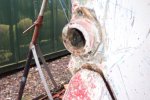
Can any forumites help me.

I am trying to remove the cutlass bearing from my long keel Biscay 36 as part of a refurb project.

I assume the housing screws onto the stern shaft.

Following advice that I have seen in other posts, I have removed the propeller shaft and the securing bolts and gone around the flange with a hack saw blade to release the caulking (which appears to be a combination of oakum or hemp and sealant).

However that is as far as I can get it - the housing will not unscrew. I have tried not so gentle persuasion with a lump hammer and length of wood, but cannot get it to budge.

Has anyone managed to solve this problem without causing damage to the boat or fitting?

Many thanks
 

Attachments

  • 100_1142.jpg
    100_1142.jpg
    88.2 KB · Views: 6
Does it screw in?

I have limited experience, but the few I've done simply slide into the deadwood.

If you use a bent coat hanger or similar you should be able to feel the inner shoulder of the bearing, this will give you some idea of how long cutlass bearing is and whether it will be possible to drift it out.

I've successfully used a washer which is a clearance fit inside the prop shaft tube, but will catch on the inner shoulder of the cutlass bearing.

Take the prop of the shaft and insert the shaft into the tube the "wrong way".

Fit the washer to the shaft and secure with an appropriate nut, roughly where you split the shaft from the gearbox coupling.

Then use the mass of the shaft, as a slide hammer, to tap the bearing out. Once it starts moving it should come out quite easily.

If the boat has a conventional grease loaded packing gland, this technique may not work. I've seen the stern tube full of old grease which makes it hard to get the washer down to the cutlass bearing.

The alternative is to split the bearing using two saw cuts diametrically opposite to each other. I've never used this method, but I'm told it works.

Some heat may help to loosen the "gunk" which is holding it in. A mixture of hemp, and different sealant suggest that been out at some time, so it may be being held in by Sikaflex or similar.
 
Thanks Ian,

I initially tried wedging it out but it didn't move which suggests it does screw in, although to be fair I gave up before I did any damage to the surrounding grp.

I have already tried the coathanger exploration, and I can feel the end of the cutlass bearing (6"). However it is seated inside the housing so the housing is going to have to come out, if only to fit the new bearing.


Cutting it out (per yours and Nick's suggestion) might offer a few clues as to how the housing is attached. I have seen lots of avice on how to do this for a P bracket, but not fro a long keel. Probably a case of me being dim, but can anybody provide any tips on how to do this without cutting through the lip of the housing? There are no convenient holes for trying to collapse the bearing.

Thanks
 
Does it screw in?

I have limited experience, but the few I've done simply slide into the deadwood.

If you use a bent coat hanger or similar you should be able to feel the inner shoulder of the bearing, this will give you some idea of how long cutlass bearing is and whether it will be possible to drift it out.

I've successfully used a washer which is a clearance fit inside the prop shaft tube, but will catch on the inner shoulder of the cutlass bearing.

Take the prop of the shaft and insert the shaft into the tube the "wrong way".

Fit the washer to the shaft and secure with an appropriate nut, roughly where you split the shaft from the gearbox coupling.

Then use the mass of the shaft, as a slide hammer, to tap the bearing out. Once it starts moving it should come out quite easily.

If the boat has a conventional grease loaded packing gland, this technique may not work. I've seen the stern tube full of old grease which makes it hard to get the washer down to the cutlass bearing.

The alternative is to split the bearing using two saw cuts diametrically opposite to each other. I've never used this method, but I'm told it works.

Some heat may help to loosen the "gunk" which is holding it in. A mixture of hemp, and different sealant suggest that been out at some time, so it may be being held in by Sikaflex or similar.

Good method with a p bracket, Ian, but won't you be slide hammering against the internal shoulder cast into the flange you correctly mentioned?
 
Your cutlass holder looks similar to that on my last boat. The outer visible part screwed onto a shaft log (metal tube) that was internally attached to a rigid bearer.

Were the bolts set screws or coach bolts (large wood screws), if the former what do they screw into ? Access to a lower nut is the devil's work.

If the holder is slightly loose I would try rotating it anti-clockwise to remove from a shaft log, perhaps with large Stilhsons, but it could be very tight.

Alternatively if it is still tight then perhaps better to re-seal and reinstall the bolts, then simply removed the inner cutlass itself, but if you have broken the seal and pulled away the sealing material then removal might be necessary to make good the seal later.

I would clean of the outer ring of the holder and see if there are any grubscrews hidden under the antifoul locking the cutlass into the tube.
 
Hello i have just removed a cutlass bearing out of my neptune 33 long keel which looks similar to yours.
After trying to tap it out from the inside of the boat with a suitable drift i eventually used a reciprocating saw and purchased a long metal saw blade around 9-10 inches long.
You need to be careful to keep the blade square on and cut evenly through the bearing . I cut a small amount and kept checking so i didnt cut into the housing.
3 cuts evenly spaced out and i used a large long flat driver to peel away the bearing from the housing and eventually it collapsed and was easy to peel away and remove .
This method worked well for me. Good luck
 
when I removed my cutlass bearing, I had to manufacture a pulling device which I could insert from the outside of boat which would drop onto rear of bearing then I would place a tube over housing and pull it out by turning nut on a threaded bar thru the tube.

all bits bought in b and q, apart from sourced scaffold tube of right diameter
 
Last edited:
You shouldnt have to remove the flange to get the bearing out. Make sure there are no grub screws holding the bearing in place (there usually are). If it wont shift, a reciprocating electric saw will make short work of cutting through the bearing shell, which should then drop out - possibly helped by a cold chisel to break it away from the housing.
 
Don't know how much access inside you've got but this is the way I removed a stubborn bearing from a P bracket.

What you need - a length of thread bar with nuts, piece of tube/deep throat socket to fit inside and up against the cutless (your going to be pushing into the boat) a piece of tube/socket to fit outside the bearing on inside of boat.

You'll need an extra pair of hands. Put tube up against the bearing inside the boat and tighten nuts with a large washer up against the tube.and hold while your oppo does same outside.

Start tightening and the nuts and washer should push the bearing out. - good luck
 
Last edited:
Hire/borrow a large stilson 18"-2 ft long(Or longer). about 6 feet of pipe to slide over the handle, try to tighten then reverse direction, do not jerk apply steady force and it should unscrew.
 
Did one like this on a friends boat. After removing the bolts the cutlass housing did unscrew from the bronze stern tube although it was tight, the worry was disturbing the inboard end. You may find the threaded stern tube has bottomed out on the cutlass bearing carrier and once it moves a bit will come undone easily.
Good luck.
Pete
 
Almost certainly the housing will be threaded onto the tube as said above.
Try heating the housing with a hot air gun preferably or a small gas torch, work fast to reduce heat transfer into the tube. You can get it quite hot without damage.
Be wary of stilsons with extension tubes, if you go too far you may distort/ crush the housing with the jaws.
 
There are photos of two variations of your bearing holder at http://coxengineering.sharepoint.com/Pages/Sterngear.aspx (not quite complete) Yours looks rather like the lower one, which is mine. The extent to which a little corrosion, dirt or sealant can increase the screw friction is amazing. I had to hammer mine undone to almost half way, after which I could unscrew it by hand. One cleaned up it went back easily.
 
Thanks to all for your advice. Thought I should report how I got on.

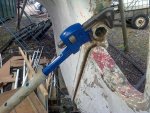
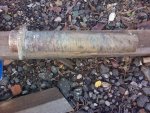
Based on the advice I started with cleaning the fitting to make sure there were no hidden grub screws. I then applied heat with a blow torch, before applying the lump hammer. After about an hour of it not budging, I resorted to a 36" Stillson inserted into a cradle support pole. This moved it, but not quite in the way I was expecting - it unscrewed at the inboard end and the whole stern tube came out!

However this turned out to be not be a bad thing. The inboard bearing fell off once the stern tube was unscrewed - the securing bolts were completely rusted away. This whole area is going to need a lot of attention when I put it all together again.

So I am still not able to get the cutlass bearing out , but to be honest think I can park the problem for now.
 

Attachments

  • Rochford-20150215-00016.jpg
    Rochford-20150215-00016.jpg
    100.3 KB · Views: 9
  • Rochford-20150215-00018.jpg
    Rochford-20150215-00018.jpg
    100.6 KB · Views: 11
Last edited:
When you put it back together you could get a compocite bearing sized for a clearance fit and bed it on epoxy, to remove the bearing cracks easily and seperates from the tube with a sharp chisel. Then clean up the ID of th ebearing carrier with sandpaper on the end of a bar attached to a drill.
Removing%20old%20epoxy%20003_zpsi6furkbx.jpg

Removing%20old%20epoxy%20002_zpsvp4zibyq.jpg
 
Top