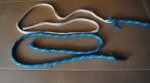
Stretchy main halyard

Actually much more complicated than that..... a bowline in slippery D12 will just slip through before it gets anywhere near MBL. Just tried it, few hundred Kg it slips through quite gently with an occasional few millimeters "bump" .

You need the Estar hitch which is a variation of the buntline hitch designed for slippery dyneema. Estar
1679581405275.png
 
You need the Estar hitch which is a variation of the buntline hitch designed for slippery dyneema. Estar
View attachment 153646
One of these is just as quick 😎
Thinking about it, think the only knot there is in dyneema onboard is the diamond knot for soft shackles. More constrictor clutches slowly creeping in.
Dyneema is woven from the hair of angels 👼
splicing-fid-set-set-of-4.jpg
 
One of these is just as quick 😎
Thinking about it, think the only knot there is in dyneema onboard is the diamond knot for soft shackles. More constrictor clutches slowly creeping in.
Dyneema is woven from the hair of angels 👼
splicing-fid-set-set-of-4.jpg
And the splice retains 98% of the strength compared with 50% for the Estar hitch.
 
I have Liros 8mm racing dynema . Where the halyard connects to the mainsail I threadle a plastic ball on the end of the rope with an overhand knot . take a loop of rope. Pass it through the cringle in the head of the sail. Take the end of the halyard complete with ball & pass that through the loop that has just been put through the sail cringle.
It means that the sail can be hoisted right to the top, without having to allow for a shackle or bowline etc. It is easy to undo & even if it does reduce the strength much the Liros halyard has 4.5 tonnes breaking load. That would just about lift the entire boat. It is certainly sufficient for my 64M2 laminate mainsail.
I would make the point that the outer covering is tight & it leaves little room for a splice. However, there is little chance that the core will slip inside the outer causing bunching at the clutch. I have had the much looser outer covering on 12m Marlow cruising dynema break. This allowed the core to slip through the cleat, leaving the covering still cleated. The resulting 2.5 tonne mooring weight dropping, caused a timber to fly up between 2 people & just missed decapitating them each by 300mm. This is inspite of the supposed SWL of the rope being several tonnes in excess of the load applied

One should be careful applying loads on to clutches with cheapo , so called cruising dynema, where the covering can bunch & jam in the clutch. It cannot be released. For that reason large racing yachts etc strip the outer covering where large loads are applied.
DSC_0003 (2).JPG
 
Last edited:
I use the stripped cover as our towel drying line. The only lines on our rig that aren‘t dyneema on our boat are the jib car adjusters. A lot of angels have sacrificed their hair.
 
Fed up with stretch in my genoa halyard, I am about to order this stuff:

Rope Dyneema size 10 mm length 25metres. colour white & red New.& unused. | eBay

Said to be Liros.
Can anyone point to good instructions on how to put a eye in the end - without using the fancy tools which I don't want to buy as I am highly likely to use one, and only once at that. YouTube or other video would be grand.
Is it possible to whip and sew an eye into it reliably?
Thanks.
 
Fed up with stretch in my genoa halyard, I am about to order this stuff:

Rope Dyneema size 10 mm length 25metres. colour white & red New.& unused. | eBay

Said to be Liros.
Can anyone point to good instructions on how to put a eye in the end - without using the fancy tools which I don't want to buy as I am highly likely to use one, and only once at that. YouTube or other video would be grand.
Is it possible to whip and sew an eye into it reliably?
Thanks.
If your halyard is only 25 metres it must be a very small boat? Would 8mm be better?

Irrespective I would (and do on a much bigger boat) use this halyard knot which works well. Jeanneau Halyard Hitch - Jeanneau Owners Network
Even if lost some strength, could probably pick your boat up with it
 
I have underestimated in the past so I have previous for this.

The mast is 36ft 6in to the deck. 25m is 82ft. halyard exits about 3ft above the deck. What does the team think?
 
If you have a furling headsail then you will be fixing to the top roller. This will have a small shackle. Pass the halyard through it & tie an overhand knot in the end of the rope. A figure 8 if the shackle is large- they rarely are. . No need for any splice- pointless
That is all you need. It has worked for me for the past 18 years & I have a laminate jib which geta a lot of tension.

My halyard passes through a mast aligner & then through the mast sheave. It did get some wear on the mast aligner & sheave, so I purchased 2 ft of dynema protection covering . I could have just whipped the end that went into the mast, but I decided to splice it in one sunny afternoon. The other end went over the end of the halyard so when I tied the overhand knot it automatically anchored that end in place .
 
I have underestimated in the past so I have previous for this.

The mast is 36ft 6in to the deck. 25m is 82ft. halyard exits about 3ft above the deck. What does the team think?
I think that’s ok. It doesn’t really need to come down to the deck to attach to the foresail really, so I think you have a safety margin. If you had the luff length of the genoa, you’d know for certain
 
This is not my experience. I have had several polyester halyards with over 300mm of stretch on a 17.8 mast. The effect on sail trim is terrible. These are not new ropes needing their initial stretch. They are well used but now retired as I couldn't tolerate their terrible stretch. They were not used on jammers but had their own dedicated ST winch. No slipping. Just very stretchy rope. Dyneema is a game changer for me as a keen cruiser

You are talking about 1.6% stretch. The OP is talking about 7% stretch. Not the same. I'm also guessing your halyards are operating at a higher % of BS than his, since you have a larger boat and the halyard was probably not up-sized in proportion. So yes, what you saw was the stretch I would calulate. He is seeing 6-8x more than you would calculate (allowance for different load factor, otherwise 4x more).

There is also something wrong with your polyester, either age, quality, or size. I have used polyester (and Kevlar and Dyneema) and it is not that bad. It should be no more than 1% at working load, or about 5-6 inches, and usually less if the line is sized properly. And that is the stretch from zero to full load. The actual change AFTER pretension should be only a few inches. Still a problem for sail trim, but not the 30 inches the OP described. There is another problem.

Not the same experience.
 
I have underestimated in the past so I have previous for this.

The mast is 36ft 6in to the deck. 25m is 82ft. halyard exits about 3ft above the deck. What does the team think?

The minimum size is almost certainly determined by the clutches.
  • Not only is Dyneema much stronger, it has much lower stretch. Normally people down size several diameters to save weight aloft
  • It is common to add core to bulk it up where it passes through a jammer.
But you can use the same size if you like. It will last as long as the cover lasts.
 
What many of us find is that, with modern rigs and sail construction, even a few inches is too much. The headboard of my mainsail moves maybe 3 inches from zero wind drifting setting to ‘as flat as you can’ 15 kn last move before reefing setting. If my halyard stretched, I’d never get the luff tight in more than 10kn. My rigs really not that radical these days
 
Top