Stray current corrosion

BobnLesley

Well-Known Member
Joined
1 Dec 2005
Messages
4,054
Location
Aground in Yorkshire awaiting a very high tide
Visit site
Can it occur due to a 12V DC leakage, or just with 100/220V AC shore power?

I ask because we've got a couple of problems that could be explained by stray current/earth corrosion, but whilst the the boat's got a shore power system, it's not been 'plugged-in' whilst afloat in more than seven years, indeed it's only been plugged-in whilst ashore about two or three times. Nor has the boat spent long periods moored/anchored amongst other boats which're plugged into shore power; no doubt more than a few run generators, but again, we might've been anchored close to such for days, not weeks or months at a time.

If it is possible to corrode from the 12V DC system, then how do I go about tracking/isolating/curing the problem?

If it is possible via a 12 volt
 
I guess it it theoretically possible to cause electrolytic corrosion from the 12v system, but it would require a pretty weird wiring fault that seems unlikely to occur. Electrolytic corrosion requires two metal objects in the water and connected to different voltages - if you somehow ended up with an anode on the hull connected to the negative side of your 12v battery and the saildrive connected to the positive side, then you could expect major corrosion - but is that ever going to happen without input from a seriously incompetent electrician?

Electrolytic corrosion is almost always caused by the 240v shore power circuit - for example your boat has the shore power ground connection bonded to your anodes, but your neighbour who is hooked up to the same shore power has some kind of wiring fault which pulls his anodes a volt or two above ground.
 
Stray current corrosion can be caused by anything which connects to the water at two or more points with the ability to pass current between them.
So, if your DC 0V is connected to the engine, it should not be connected to the water anywhere else, except via the engine.
For example if you were to bond a seacock to 0V, that bonding wire should go to the engine, not direct to the battery or any other part of the DC circuit.
Your bonding and DC0V nets should be distinct things connected at one point only, so you cannot get what would be called in audio, an 'earth loop'.

It can be dificult to reconcile conflicting requirements of avoiding earth loops and adequately bonding 230V 'mains earth'.
The VHF often grounds to the rig and hence the keel etc, SSB and ham radio is something of a free for all.

Connecting any part that's even damp to some random landlubber voltage labelled 'E' is just a 'Bad Thing', even with a galvanic 'isolator' in the way it's fraught.
 
I learnt a trick from Nigel Calder's excellent Boatowners Mechanical & Electrical Manual with everything off that is normally off to disconnect the positive lead from the battery then measure the voltage between the battery post and terminal connector just removed.

With everything off the voltage should be 0, anything else then something is causing a conductive circuit.

In my case a bilge flappy type switch, providing a path directly into salty water and then out via the bonding circuit.

This is now an annual check on my boats since.
 
...if your DC 0V is connected to the engine, it should not be connected to the water anywhere else, except via the engine.
For example if you were to bond a seacock to 0V, that bonding wire should go to the engine, not direct to the battery or any other part of the DC circuit...

So are you saying that even if the battery bank's negative cable is grounded to the boat engine, then everything else 'which touches the water' - you mentioned sea cock, but I'm thinking here of an anchor windlass in particular - must also ground DIRECTLY to that same point on the engine and not just to the battery's negative pole, or a shared bus-bar earth which itself then subsequently connects to that same earth point on the engine?
 
Last edited:
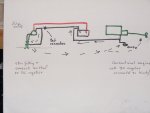
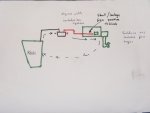
A couple of illustrations of the sort of thing that can happen to cause serious electrolysis, as opposed to galvanic corrosion

One shows a boat with conventional shaft drive and hull anode. An automatic bilge pump has been added. The seacock and trough-hull are bonded to the DC negative using the DC connection to the pump as a convenient way of doing this.
A bad connection exists in the DC negative supply to the pump. Over time this deteriorates until the pump does not work.
The float switch remains closed because the water is not being pumped out BUT an alternative path back to DC negative exits via the bonding to the seacock, the water and the stern gear and hull anode. The current that flows via this route is not sufficient to run the pump but it causes electrolysis of the skin fitting which eventually fails causing the boat to flood and sink.

The seacock should not have been bonded to the dc negative and certainly not by using the pump supply wiring

The other shows a boat with a sail drive which is not isolated from the engine but which has an isolated engine electrical system ( eg the Perkins derived MD22).
A short occurs between the DC positive wiring to the starter motor and the engine block The keel has been bonded to the DC negative A circuit then exists between DC + via the block, saildrive, through the water to the keel and then back to DC -
This is pretty much what happened to Nigel Mercier a few years ago. All that was left of the saildrive when the boat was lifted was the drive shaft. The DC negative should not have been bonde to the keel if it was supposed to be an isolated DC system. I don't know why it was.
 

Attachments

  • Electrolysis 1.JPG
    Electrolysis 1.JPG
    95.4 KB · Views: 47
  • Electrolysis 2.JPG
    Electrolysis 2.JPG
    83.6 KB · Views: 42
So are you saying that even if the battery bank's negative cable is grounded to the boat engine, then everything else 'which touches the water' - you mentioned sea cock, but I'm thinking here of an anchor windlass in particular - must also ground DIRECTLY to that same point on the engine and not just to the battery's negative pole, or a shared bus-bar earth which itself then subsequently connects to that same earth point on the engine?
The term stray current corrosion is more properly used in steel boats where the earth return is via the hull, but the term is also used in similar circumstances on grp boats where shorts or other problems allow a voltage to be applied where it is undesirable. There are some good examples on my website under <metallurgy. As said, careful monitoring with a meter is the way to eliminate it.

A good earth between battery and engine/gearbox should all be at zero voltage but corrosion and poor joints can lead to problems.
 
Found it!
There's some sort of short-circuit within our Waterwitch bilge pump switch and it's sending 12V down the earth wire - it 'sparked' when I disconnected it to remove the gearbox.
Good result! Do you have any pics of the damage that caused you to suspect the problem? It would be a useful addition to the website, if you agree.
 
Found it!
There's some sort of short-circuit within our Waterwitch bilge pump switch and it's sending 12V down the earth wire - it 'sparked' when I disconnected it to remove the gearbox.

I have junked my Waterwitch switch and gone back to a manual switch .. I didn't have corrosion as I do not ground out gear except via engine block .... but it flattened my battery !! In fact damaged it enough - I had to replace.
 
Top