Storm Floris

Thistle

Well-Known Member
Joined
2 Oct 2004
Messages
4,033
Location
Here
Visit site
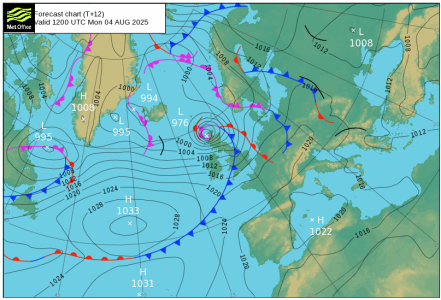
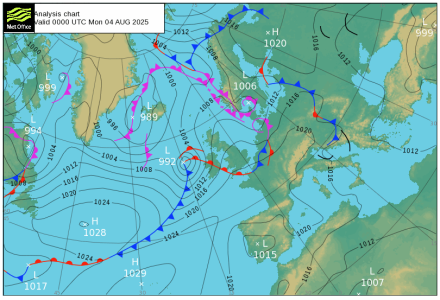
Looking at the Met Office surface pressure forecasts I see that they are predicting that the low that is generating Storm Floris will drop from 992 mb to 976 mb over a 12 hour period. How do they predict such a large pressure drop? What information is it based on?Screenshot 2025-08-04 101112.pngScreenshot 2025-08-04 101143.png
 
Frank Singleton sits in his little cubby-hole and fiddles with his slide rule until he gets the numbers he wants and then announces doom and gloom to the rest of us.
 
long since learned that the best way of forecasting the weather is to assume that tomorrow is the same as today. Wont be right all the time but that isnt the issue. The issue is whether its nearer right than the met office and the answer to that is yes.

the weather at our local weather station is near enough exactly what it was 24 hours ago - 22kngusting 31 compared to 24kn gusting 32
 
long since learned that the best way of forecasting the weather is to assume that tomorrow is the same as today. Wont be right all the time but that isnt the issue. The issue is whether its nearer right than the met office and the answer to that is yes.

the weather at our local weather station is near enough exactly what it was 24 hours ago - 22kngusting 31 compared to 24kn gusting 32
That would go badly for us.

Yesterday we had very calm sunny weather that gave time to prepare for today's gales.
 
Last edited:
long since learned that the best way of forecasting the weather is to assume that tomorrow is the same as today. Wont be right all the time but that isnt the issue. The issue is whether its nearer right than the met office and the answer to that is yes.

the weather at our local weather station is near enough exactly what it was 24 hours ago - 22kngusting 31 compared to 24kn gusting 32
That may be true for your location in Wales, but not in the area affected by the storm. Stornoway was SW 9kts gusting 13 yesterday morning; this morning it was SSE 32kts gusting 43. As for barometric pressure, John O'Groats recorded 977mb at mid-day today, so the MetOffice was pretty much spot on with the forecast.
 
long since learned that the best way of forecasting the weather is to assume that tomorrow is the same as today. Wont be right all the time but that isnt the issue. The issue is whether its nearer right than the met office and the answer to that is yes.

the weather at our local weather station is near enough exactly what it was 24 hours ago - 22kngusting 31 compared to 24kn gusting 32
Provide statistical confirmation.
 
The nonsense about persistence forecasts was kicked into touch longer ago than I can remember. And that is a long time ago.
Before I was born possibly. We are our club’s weather nuts. I’ve just had some practice in looking at the forecasts, and remembering what that’ll mean locally. The last bit is quite easy, it’s working out what the weather will do more than a day or 2 ahead that seems to be challenging. And whilst it seems as if we get a F5 south westerly to blow over every spring ebb, I think that’s just the law of sod in action. Anyway, tomorrow’s weather will be nothing like todays. Which tends to reinforce your point.
 
Speaking of weather (32S). Last Saturday bureau forecast a front arriving and it did. A dilly. The temperature during the night was reasonably warm for winter due to warm North east winds. Such that the maximum temperature for the day occurred at 6AM before sun rise. 15 degrees. Then the cold front arrived wind swung around to south and cold set in with rain. Very odd. But typical that we et nicer weather just before a storm. I love looking at the rain radar to see rain coming. ol'will
 
So a bit shy of a couple of hundred iterations of calculations based on a set of initial values. Sounds like huge scope for compounding any errors (even just rounding errors) in those initial values. I'd guess there must be a bit more to it.
You are clearly blissfully unaware of the research that has gone into model development dating back to the first electronic computers, the development of satellite sensing back to the 1970s, the R&D into use of these many and varied data. But, yes there is always scope for a glitch in the data or model formulation. One of the benefits of having models run by major weather services. Just occasionally, one will differ from the rest. The similarity between models even out to 5 or more days is encouraging. So is the ability to give days warnings of severe events even though the detail will never be perfect/
 
Last edited:
You are clearly blissfully unaware of the research that has gone into model development dating back to the first electronic computers, the development of satellite sensing back to the 1970s, the R&D into use of these many and varied data.
Hence my question!
 
Top