Storm covers for windows and hatches

Tintin

Well-Known Member
Joined
21 Mar 2009
Messages
4,822
Location
Kernow
Visit site
Following on from the thread about the loss of Essence, I was wondering how one might go about modifying a standard production AWB to make it easy to fit storm covers on windows and hatches.

Also plywood is often mentioned, but what about thick clear acrylic or lexan?

Thoughts people?
 
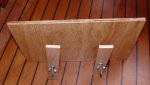
I made this type of boards, the wooden battens proved too flexible so I changed it with a light alloy profile.
A rubber contour might be added to make the contact surface between the wood and the alu frame more waterproof.
(Happily) never used them in anger.

storm board.jpg
 
I would suggest rather than covers over windows if you are concerned about green sea stoving in the windows that you consider mid window support for the acrylic from inside. So a bar from front to back inside the window from stout attachments at each end, and with padding or similar so that window centre is supported would give the window more strength. ie rather than cover windows make them stronger. Vertical bars could do the same thing. The number of bars being up to you and considering water loads likely from the outside. The advantages...always in place with no worries about stowage. ol'will
 
On Essence the windows apparently popped out from internal pressure and/or flexing, rather than being stoved in by water pressure
 
What boat do you have, with what kind of frames? Pictures would help.

On my boat it's reasonably easy to fix as I could weld small pads externally then drill and tap to take a bolt- I was asking really for more general interest and if I were to get a GRP boat again in the future.
 
I was asking really for more general interest and if I were to get a GRP boat again in the future.
It interests me too.

I've seen individuals do it with extended bolts on the inside, on to which they attach plywood boards with wing nuts where they have Lexan/polycarb deadlights screwed onto the GRP. However, uncut or overlength screws for such purposes are one of my personal bugbears. I have no idea how people can live with them. You are bound to get your head thrown against them, or rip some piece of clothing, some day or another.

Is there a choice of inside or out?

What's the technical name for the sort of toggle bolts you see on proper metal ship style storm covers, the ones with large knurled knobs on them?
 
Whatever you do, do not have bolts sticking out on the outside. I did that. After a few months, a number of nasty injuries and a couple of F10+ storms with breaking seas later and in the open ocean, I cut them off with the hacksaw. The window, facing forward was 30"x24" and 10mm laminated and tempered glass. The cover was made from 3/4" ply. I never used it.

The most sensible solution I saw was on a Fisher that went blue water where you could slide acrylic panels into rails either side of the wheelhouse windows.

Personally, I would not bother with storm shutters any more, even though we have something of a greenhouse on top. I would just carry a suitable assortment of suitable plywood pieces, a collection of self-tapping screws and a battery operated screw gun for emergencies. Emergency being here the operative word.
 
I've still got those old fashioned, car-style rubber seals holding the flat acetate (?) panes in place. I should imagine they kick in rather easily. Come to think about it, external ply wouldn't work well because the cabin top is slightly curved, I think in two planes.
 
I've still got those old fashioned, car-style rubber seals holding the flat acetate (?) panes in place. I should imagine they kick in rather easily. Come to think about it, external ply wouldn't work well because the cabin top is slightly curved, I think in two planes.
The shutter need not follow the curvature or have direct contact with the glass/acetate, in fact it is better if there is a space between the two.

There are two ways of looking at the problem:
a) to prevent the window from being stove in in the first place,
b) to have an emergency patch for one that has been stove in.

I suspect that the loss of cabin ports on small (sub 50') yachts due to wave action is somewhere in the same category of probability as losing a mast or the keel dropping off. For 99.5% of sailors an emergency patch collecting dust in it's locker is all they will ever need.
 
I'm wondering what it is that you're all doing on your boats in 2021 that you need such things? You'd have to go pretty far out of your way to be surprised by weather these days so presumably sailing into the eye of storms on a lark?
 
Top