Storm Éowyn

All my working life in the Met Office, over 15 years as a forecaster, 10 as a senior forecaster. Over 60,000 miles as a cruising sailor, Channel, Biscay, Mediterranean, Caribbean, 30 years (not very successful) dinghy sailing.
I did not ask for your CV. I just said that I did not know . But well done. You must be really proud of yourself to get to the rank of "senior" ==after 15 years :rolleyes:
 
My memory agrees that's how it used to be but this year particularly it has been anything but. SW3 in the west has been anywhere from E to N varying from 0 to 6 or more. I've gone from 2 reefs and rolled genoa to motoring and then back again too often and, like others I've chatted with, I'm fed up with it.

Well there is not much you can do about it, so being fed up is counterproductive to enjoying the sport. We all experience such weather, but also experience steady wind directions and speeds. I think it has always been like this.
 
Passed the ship many times, then dived into the Drumfork club for a pint.
image
 
Last night a scientist on the BBC stated that for every degree rise in temperature due to MMGW, it would have a certain percentage increase (2% iirc) in the jet stream velocity which, amongst other things, would increase speed and risk of depressions rapidly deepening.
I cannot comment on the numbers quoted nor the knowledge base of the BBC scientist. It is highly unlikely that he is an expert in the field. Having said that, from first principles, if you put more energy into the atmosphere then you will increase temperatures and wind. There will be more energy to drive the atmosphere. It is rarely straightforward. The atmosphere is complex. An example is hurricane and other tropical storm behaviour. Warmer seas create increasing potential for major hurricanes to be more severe than in the past. However, there could be no increase in numbers of hurricanes and, perhaps, even fewer hurricanes overall
 
My memory agrees that's how it used to be but this year particularly it has been anything but. SW3 in the west has been anywhere from E to N varying from 0 to 6 or more. I've gone from 2 reefs and rolled genoa to motoring and then back again too often and, like others I've chatted with, I'm fed up with it.
I agree - it's not that the forecast is wrong, more that you can get hours of full gust strength wind rather than an occassional one off blast.

I bought an even smaller Solent jib in response!
 
I did not ask for your CV. I just said that I did not know . But well done. You must be really proud of yourself to get to the rank of "senior" ==after 15 years :rolleyes:
I have to assume that you make statements for a reason. Most people in these forums make statements but give no idea of their competence in the subject being discussed. I am one of the few to use my real name and make my background clear. Unlike many, I try to comment only on matters where I have real knowledge. I try not to fly kites. Thank you for your congratulations. I was quite happy to be a senior forecaster in mid career. It gave me a better understanding of.example, for example, data needs and the impacts of new technology..
 
Last edited:
Sorry to disappoint you. Maybe I fid not see the same clip, I thought that I had seen a man make similar statements. I never like such numbers with no error bar attached.
I have a post with the link to research in the climate change thread awaiting moderators approval. I have kept it on topic about impact on sailing, so hope it will get approved.
 
ISTM that good science, especially when dealing with chaotic systems like the weather, is very careful not to make claims of precision, that data always come with degrees of uncertainty. The problem comes when laymen, especially journalists with an eye to a headline fail, sometimes wilfully, to mention the variability and uncertainty and Joe Public then blames the science for getting it wrong. It's even worse when industrialists or politicians (looking west, but naming no names) use twisted "facts" to rubbish the science.
 
So a F9 could be F8 or F10. That means wind speed can be 34MPH or 55MPH. That is some variation is it not? 🫣
I wish the Met Office forecasts were that narrow banded - since last July wind F2 gusting F6 have been a regular feature, almost every day some months. I have abandoned Met Office forecasts for that reason.
 
I cannot comment on the numbers quoted nor the knowledge base of the BBC scientist. It is highly unlikely that he is an expert in the field.
SHE

Professor Liz Bentley
Having said that, from first principles, if you put more energy into the atmosphere then you will increase temperatures and wind. There will be more energy to drive the atmosphere. It is rarely straightforward. The atmosphere is complex. An example is hurricane and other tropical storm behaviour. Warmer seas create increasing potential for major hurricanes to be more severe than in the past. However, there could be no increase in numbers of hurricanes and, perhaps, even fewer hurricanes overall
I’d politely suggest that the CEO of the Royal Meteorological Society might just have something more substantial than “first principles” to base her claims on.
 
I have to assume that you make statements for a reason. Most people in these forums make statements but give no idea of their competence in the subject being discussed. I am one of the few to use my real name and make my background clear. Unlike many, I try to comment only on matters where I have real knowledge. I try not to fly kites. Thank you for your congratulations. I was quite happy to be a senior forecaster in mid career. It gave me a better understanding of.example, for example, data needs and the impacts of new technology..
....and long may your comments continue, Frank. Highly valued and much appreciated.
 
I am just off to check a property on the Lleyn 190m higher up and just 3 miles inland from Aberdaron met station . The station recorded 93 miles an hour yesterday and 92 miles an hour during Darragh.

Our local armchair weather observers distinctly agreed that Eowyn was louder than Darragh. No empirical data for this!

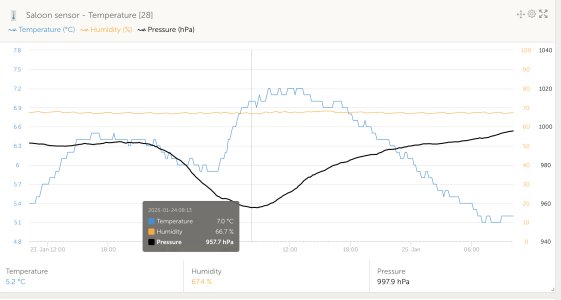
Could the sound increase be linked to a difference in barometric pressure?

We could visibly see the effect of barometric pressure as we had nearly full coverage of sand banks on the Menai usually well exposed even on neap tides. An educated guess is the storm surge was up to 1m or more!
 
Big thanks to all the marina and boatyard staff who were out checking on our boats through the storm - and were out again this morning in the snow checking again.
Apparently at the height of the storm the pontoons were too dangerous even for staff fully kitted with lifejackets etc, but all checked as often as possible. Great job.
 
Top