Sterngear questions

Gordonmc

Well-Known Member
Joined
19 Sep 2001
Messages
2,563
Location
Loch Riddon for Summer
Visit site
Toward the end of last season I experienced a slow leak from the sterngear of my boat.
I tracked it down to the aft-most rubber hose which attaches to the sterntube. With the boat ashore I have removed the prop and shaft and disassembled the sterngear, pictured:

DSC_0138_zpsigvw5jbe.jpg

DSC_0137_zpsmdwt6at9.jpg


The suspect hose is to the left in the picture. It was cut off the sterntube, but was not in great condition and what looks like plumbers mate suggests it has been a problem before my ownership
Questions.
First, I don't particularly like the intermediate bit of 60mm stainless tube as it doubles potential failure points. Has anyone seen a similar arrangement?
Although there is no evidence of a tortional sheer problem should I be worried?
I suspect the stuffing box is an old Vetus model. The spigot takes a water supply. The packing material appears to be nitrile or something similar and has never been a problem apart from one time a drip was cured by nipping up the nylock nuts. What is the packing material likely to be and should I replace?
The engine mounts have been replaced with R&Ds and the shaft coupling is not flexible. Should I be considering a flexible coupling, such as an R&D/Bullflex or similar.
Thanks for any comments. BTW, I have ordered new rubber stern gland hose from Norris.
 
Last edited:
I would get rid of the ss tube for a start. It doesn't perform any useful function. Personally I don't like the flexible hose arrangements and feel that a stern gland rigidly fixed to the sterntube is safer. You would need to add a flex coupling like the R & D. The best packing for the sterngland is graphite impregnated. I got mine from ASAP.
 
The best packing for the sterngland is graphite impregnated. I got mine from ASAP.

I prefer not to use graphite myself, as I think it can introduce wear on the actual shaft. I personally use PTFE impregnated gland packing and find it doesn't create any wear and performs just as well.I suppose it's down to personal choice at the end of the day. :encouragement:
 
Toward the end of last season I experienced a slow leak from the sterngear of my boat.
I tracked it down to the aft-most rubber hose which attaches to the sterntube. With the boat ashore I have removed the prop and shaft and disassembled the sterngear, pictured:

The engine mounts have been replaced with R&Ds and the shaft coupling is not flexible. Should I be considering a flexible coupling, such as an R&D/Bullflex or similar.
Thanks for any comments. BTW, I have ordered new rubber stern gland hose from Norris.

Ps. How do I get the pics to display?
Hi Gordon

Yes you did right to order your new rubber stern tube from T Norris as some do not realise it is not normal rubber piping as it has a both thicker wall and the shore hardness is different to normal rubber.

I also had problems years ago and also did fit a flexible coupling from R & D so agree might be worth thinking about.

One tip after a couple of trips check the jubilee clips on the stern tube are tight !

Mike
 
I was advised that PTFE can run hot so I went for graphite. I don't think ASAP stock PTFE anymore because of problems with it.
I prefer not to use graphite myself, as I think it can introduce wear on the actual shaft. I personally use PTFE impregnated gland packing and find it doesn't create any wear and performs just as well.I suppose it's down to personal choice at the end of the day. :encouragement:
 
I was advised that PTFE can run hot so I went for graphite. I don't think ASAP stock PTFE anymore because of problems with it.

I replaced my original extremely poor gland packing with PTFE. I could not stop it running hot, even with the adjusting bolts slackened off so much that they were rattling. I thought it would settle down with time, so went out several times on trips of up to 20 miles, pouring seawater over the gland to cool it. After something like 50 miles in all it was exactly the same. I pulled the PTFE out, replaced it with ASAP's cotton/graphite which ran cool from the word go.

So far as the OP questions are concerned, the rubber-stainless-rubber arrangement seems very odd. Presumably there is a reason for its fitting but if possible I would do away with it, just put the packed gland onto the stern tube with a short length of the correct hose. The 'rule' is that of engine mountings, stern gland and coupling, any two can be flexible but not all three. So if keeping the gland on a rubber hose I would not introduce a flexible coupling.
 
The only type of packing I've found on the T Norris website looks suspiciously like graphite impregnated cotton.

Yes, I found the same. It doesn't actually state the composition but it's black, unlike PTFE which is white http://www.tnorrismarine.co.uk/product/associated-stern-gear-parts/

If the material was pure graphite there is some truth in the warning. Graphite grease is different though, has been used for this purpose for decades, maybe even centuries.
 
Hi all and thanks for your advice.
I have spoken to Norris who opined that the stuffing box is probably home made, turned out of a block, and uses packing, rather than a seal as I had thought.
Thinking back, the nitrile-looking material is more likely to be compressed graphite packing. I will pull it out, something I did not want to do with a seal which would inevitably cause damage.
The "stuff" does not look like packing on boats I have owned in the past which had traditional greased packing.
Norris only do graphite impregnated packing so I will order some after measuring the shaft - box ID clearance.
Going back to the intermediate stainless steel tube, it may be there because where the shaft tube emerges from the hull is not easily accessible, on the other side of a bulkhead from the engine compartment.
I will consider options!
 
Last edited:
The best packing for the sterngland is graphite impregnated.

I would caution against using graphite. It is at the wrong end of the electrochemical scale - big problems with corrosion.

Ask T Norris for advice; they have never let me down.
By the way I'm not impuning Norris's in any way. I've heard nothing but good reports on them.
 
Interesting replies re the use of PTFE packing instead of Graphite, I was only speaking from my own experience of replacing my prop shaft and gland packing on a re fit 6 years ago now, on my present boat. When I removed the stern gland, and gland packing which is on a flexible tube mount as used in the 70's I found that the prop shaft had been worn with quite a deep groove where the packing had been.This led me to believe that the graphite packing had worn the shaft and I needed to replace it.
I must say that the PTFE packing that I replaced it with has not caused me any grief in 6 years of use, and I have not found it to be working hot, although now vyv has said that I will check on my next trip aboard.
I also find that I don't have to continually feed the stern gland greaser as it doesn't drip ,and I haven't needed to adjust it in 6 years of average use. perhaps I am just lucky, but I will definitely be checking now to see if it does actually run hot, as it is something I have not checked in the past, as nothing had drawn my attention to the fact I needed too.

Thanks for the heads up vyv
 
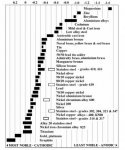
I am surprised at Norris' selling graphite as suitable for a stern gland. Took a bit of digging around of college books which hadn't seen the light of day for decades, but here is the electrochemical series for sea water:

Corros1.jpg

As you can see, graphite is the most noble in the table; everything inferior to it will corrode. There is a significant potential difference with poor oxide stainless steels (the unshaded boxes), even greater with the bronzes (0.6V). It is an excellent electrical conductor.

(Compare it to zinc, which is inferior to the bronzes to a smaller extent (0.3V), and which we are all happy to use to protect our sterngear.)

Solid PTFE is a poor engineering material as under strain it will creep and flow. PTFE impregnated cord should be fine.
 
"Solid PTFE is a poor engineering material as under strain it will creep and flow. PTFE impregnated cord should be fine."
But the experienced of our esteemed friend suggests it's not.
PTFE impregnated cord is fine for valve packings which do not continuously rotate.
 
That's a very interesting table.

I am surprised that people have had trouble with PTFE cord in their stern gland packing though, as I always thought PTFE had some sort of friction free qualities as it is used for bearings, although not high speed of course. A solid block of PTFE is quite soft to touch, as I have made bearings in the past in the lathe when attempting to make a S/Steering gear. I would assume that if it got so hot with friction, it would melt rather than create so much heat as would be noticeable to the touch, especially since it is only impregnated into the Cord for a stern gland?

Unless of course it is packed so tight that it has so much friction on the shaft revolving, which will in turn will create heat.

I'm still going to check mine when running the engine as this has made me wonder about it, and its always going to be in the back of my mind.
 
I am surprised at Norris' selling graphite as suitable for a stern gland. Took a bit of digging around of college books which hadn't seen the light of day for decades, but here is the electrochemical series for sea water:

View attachment 49034

As you can see, graphite is the most noble in the table; everything inferior to it will corrode. There is a significant potential difference with poor oxide stainless steels (the unshaded boxes), even greater with the bronzes (0.6V). It is an excellent electrical conductor.

(Compare it to zinc, which is inferior to the bronzes to a smaller extent (0.3V), and which we are all happy to use to protect our sterngear.)

Solid PTFE is a poor engineering material as under strain it will creep and flow. PTFE impregnated cord should be fine.

See post #10. It isn't graphite that is used, it is cotton impregnated with a grease that contains graphite. Very little risk of galvanic corrosion and many years of successful use to prove it.

Conversely, PTFE is white because the clear polymer is filled with glass powder to improve its mechanical properties. This has a remarkable ability to wear counter-faces, especially 300 series stainless steels. In trials on suitable seal materials for sub-sea ball valves PTFE was ruled out very early on when wear of the balls was found to be unacceptably high. Plus it has very poor thermal conductivity, which is presumably the cause of my problems. It is surely for good reason that ASAP and T Norris no longer stock it.
 
Copy the IMG link from photobucket remove the rubbish at the start and the end so that you only have
at the end then paste onto your post.

Like this

http://i134.photobucket.com/albums/q96/gordonmc_photos/DSC_0138_zpsigvw5jbe.jpg[/IMG) ...... I changed the square bracket to a curved one at the end of this string so it wont work. I'm sure you get the idea.


Put in a square bracket and it will look like this


[IMG]http://i134.photobucket.com/albums/q96/gordonmc_photos/DSC_0138_zpsigvw5jbe.jpg
 
Last edited:
Top