Sterling Pro Charge Ultra Charging Profile

  • Thread starter Thread starter Deleted member 36384
  • Start date Start date
D

Deleted member 36384

Guest
Hello,

My boat is 24V. I have a Sterling Pro Charge Ultra 24V, 30A model. It is connected to 2 x 12V Sealed Lead Acid starter batteries and 4 x 6V Trojan T105s. Is there such a thing as a charging graph, which would indicate expected voltages and currents through the 3 x stages of charging: Fast Charging, Absorption and Float? Note that this is what the LEDs are labeled on the charger and I assume that Fast Charging is the bulk stage, but that assumption may be wrong.

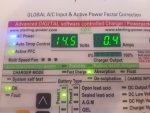
My batteries were fully charged at home the week before installation 2nd week March, and taken to the boat and fitted on the 22 March, for the following Friday launch which never happened due to lockdown. This week the yard switched on my charger and it shows Absorption Mode led on, 29.4V, 0.7A. From the installation manual, there are two Presets 1 and 2, Preset 2 states that for sealed lead acids 29.2V charge voltage, 26.8V float (charge and float are the terms used on the instructions). I don't know how long the charger had been on for, but they took a picture and emailed it to me asking if all was okay. There is a percent charger output LED scale, 5 LEDs from 0 to100%, which is showing no illuminated LEDS, which I suspect is correct, based on the low output current.

My understanding of 3 x stage charging is that Absorption starts around 80% of charge capacity and float around 90%. The charger is connected straight to the batteries using 2 of the 3 output ports on the charger, to one bank each, temperature monitoring is connected to T105s . I have set the charger to Sealed Lead Acid mode.

Basically, I have no confidence as to what the numbers should be for charging in the various modes, hence my query if there is a charging graph. I can't find one on Sterling's site. Second question is, do the numbers look okay for absorption. I have no sense of how high the voltage should be but have seen the charger as high as 30V / high amps (19A IIRC), after a week of sailing on alternator only charging.

I am thinking that the 29.4V / 0.7A in absorption mode is okay.

Thanks,

BlowingOldBoots
 
Looks OK to me. When you first turn the charger on it will run through a cycle, it will then settle down and look after your batteries.

Taking your batteries home and charging them seems like a waste of time when you have this charger fitted. If the boat is unattended the charger will go into a power saving mode, the charger will power down and switch to a monitoring mode, No charging will be done. If the monitor detects a drop in battery voltage it will turn back on, top the batteries up and once again revert to monitoring.
 
The correct charging profile involves dropping down to float when the battery acceptance rate has reduced to a suitable value.

This value is around 0.5-2% of battery capacity. With a 450 Ahr house battery bank, as you have, this is a current of 2.25A to 9A.

So not dropping to float despite the batteries only accepting 0.4A means the acceptance phase is lasting too long and the charger should have dropped to float a long time ago.

This does not necessarily mean there is anything wrong with the charger. They can only do a relatively crude job at charging the battery correctly. Starting a new charge cycle on batteries that are only slightly discharged is one time when they are likely to overcharge the batteries. It will not do much harm, but if you see this again try and force the charger down to float.
 
I suspect when you switch the charger on, it avoids switching to float for a period, regardless of the current drawn.
So long as that period is not 'many hours' and you don't switch the charger on too often without drawing any load, it won't do any harm.
29.4 is a fairly aggressive absorption voltage. But in line with Trojan data.

Ideally you want to know it's dropped to float after a reasonable time.
 
The correct charging profile involves dropping down to float when the battery acceptance rate has reduced to a suitable value.

This value is around 0.5-2% of battery capacity. With a 450 Ahr house battery bank, as you have, this is a current of 2.25A to 9A.

So not dropping to float despite the batteries only accepting 0.4A means the acceptance phase is lasting too long and the charger should have dropped to float a long time ago.

This does not necessarily mean there is anything wrong with the charger. They can only do a relatively crude job at charging the battery correctly. Starting a new charge cycle on batteries that are only slightly discharged is one time when they are likely to overcharge the batteries. It will not do much harm, but if you see this again try and force the charger down to float.
It's not a 450 Ah bank. It's a 24v 225 Ah bank.
 
I suspect when you switch the charger on, it avoids switching to float for a period, regardless of the current drawn.
So long as that period is not 'many hours' and you don't switch the charger on too often without drawing any load, it won't do any harm.
29.4 is a fairly aggressive absorption voltage. But in line with Trojan data.

Ideally you want to know it's dropped to float after a reasonable time.

Yes, although the Pro Charge Ultra is user-customisable you can't change the absorption duration which, even with the low current, will run its course before switching to float as said above. The higher charging voltage will likely be due to temperature adjustment as it's been chilly recently and the temperature sensor is fitted.

It all sounds fine.
 
Last edited:
It's not a 450 Ah bank. It's a 24v 225 Ah bank.
Sorry I missed the bit about 24v, that is a help. You can halve the currents I quoted. So the charger should ideally drop down to float when the current into the battery at the absorption voltage drops to between 1.12A and 4.5A (depending on how agressive you want the charging process).

0.7A is still too low (I would suggest around 2-2.5 A) but not as incorrect as if was 12v system.
 
Thanks for the feedback folks, good info for me.
The batteries were taken out as the boat was in the yard for a couple of jobs with no direct access to shore power. Also one of the jobs was filling an old shower sump outlet hole, and the workers could stand in the battery bay and work easier inside the cockpit locker.
I have an older model BEP Battery Monitor which just shows various data points at that time. If I was to upgrade the battery monitor and wanted one that showed trends over time, what would you recommend.
 
Sorry I missed the bit about 24v, that is a help. You can halve the currents I quoted. So the charger should ideally drop down to float when the current into the battery at the absorption voltage drops to between 1.12A and 4.5A (depending on how agressive you want the charging process).

0.7A is still too low (I would suggest around 2-2.5 A) but not as incorrect as if was 12v system.

As PaulRainbow, lw395 and I suggest, the charger is probably on it's way to float and is just working through its minimum duration of absorption before switching. (I've got a 12 volt version of this charger.) But as lw395 says, it would be handy for the yard to reassure him that it has now switched to float, just in case there is some kind of fault.
 
As PaulRainbow, lw395 and I suggest, the charger is probably on it's way to float and is just working through its minimum duration of absorption before switching. (I've got a 12 volt version of this charger.) But as lw395 says, it would be handy for the yard to reassure him that it has now switched to float, just in case there is some kind of fault.

It is not likely the charger is faulty.

It is significantly overcharging the battery on this occasion. This does not do a great deal of harm to flooded lead acid batteries, if it is only done occasionally and the water is replenished.

If these results are typical of most charging cycles, for maximum battery life the charging parameters should be adjusted (if this is possible) so the charger drops down to float at approximately the correct point. If this is not a typical cycle occasional overcharging is preferable to consistently undercharging.

There is a user guide for charging Trojan batteries here:
https://www.trojanbattery.com/pdf/TrojanBattery_UsersGuide.pdf
 
Last edited:
I have a Pro Charge Ultra 12V 60A charger, and am fairly sure that Sterlings tend to charge at the absorption voltage for a minimum of an hour, so it is likely that the batteries in the OP were pretty much full, hence the low Amps, and the photo was taken in the first hour of absorption.

I've speed read the manual, but cant find the reference to this. On my Pro Combi S inverter charger, there is an algorithm which measures the length of time of the bulk charging phase, multiplies it by a number, (10?), then charges in absorption for this time, or 1 hour, whichever is the greater, (i.e. minimum 1 hour).

If correct, once the OP charger has done its hour at the higher absorption voltage, it will drop to the lower float voltage and stay there unless it is turned off and on again.
 
Top