Sterling charger failed after less than 3years and they want £245 to replace

I don't disagree but is it worth going to the trouble and expense for that last 5%?
Its that last 5% that then sulfates if the batteries are NEVER got back to 100%. The next time it's the next 5% - and so on until the batteries die. That's why you need to equalize once a month - or guarantee a 100% charge.

For cruisers who only go into a marina occasionally this is a real problem.
 
So there we have it. Looks like they can't or won't repair them, so just want to sell you another at a discount... its win win for them.

That ties in with my experience to an extent. Our 350W inverter packed up after a few years service so I emailed them to see if repairable or throw away. Reply from Charles was to send it back but, when I later phoned to ask address details, was told by someone else that they don't do repairs - "we don't have facilities to be a repair shop and labour + postage costs would be too high".
 
Its that last 5% that then sulfates if the batteries are NEVER got back to 100%. The next time it's the next 5% - and so on until the batteries die. That's why you need to equalize once a month - or guarantee a 100% charge.

For cruisers who only go into a marina occasionally this is a real problem.

That cannot be right or every motor vehicle & most vessels would have heavily sulphated batteries - automotive charging systems as also used on most boats never charge the batteries above 80%.
 
That cannot be right or every motor vehicle & most vessels would have heavily sulphated batteries...
Starter batteries on cars don't cycle to 50% like service batteries on boats so they get back to 100% charge very easily.

Starter batteries on boats take maybe 1-2 Ah from the battery which is very quickly replaced, service batteries take maybe 200-300 Ah which is why the take so long to recharge.

- automotive charging systems as also used on most boats never charge the batteries above 80%.

Exactly!!! Which is why you must charge them to 100% regularly. Batteries don't die - they get murdered!
 
That Irish bloke is Mr Sterling....

Really?
There is an older sounding bloke who is very polite and very helpful I thought he was the boss?
That Irish does seem very knowledgeable. But really should let other people answer the phone because he comes across as as rude and arrogant.

I thought i had a problem with an alternator to battery charger. The remote control was giving me an odd reading. I phoned sterling and got mr Irish and was explaining to him what it said.
His response was "you will have to put a meter on it as the remote control is just the to keep the masses happy and is useless"

In fairness it was something that I had done that I worked out without the help of sterling.
The equipment is good and would recommend
In general I'm happy with the service I have had off them and would purchase off them again.
 
Really?
The remote control was giving me an odd reading. I phoned sterling and got mr Irish and was explaining to him what it said.
His response was "you will have to put a meter on it as the remote control is just the to keep the masses happy and is useless"
.
.
In general I'm happy with the service I have had off them and would purchase off them again.

I know that you said the problem lay with something you'd done but the response wasn't exactly inspiring. The remote is an optional extra and costs £80+, nice to know that Sterling are happy to sell something they consider useless. Giving them the benefit of the doubt, perhaps it works as intended and they just thinks it isn't required and only bought by "the masses" who don't know any better.

Doubt I'd deal with them if that's the attitude of the guy at the top.
 
Last edited:
You seriously disagree with everybody's theories - without coming up with facts that are accurate. Victron clearly support my theories - I should I say I support their well proven and well written and very informative documentation.

Perhaps you could do with re-reading their excellent output - ie they specifically refer to the battery type as being one of the governing factors in choosing the size of charger.
When they produced a 60amp charger they gave a range of 400 - 1000 ah as the bank to be serviced. They then go on to point out that the lower end is for batteries which can accept a high charge the top for more conventional batteries.

In fact, as the makers of the batteries probably know more about their products than the manufacturers of chargers, one should follow the charging regime that the manufacturer recommends. Rolls (arguably the most highly regarded battery supplier around) generalise that their batteries should, as a rule of thumb, be recharged at 20% of capacity but, if you read the data-sheet on their individual batteries you'll find a wide variation on this rule of thumb.

The problem I have is your contention that you should have a large enough charger to totally recharge your battery bank within 24 hours - in my opinion this is a fail-safe way to ensure a regular annual turnover of your batteries. Perhaps you did not mean that your charger should be able to take your batteries from 30% to 100% in a day, but that is certainly what you appear to be saying.
As already asked "is that last 5% worth having" - I'd go so far to expand that by adding "at what cost". Having run an electric FLT sales operation I am well aware that fast charging = short life and that the mode and period of equalisation is highly dependant on battery plate construction.
If you wish to persist in claiming that fast-charge is the only important factor in the choice of charger, then I hope you won't take it amiss if we agree to disagree.
 
Quite. But the answer is because they start to get really expensive after that.

My current 30A charger is pitifully undersized for my 600Ah+ batteries, and the 60A seemed a good compromise. I have Lifeline AGMs, and my charger doesn't have a setting for these, I also want equalisation as you later mention. I could get a separate charger for my starter battery, as this has a different construction anyway.

In practice it's probably better to have separate chargers for different batteries - I hesitate to suggest that as both CTek and Victron both do just that and they're trying to sell the things. ;-(
 
If you wish to persist in claiming that fast-charge is the only important factor in the choice of charger, then I hope you won't take it amiss if we agree to disagree.
Great Charles - now we are having a conversation.

First I would be interested to know where you are coming from with your Electric FLT sales operation. I Googled FLT? Friendship, Love and Truth, or Fuzzy Logic Toolbox!

I think you have totally misread my posts. I am not an advocate of Mr Sterling's fast charge policy of sticking 14.8 volts into every battery. I never said anything about fast charging. Fast charging is all about a high charge voltage and not a high current capability. The point I was making was the general misunderstanding that:

“Batteries are fully charged when the regulator drops down to a float voltage.”

My point is that to fully charge you battery if you tie up to a dock or go into a marina once a month to guarantee a 100% SoC then if you start with a large charger then your batteries will get back to FLOAT quicker because the BOOST mode will put many more Ah into the battery. If you are aware of the "Charging Gotcha" and reset the charger when it goes to float it will get the batteries back to 100%.

It takes a bit of simple maths to prove the point ignoring inefficiencies and boat loads and duff wiring!

A 200 Ah battery bank should have a charger that can give it 40 amps - your figure of 20% which is regarded as the average - except for some Rolls and Trojans @ 10-13%. Or Lifelines AGMs at 130%. If it is discharged to 50% it may accept 40Ah each hour during the boosts stage, and after 1.5 hours will have put in 60 Ah and get to 80% SoC) and the remaining 40Ah in 5 hours during the less efficient absorption phase, a total of 100 Ah in 6.5 hours. With inefficiencies and the "charging gotcha" this will be about 95% SOC or less. (Note to replace 100Ah you actually need to put in 130Ah)

A smaller 20amp charger (10% of battery capacity) may accept 20Ah in 1 hour during the boost stage, but it will take 3 hours in boost to get 60 Ah in and reach 80% SoC. The remaining 40Ah in absorption mode will take longer because the current acceptance of the battery will still be higher than the charger can deliver. Maybe after 2 hours the battery acceptance becomes less than the 20 amps that the charger can deliver - at this point a larger charger is of no use. So the absorption phase is now going to take in 7 hours instead of 5 a total of 100 Ah (95% SOC) in 10 hours.

So a 50% smaller charger will take about 60% longer to get to the same state of charge. It will still need to sit there another 10 hours at maybe 1 amp to put in another 10 Ah and get back to 100%

My Victron charger will stay at 14.4v for 5 X the time it took to reach 14.4v. So if it reaches14.4v after 1 hour It will stay there for 5 hours and then fall to float. With a large bank this should be reprogrammed to stay at 14.4 volts for maybe 10 hours, or until the batteries are very nearly 100% when the charger finally drops to float. Being able to re-programme a regulator like this will get batteries back to 100% SOC much faster and more often. Failure to do this is a major cause of early battery failure.

I hope you don't find anything here we can disagree on!
 
I'm hereby laying down the gauntlet as its about time...!!

Will someone please come up with a rought rule of thumb connecting battery AH and charger AH to give charging times to 80%, 90% and 100%.

Assume its from 40% and there is no load and we are not adopting Sterling's method.

Produce a table showing the above for different battery types and a 4 step charger. or for named chargers.
 
>Thanks, but I've just realised I can't sue Sterling as my contract was with the marina

Anybody who sells something is subject to Sale of Goods Act. Claims have been made up to six years after purchase.
 
>Thanks, but I've just realised I can't sue Sterling as my contract was with the marina

Anybody who sells something is subject to Sale of Goods Act. Claims have been made up to six years after purchase.

That is too simplistic. Ian is making the point (correctly) that he cannot claim directly from the manufacturer as he bought the product from a third part retailer.

The " 6 years" is also misleading. He has to prove that the failure was because of a manufacturing fault or that is was not of merchantable quality, or fit for purpose.

The argument is first whether 3 years is a reasonable period, then whether the failure was due to a fault. The manufacturer says the failure was due to misuse but has offered a goodwill gesture of a discount on a replacement, claiming the unit cannot be repaired.

The issue is more about the attitude of the manufacturer than the legal position. While it is theoretically possible to make a claim up to 6 years, it may not be practical either because it is impossible to prove the cause of failure - or more likely the cost of bringing the action exceeds the value of the item.

For an action to succeed, for example through the small claims track, Ian would first have to show that there was a manufacturing fault, second that he had pursued the matter correctly through his supplier and that he had given them the opportunity to respond. As it is, he has not given his supplier an opportunity to respond, the cause of the failure is in dispute and he has rejected the goodwill gesture.

Perhaps the lesson is to follow the proper procedures so that at least you can show that you have given the supplier the opportunity to resolve the problem, but there still remains the issue of determining the cause of failure.
 
I'm hereby laying down the gauntlet as its about time...!!

Will someone please come up with a rought rule of thumb connecting battery AH and charger AH to give charging times to 80%, 90% and 100%.

Assume its from 40% and there is no load and we are not adopting Sterling's method.

Produce a table showing the above for different battery types and a 4 step charger. or for named chargers.

Better you than me, as you have the old statistical situation of n(n-1) N is battery type (gel, AGM, open flooded) + plate hardener (antimony or calcium or a mix) + plate # (5, 7 or 9) + charge stages (voltages) + charge volume (current) - you end up with 10 to the power of 9 different tables.
I suggest you do the work yourself, by observation and continuous measurement. It'll be better than anything offered on a plate or off the shelf. They're actually doing some of this research @ Loughborough and would, I'm sure, be glad of a PhD funding.
 
That is too simplistic. Ian is making the point (correctly) that he cannot claim directly from the manufacturer as he bought the product from a third part retailer.
The " 6 years" is also misleading. He has to prove that the failure was because of a manufacturing fault or that is was not of merchantable quality, or fit for purpose.
The argument is first whether 3 years is a reasonable period, then whether the failure was due to a fault. The manufacturer says the failure was due to misuse but has offered a goodwill gesture of a discount on a replacement, claiming the unit cannot be repaired.
The issue is more about the attitude of the manufacturer than the legal position. While it is theoretically possible to make a claim up to 6 years, it may not be practical either because it is impossible to prove the cause of failure - or more likely the cost of bringing the action exceeds the value of the item.
For an action to succeed, for example through the small claims track, Ian would first have to show that there was a manufacturing fault, second that he had pursued the matter correctly through his supplier and that he had given them the opportunity to respond. As it is, he has not given his supplier an opportunity to respond, the cause of the failure is in dispute and he has rejected the goodwill gesture.
Perhaps the lesson is to follow the proper procedures so that at least you can show that you have given the supplier the opportunity to resolve the problem, but there still remains the issue of determining the cause of failure.

http://whatconsumer.co.uk/how-long-should-it-last/ says :-

Durability
Durability is another recent addition to the definition of quality. How long should a dishwasher or a vacuum cleaner or a printer last? This is a very common source of complaint and one which manufacturers were always quick to turn back on the consumer, requiring them to provide proof that the item did not conform to contract specification from the start, or implying an element of misuse or neglect. Thanks to the new European Regulations, UK law now offers greater protection for consumers against products which develop faults within the first 6 months. The assumption is now that if it breaks down within this time period it cannot have conformed to the contract specification when purchased and you have the right to an automatic repair or replacement. Having said this, items which should last several years can still break down after this six month period. If the retailer or manufacturer’s warranty has run out, the shop is often quick to say there is nothing they can do before attempting to sell you an extended warranty. This is misleading. If you buy something which should last 7 years but breaks down after a year and a day, you can still claim it was of poor quality in reference to the durability aspect. In this respect it will help to know how long items such as washing machines or printers should last. You can get this information relevant trade association
 
TThe manufacturer says the failure was due to misuse but has offered a goodwill gesture of a discount on a replacement, claiming the unit cannot be repaired.

No Tranona, they've never claimed I misused it so not sure where you got that from. Their technician told me a transistor had blown and let mains voltages get to parts that don't take kindly to them. The unit has a made in Taiwan sticker on the underside so I guess that they don't even attempt to repair them but nonetheless should have been able to replace the pcb, the cost of which I would have contributed to upto the value of about £100 or so.

As it happens, others have become involved so there may yet be an acceptable compromise. I will update this thread is due course.

As far as durability, or life expectancy goes, I think 6 years not unreasonable so as its lasted half this, then I should not have to pay more than £135 (paid £270 fo it) for the repair or a replacement. I would possibly have agreed to pay the difference between the one that blew and its nearest equivalent if this was the only option and this difference was not too high (say £50).

In fact the Pro charge Ultra PCU1230 - (the replacement for the Procharge D 1230 that failed) sells for the same price from most online chandlers so why Sterling could not simply have offered my one of these for half price is beyond me. This thread would have had an entirely different theme had they done so.... Instead they wanted £245, presumably for a larger version which I never asked for...
 
Last edited:
Great Charles - now we are having a conversation.

First I would be interested to know where you are coming from with your Electric FLT sales operation. I Googled FLT? Friendship, Love and Truth, or Fuzzy Logic Toolbox!

I think you have totally misread my posts. I am not an advocate of Mr Sterling's fast charge policy of sticking 14.8 volts into every battery. I never said anything about fast charging. Fast charging is all about a high charge voltage and not a high current capability. The point I was making was the general misunderstanding that:

“Batteries are fully charged when the regulator drops down to a float voltage.”

My point is that to fully charge you battery if you tie up to a dock or go into a marina once a month to guarantee a 100% SoC then if you start with a large charger then your batteries will get back to FLOAT quicker because the BOOST mode will put many more Ah into the battery. If you are aware of the "Charging Gotcha" and reset the charger when it goes to float it will get the batteries back to 100%.

It takes a bit of simple maths to prove the point ignoring inefficiencies and boat loads and duff wiring!

A 200 Ah battery bank should have a charger that can give it 40 amps - your figure of 20% which is regarded as the average - except for some Rolls and Trojans @ 10-13%. Or Lifelines AGMs at 130%. If it is discharged to 50% it may accept 40Ah each hour during the boosts stage, and after 1.5 hours will have put in 60 Ah and get to 80% SoC) and the remaining 40Ah in 5 hours during the less efficient absorption phase, a total of 100 Ah in 6.5 hours. With inefficiencies and the "charging gotcha" this will be about 95% SOC or less. (Note to replace 100Ah you actually need to put in 130Ah)

A smaller 20amp charger (10% of battery capacity) may accept 20Ah in 1 hour during the boost stage, but it will take 3 hours in boost to get 60 Ah in and reach 80% SoC. The remaining 40Ah in absorption mode will take longer because the current acceptance of the battery will still be higher than the charger can deliver. Maybe after 2 hours the battery acceptance becomes less than the 20 amps that the charger can deliver - at this point a larger charger is of no use. So the absorption phase is now going to take in 7 hours instead of 5 a total of 100 Ah (95% SOC) in 10 hours.

So a 50% smaller charger will take about 60% longer to get to the same state of charge. It will still need to sit there another 10 hours at maybe 1 amp to put in another 10 Ah and get back to 100%

My Victron charger will stay at 14.4v for 5 X the time it took to reach 14.4v. So if it reaches14.4v after 1 hour It will stay there for 5 hours and then fall to float. With a large bank this should be reprogrammed to stay at 14.4 volts for maybe 10 hours, or until the batteries are very nearly 100% when the charger finally drops to float. Being able to re-programme a regulator like this will get batteries back to 100% SOC much faster and more often. Failure to do this is a major cause of early battery failure.

I hope you don't find anything here we can disagree on!

Shall we first agree on terminology - 1. bulk phase = high voltage and high current to bring the back emf to c 13.5v (conventional regulator)
2. Absorption or float = high voltage c 14.4v and low current. 3. Equalising charge = high volts and low current , most switch-mode chargers do not have this programme which is recommended by many lead-acid manufacturers to be done on a regular cycle of 3-18 months.

I can see an inherent flaw in your argument about a big charger getting through the boost/bulk stage. that has to do with the speed at which the conversion back to sulphuric acid and H2 takes place at the plates.
 
Last edited:
Shall we first agree on terminology - 1. bulk phase = high voltage and high current to bring the back emf to c 13.5v (conventional regulator)
2. Absorption or float = high voltage c 14.4v and low current. 3. Equalising charge = high volts and low current , most switch-mode chargers do not have this programme which is recommended by many lead-acid manufacturers to be done on a regular cycle of 3-18 months.

I can see an inherent flaw in your argument about a big charger getting through the boost/bulk stage. that has to do with the speed at which the conversion back to sulphuric acid and H2 takes place at the plates.

Float voltage is always around 13.4 - 13.6 from what I've seen.
 
Shall we first agree on terminology .....
Good idea - and I also will not rise to ianj99 challenge: "I'm hereby laying down the gauntlet as its about time...!!" As you say a PHD study is needed for this.

This thread seems to be running in two directions at the same, but I assume people are happy because there are over 4000 viewings.....

What I would say to ianj99 is that Victron reckon that the absorption stage is 5 times longer than the boost stage, and I reckon that gets you to 90%. So, depending on you battery capacity, if it takes you 2 hours to get to 80% (boost stage) it takes 10 hours to get to 90% float stage, and another 10 hours to get to 100%. The make of the charger has nothing to do with it, and all flooded LA batteries, not Gels or AGMs, will take roughly the same time if their rate of charge is the same at 20% of C and the battery capacity is the same. Not that difficult really - but Charles is right - do some tests on your system and talk to others and see how theirs works.

Lets define the three stages of a multi-stage regulator, which is what the OP was asking about, and not confuse the discussion with automotive regulators and back EMFs.

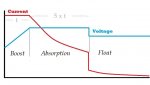
When any multi-stage regulator starts charging it provides a constant current for a time t. This is the “Boost” stage where the voltage slowly rises to the maximum absorption voltage which is usually 14.4 volts. At 25ºC this is the battery gassing voltage.

During the absorption stage the regulator changes to a constant voltage source, or voltage limiter, and holds the voltage at the Absorption voltage for a time which maybe 5 x the Boost time t. This varies with each regulator, and may simply be set at 2-3 hours, which is why many regulators fall to float far too early. During this period the charging current falls away - this is determined by the state of charge of the battery and not controlled by the charger. At the absorption voltage of 14.4 volts the battery will start to gas slightly, batteries need this to stir the electrolyte, and the battery will start to gas more heavily when it is fully charged. It’s the extra energy going into a fully charged battery that can cause excessive gassing. This is why it is so important to have multi-stage regulators on ALL charging sources that will drop down to float mode when they THINK the batteries are fully charged. But beware, at this point the batteries may only be 90-95% charged. This “float” stage (13.2v to 13.8v) will finish charging the battery at a safe voltage to avoid any further gassing, but this lower float voltage produces a big drop in the charging current, so the last 5-10% of charge can take a very long time.

Looking at the graph below it is easy to see why a generator or alternator will take a very long time to get to 100% SOC, and with a small solar array there are not usually enough hours in the day! I really do welcome any comments on this explanation of a multi-stage charger.

OPEN THIS GRAPH IN ANOTHER WINDOW:

Charge graph 2.jpg
 
Last edited:
Good idea - and I also will not rise to ianj99 challenge: "I'm hereby laying down the gauntlet as its about time...!!" As you say a PHD study is needed for this.

Chicken!!!

Let me summarize. If you want to achieve more than 95% soc, then you will not do it overnight starting at 40% soc with just about any combination of battery and charger.

In other words, by all means install a high current charging system to get to 80-90% in hours, but forget the last 5% unless you have another half day on shorepower.
 
Top