
Steel Keels and Antifoul

Jokani

Well-Known Member
Joined
21 May 2014
Messages
840
Visit site
Iron Keels and Antifoul - SOLVED

Here is a picture of my Westerly Centaur keel and Hull:
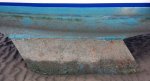
keel-and-hull.jpg

These barnacles have built up after only 2 months in the water!

Over the winter I am planning on having the keels slurry blasted to get me back to clean steel.

But that is where the plan ends at the moment.

After the keels are clean, what would be the best process epoxy, paint, both? And what would be the best materials?

The hull below the waterline, just clean and anti-foul?

Thanks in advance
 
Last edited:
First I would then treat the keel with Firtan to convert any remaining rust, preferably 2 applications. Then apply 5 coats fo International Primocon http://www.yachtpaint.com/gbr/diy/products/primers/search.aspx. Then 2 coats of hard antifouling of a different colour to your final coats of self polishing antifouling.

Personally I would not epoxy the keels as water could get underneath the epoxy and lift it all off due to a thin layer of oxidised iron (rust) stopping a perfect bond.
 
I think you will find that they are cast iron, not steel. The difference is that CI contains graphite flakes that can have a galvanic corrosion effect in seawater, and it is quite porous. Drying a CI keel completely is virtually impossible. The usual advice is to grit blast dry, where the yard will allow it, using aluminium oxide grit, to SA 2.5 standard. Within 30 minutes the keel should be epoxied to preven rusting by atmospheric moisture. Four or five coats of epoxy primer are the usual recommendation. Best done on a warm, dry day in summer!
 
What a timely thread.

I am thinking of taking everything back to bare hull/keel and have the same sort of questions.

After having a rough estimate the hull to be blasted, over £500 (a Victor Meldrew moment), I am investigating doing it chemically.
 
I believe that the yard I am in will only allow slurry blasting and not grit or shot blasting, does this mean that they will not dry sufficiently to epoxy, and that going the Firtan route would be best?
 
The next best alternative to grit blasting is needle gunning but this can sometimes be problematic with cast iron, which is relatively soft and porous, after that angle grinding is probably next. Going the chemical route is never going to be as effective as grit blasting but it may be your only alternative. Epoxy over Fertan will probably not work. My experience with Primocon is not very impressive, whereas my epoxied keel lasted ten years.
 
Mine was recently blasted with olivine, and the results were very good. Softer and less carcinogenic than sand; yards may have less problems in allowing its use.

AFAIK blasting with sand has been illegal for many years. I had not come across olivine before but it seems to be good stuff .http://www.scangrit.co.uk/?page_id=94

Aluminium oxide is usually recognised as being the most effective blasting abrasive
 
The last time I worked on a cast iron keel I wanted to make sure I would not have to do it again for a very long time.

Getting a good dry grit blasting can be a problem, I located one of the mobile blasters and they set up an enclosure in their yard.

I was concerned about the problems created by moisture in the cast iron so spent a lot of time making sure it could not get wet when it rained and used a number of methods to heat the keel, ranging from Oxyacetylene to hot air pumps used to dry carpets. This was done over a month and the change was noticeable.

When I came time to blasting I was there with all the kit on and applying the epoxy resin only inches from the blasting nozzle, this was to avoid any chance of 'flash rusting'', and only after the area was a silver grey with no shadows. using only and 80 mm roller in a small extension we managed to get a good first coat on.

The next afternoon I had a close inspection and found only a couple of spots that has grit stuck in it, sanded with a concrete grinding disk and re-coated before the dust settled, then lightly sanded all over and added 5 coats wet on tacky to avoid more sanding.

2 days later; another wipe down with Acetone and a light sand and another wipe with more Acetone using white cloth only. Then started filling in any low spots and fairing with a mix of epoxy and Micro-spheres, these are made of glass not resin like Micro-balloons are, a bit harder to sand but more robust and less effected by solvents and other chemicals.

Finally the epoxy was primed and over coated with long chain polymer two part paint than hard anti foul followed by an ablative anti foiling paint.

It was a bit over 12 years later when the first sigh of any rust showed, and that was due to the anchor chain fouling the keel.

Would I do it all again if she started to rust?

We will never know, I sold her and bought a cat. Saw her in Cairns about 5 years later, the new owner (not the bloke I sold her to) had just sailed up from Brisbane with a hired skipper. She, the new owner was not that confident being new this boat. She sailed out a few later and ran her into the ribbon reefs where she still sits on the bottom today.

And I still wonder how the keel looks.

Good luck and fair winds. :)
 
Rather than use a straight epoxy primer I would use a zinc rich epoxy primer. At least two coats.

But success is dependent on your surface preparation. Slurry blasting is supposed to remove surface salts but does not seem to be the route to go to me. Dry grit blasting followed by painting within 30 minutes is what I would do. Maybe slurry blasting followed by an immediate acetone wash might work?.
 
AFAIK blasting with sand has been illegal for many years. I had not come across olivine before but it seems to be good stuff .http://www.scangrit.co.uk/?page_id=94

Aluminium oxide is usually recognised as being the most effective blasting abrasive

Olivine was very versatile; we had the entire bottom done as well as the keel. It is soft enough that by varying the pressure and distance, it can be used on both the GRP and the cast iron surfaces effectively. The GRP was perfectly prepared for the application of Coppercoat with no damage to the gel-coast, and the cast iron was brought to a gray metal surface. The blasting removed all corrosion products with no problem. I think that it partly works because the crystals have a weak cleavage, and so shatter on impact.

I was very impressed with it, but I think that for use on both GRP and cast iron it requires a skilled and careful operator, as it obviously could damage GRP if used too zealously.
 
I had a boat done by our local blaster using olivine. Results were great, both on the GRP and on the keel, where he used higher pressure and worked closer.
More recently I made the mistake of having a different boat done by a much better known outfit who happened to be on site who normally blast wet but their wet equipment was out of action. They did it dry with crushed glass. I could have wept. In places it went through the gelcoat. Caused me a lot of remedial work.
They blamed the quality of the gelcoat, my belief is that it was the over harsh blasting medium.

As this thread is really about steel/iron keels I should mention that the first boat above had a cast iron lifting keel, with a fixed stub on the hull which was blasted with olivine. The casting quality of the blade was atrocious, I think it must have been made from any old rubbish that Beneteau's contractor could get. I took it away and had it done in a blasting cabinet in a dry workshop. The blaster (who coincidentally turned out to have a past as a serious Tornado racer) did it last thing one day. By next morning it was horrible with moisture coming out of it. So he did it again with me there and immediately put it in my trailer. By the time I got home 30 mins later it was going again, dark patches developing. I slapped epoxy on with great urgency. 2 years later it was coming through in places. If this casting quality is typical, I think it's an unwinnable battle.
 
Last edited:
Why bother?

Ten years ago, or more, when I bought LUTRA asked for advice on clearing rust on the keels. Apart from adding some keel anodes the advice was to ignore it.

Well I am still here and so are the keels. The anodeshave to be changed every few years.
 
+1 for Fertan, converted the rust nicely and reduced the need for speed in further coating.
I then used Ferpox, from the same company, a one part epoxy so no mixing etc. Lasted for three years and then only needed minor retouching with Fertan followed by Ferpox in small areas. Easy to do, not too time and weather dependent and three years on old cast keels was OK I thought.

Andy
 
I did not realise that it was an option to epoxy over Fertan, I was assuming that epoxy needed to be applied directly to the cast iron cast.

Ferpox looks hard to get hold of in the UK?
 
An excellent alternative to Olivine is to use Garnet - next down to diamond on the hardness scale - it is much cleaner and the results from an experienced user are superb.
Rust tends to remain in the fine scratches of steel, you have to grind quite a bit of the surface away to be sure of destroying all rust.
Needle guns tend to 'hammer' the rust even further into the surface.
High Pressure grit blasting using a fine abrasive gets into far more of the scratches and crevices and leaves a much better surface for painting/coating.
Why squirt high pressure water into the very item you are trying to get as dry as possible before painting?
Wet or slurry blasting is usually used to keep the dust down.

Wino
 
I did not realise that it was an option to epoxy over Fertan, I was assuming that epoxy needed to be applied directly to the cast iron cast.

Ferpox looks hard to get hold of in the UK?
Ferpox over Fertan and over some old two part epoxy seemed to work fine. In fact Ferpox over nearly anything seemed to stick like the proverbial.
Amazon has Ferpox listed as in stock.

Andy
 
Why do anything? For many years I had a bilge-keeler with steel keels. I tried all manner of paint coatings, including Primocon and Epoxy, pre-treated with either phosphoric, oxalic or tannic acid rust killers, then overcoated with antifouling. To no avail, invariably within three months of immersion, all traces of paint had stripped away. I guess it was galvanic action.

Eventually I stopped painting or antifouling the keels altogether. When the boat was lifted for winter storage, most years they emerged shining clean, though just once or twice some form of fouling did get a good hold as in the OP's picture. Once ashore and cleaned I immediately painted over with a single coat of Primocon which would hold off rusting while the boat was laid up. Just before relaunching I wirebrushed off any light rust that had formed, and that was it.
 
Last edited:
Top