
Steel hull corrosion?

  • Thread starter Thread starter Obi
  • Start date Start date

Obi

Well-Known Member
Joined
23 Jun 2009
Messages
742
Location
Landlocked temporarily.
Visit site
Morning all,
A little bit of arm chair yacht shopping led me to this. I'm out of my depth here. I am wondering if anyone with knowledge/experience of steel can comment.
Is it possible to assess from these pictures, the event of the issues that can be seen here? Is this just a case of sand it down and re anti-foul, or is this likely to need to go back to bare steel, possibly welding, and then many coats of the epoxy paint for steel?
Thanks.
O.
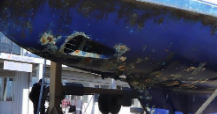
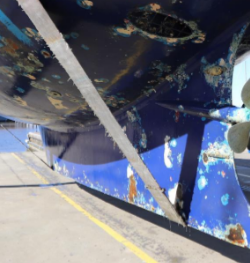
1748763214341.png
1748763249841.png
1748763286518.png
 
The best and IMHO the only way is to grit blast and rust on steel boats then paint with epoxy paint.

I use epoxy tar below the water line as I consider epoxy tar gives better protection.
 
  • Like
Reactions: Obi
The best and IMHO the only way is to grit blast and rust on steel boats then paint with epoxy paint.

I use epoxy tar below the water line as I consider epoxy tar gives better protection.
Thanks Roger. I am no stranger to sanding back and antifouling GRP. Steel is entirely new to me.

Would grit blast and epoxy be a much bigger job? I expect it to be much more involved and costly because last week I heard that steel boats can require 12 coats of epoxy. Any further thoughts you can share?
O.
 
Any rust at all means back to bare steel for the rusty bit... To me that looks like back to bare steel for the whole hull.
 
  • Like
Reactions: Obi
The more coats of epoxy the better as all paint is hydroscopic to some extent, but epoxy tar is less hydroscope that non epoxy tar
 
  • Like
Reactions: Obi
Three coats of Hempel's High Build epoxy has kept my previously owned Steel hull rust free for well over thirty years now. But it was professionally blasted and immediately sprayed with epoxy holding primer before rolling on the high build coats.
 
  • Like
Reactions: Obi
You need to finish the grit blasting and then epoxy the same, low humidity, day.

Raw steel rusts, at a microscopic leverl as soon as you finish blasting (which is easier if you have it done professionally as they know the issues.

Galvanising has the same issues, any rust and the gal will not react - but they usually blast, acid wash and straight into the zinc bath - not quite so easy with a steel yacht.

Jonathan
 
I would probably get a quote for professional blasting and first couple of coats, then DIY for the remaining coats.
The thing with rusty steel is that sanding won't cut it. You need an angle grinder with a twisted bristle cup brush or similar, plus ear protection, good goggles, heavy leather gloves and thick overalls. Frankly it's pretty unpleasant, only suitable for small areas and not the best way to go even then. Grit blasting is far more efficient and effective, and it's a real economy in the long run to get it done professionally.
 
Morning all,
A little bit of arm chair yacht shopping led me to this. I'm out of my depth here. I am wondering if anyone with knowledge/experience of steel can comment.
Is it possible to assess from these pictures, the event of the issues that can be seen here? Is this just a case of sand it down and re anti-foul, or is this likely to need to go back to bare steel, possibly welding, and then many coats of the epoxy paint for steel?
Thanks.
O.
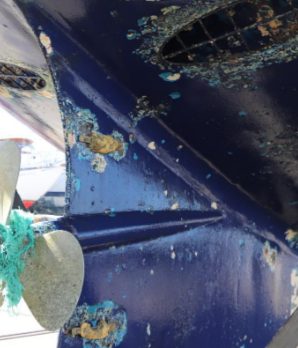
View attachment 194131
View attachment 194132
View attachment 194133
I remember one chemistry lesson at school where we put one bright shiny nail in tap water and another in water that had been boiled. The first nail rusted, the second didnt because steel needs water and its dissolved oxygen to oxidise. Relevance to your question? The only prevention you can have apart from galv is an airtight and water tight coating which you could in theory apply over rust. Wouldnt suggest doing that in this case since the crevises where corrosion has taken place already will hold reservoirs of water likely salty .

Did an experiment with the keels of a Hunter that I once owned. Both keels were thoroughly cleaned free of obvious rust. One was then coated with several layers of epoxy tar and the other with a couple of layers of chlorinated rubber paint as used, I had been told, on big ships. The keel that rusted was the epoxy coated one where the issue was that any porosity / blowholes / damage, however tiny, let in water than then the rust crept under the coating in the way that those who potter with old cars will recognise happens with underseal.

After a working lifetime in the steel industry I would not go near a steel boat. Its not so much the rust that occurs on the outside of the hull but the rust on the inside thanks to condensation in the nooks and crannies you cant see or get at.
 
After a working lifetime in the steel industry I would not go near a steel boat. Its not so much the rust that occurs on the outside of the hull but the rust on the inside thanks to condensation in the nooks and crannies you cant see or get at.
I've owned a couple of steel boat (one yacht, one narrowboat) but I'm not sure I'd want another. The yacht was in good order and has been properly painted when built, but there was an area in the lazarette that gave me uncomfortable feelings - damp, hard-to-access little internal water-trap angles that I suspected were harbouring deep little pockets of rust... The narrowboat had been let go a bit and took a lot of hard, messy work to sort out. Neither of them was truly relaxing to own.
 
  • Like
Reactions: Obi
Thanks, everyone. There are some very helpful comments and food for thought as I consider whether to take this further.

I think I too would concerned about water-traps, condensation in hidden corners inside the hull, as well as poor earths. Once every thirty years or more does good though if the work is done properly or professionally.

Roger your pics look almost post-apocalyptic and it speaks well to what a horrible job it is. I disliked doing anti fouling on GRP, so what you show there looks like a few weeks of very unpleasant activity. For me the worst thing, apart from the PPE, debris and summer heat, was being bent under the hull for hours each day trying to work.

I suspect from the photos of the yacht that I have seen the paint may have been applied with poor process in the past, as pointed out by MisterBaxter it might need the entire hull grit blasting and doing. I think this because it was about 10 years ago when the paint looked fresh in some photos, but more recent ones show discolouration and previous repairs through the paint above the water line.
Had I decided to move from the armchair into a buyers seat, I hoped to get away with a polish on the upsides. It seems maybe not.

It was expensive to address the hull on my GRP yacht 20 years ago. This is going to be a significant jump in cost making the yacht less of an attractive proposition, but I have fallen for her somewhat. I've been wondering about whether to sell a few things and get stuck in.

Pause for more thought...

Thanks again everyone, that was a great set of responses :)
O
 
I have always remembered a comment made to me by the sales director of Prout some decades ago. After a similar conversation about the choice of hull material ( ferro, concrete, wood, GRP) she made the point that GRP of all of them was by far the easiest to repair and apart from after a boat fire, grp was infinitely repairable with very basic skills and tools.

The owner of a lovely wooden yacht said much the same thing - he could only afford a wood boat because he owned a boatyard and a marina.
 
  • Like
Reactions: Obi
I have always remembered a comment made to me by the sales director of Prout some decades ago. After a similar conversation about the choice of hull material ( ferro, concrete, wood, GRP) she made the point that GRP of all of them was by far the easiest to repair and apart from after a boat fire, grp was infinitely repairable with very basic skills and tools.

The owner of a lovely wooden yacht said much the same thing - he could only afford a wood boat because he owned a boatyard and a marina.
The drawback of GRP - which is only important for people venturing far from civilisation - is that repairs aren't load-bearing for several hours or even days after carrying out the repair. Wood and steel can bear loads immediately after a repair, which might be important if you're far from boatyard or marina facilities. But otherwise, wood and steel tend to have limited lifetimes, barring heroic efforts at preservation and maintenance.
 
  • Like
Reactions: Obi
This reminded me of a comment by a friend who had cruised a bit.. He was in an anchorage with a steel boat that the bow was a bit 'turned up'
Apparently, they were sailing at night and miss interpreted two sets of lights and ran into the middle of the big tanker...
Any other material would have been disaster.
 
  • Wow
Reactions: Obi
R.5fe13e512e58bf487612f8b378b8996b


Advantage of a steel boat
 
  • Like
Reactions: Obi
I would agree with what most others have said here! The only way to deal with the failed coatings on the boat in question is to grit blast and apply multiple coats of a good quality epoxy primer, followed by a suitable tie coat and then the antifouling. It is important to achieve a suitable surface finish to any chosen preparation method in order to provide the required key for the epoxy. Grit blasting does this in addition to removing layers of failed coatings and rust. I’m not keen on the use of wire brushes on angle grinders, as these can leave an almost polished surface which is not desirable.
Another point which I don’t think has been mentioned in the thread so far, would be concern relating to the condition of the steel on the inside of the hull. The inside of the hull is much more difficult to achieve a good quality of protection to the steel than the outside during the initial build, so if the outside coatings have failed - what’s happening inside?
 
Thanks to the clarity and views shared my thoughts have shifted from tidying up to thinking over whether I am really prepared to strip it all, outer and inner hulls and do it all properly. It's daunting to say the least, but if I am to go ahead then it's clearly the right thing to do. I will have the time. If I don't do it properly, I know it will always be a concern in my mind. Roger sets a superb example and expectation with his photos of what I am taking on (thanks) and the group have all supported the same views. It is not off the cards yet :)
 
Top