Starting problem

Caladh

Well-Known Member
Joined
25 Oct 2009
Messages
1,541
Location
Out there again and no longer dreaming
Visit site
I turn the ignition switch on, the alarms go off but when I try to start - nothing happens. I thought it was the cables on the back of the starter which I’ve cleaned up. There is a spade connector also which I thought wasn’t making a good contact and re attached it. In the past, fiddling with these cables has caused the starter to start and all is well. However today before she comes out of the water I came to start her and zilch again. I again fiddled with wire to no avail. I’m wondering if it’s the starter switch ? Not sure how to even start trouble shooting this issue. Anyone been there before ? I had the starter serviced two years ago and a new solenoid fitted.
 
Would be helpful to know what the engine is.

Assuming it's a standard pre-engaged starter, short the main battery cable on the solenoid to the small wire with the spade terminal. If it turns over it's not the starter, if it doesn't, it is the starter (assuming there is power at the main battery cable, check with a multimeter).

If it does turn over, it could be the switch, a secondary relay/solenoid (if fitted) or the wiring. The wire with the spade terminal should be positive when the key is turned to the start position, if not, start at the switch, does the switch terminal become live when you turn the key ? Work your way from there to the solenoid.
 
An AVO meter would be useful, and quite inexpensive, or at least an old headlamp bulb with lengths of wire attached to the + and - terminals of one of its elements ( the one that's still working?).
A 12 volt bub on a couple of leads may be a better choice than a multimeter for trouble shooting a situation like this .

Digital meters draw so little current that they can give what appears to be a normal reading even though there may be bad connections. Sooner or later likely to make a fool of you if you are not careful.
 
Last edited:
Would be helpful to know what the engine is.

Assuming it's a standard pre-engaged starter, short the main battery cable on the solenoid to the small wire with the spade terminal. If it turns over it's not the starter, if it doesn't, it is the starter (assuming there is power at the main battery cable, check with a multimeter).

If it does turn over, it could be the switch, a secondary relay/solenoid (if fitted) or the wiring. The wire with the spade terminal should be positive when the key is turned to the start position, if not, start at the switch, does the switch terminal become live when you turn the key ? Work your way from there to the solenoid.
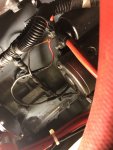
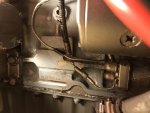
The engine is a Yanmar 4JH-TE. I’ll set to troubleshooting next week and update. Here are a couple of pics - not too clear but the first shows thick red + side of things, the second shows the spade terminal wire going to a terminal box below the starter which I’m not sure what it is ! Thanks for the method to troubleshoot.
 

Attachments

  • C518382B-F778-4A47-9A7E-F5ACAD7BE677.jpeg
    C518382B-F778-4A47-9A7E-F5ACAD7BE677.jpeg
    579.7 KB · Views: 90
  • 2BEA3F35-BA41-4AE5-B1EC-129F5DF87641.jpeg
    2BEA3F35-BA41-4AE5-B1EC-129F5DF87641.jpeg
    691.2 KB · Views: 91
Last edited:
The engine is a Yanmar 3JH-TE. I’ll set to troubleshooting next week and update. Here are a couple of pics - not too clear but the first shows thick red + side of things, the second shows the spade terminal wire going to a terminal box below the starter which I’m not sure what it is ! Thanks for the method to troubleshoot.
Paul's description of diagnosing the problem is so simple and accurate that you should be able to sort it out. Any multimeter will tell you if you have a voltage at a particular point
 
Paul's description of diagnosing the problem is so simple and accurate that you should be able to sort it out. Any multimeter will tell you if you have a voltage at a particular point

You're assuming the OP knows how to use a multimeter. I'd go for a test lamp as per Post #4.
 
I was also going to suggest shorting the starter terminals.

I have the same engine and when it began to start unreliably, I added a relay in the starter switch circuit (I couldn't face pulling the loom apart).
That; get a short length of wire and short the motor feed onto the solenoid. If it works the key switch/start button is probably fritzed.
 
That; get a short length of wire and short the motor feed onto the solenoid. If it works the key switch/start button is probably fritzed.
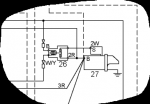
There is a "start relay " between the key switch and the starter solenoid ( see the schematic in the Operation Manual ) This could have failed .......... vague recollections of peeps having trouble with these before ... can be replaced, IIRC, with a heavy duty automotive relay if necessary.

Item #26
1636864195627.png
 
Last edited:
There is a "start relay " between the key switch and the starter solenoid ( see the schematic in the Operation Manual ) This could have failed .......... vague recollections of peeps having trouble with these before ... can be replaced, IIRC, with a heavy duty automotive relay if necessary.

Item #26
View attachment 125748

Seems to be really common these days, additional unnecessary complication of somthjbf that should be really simple....the volvo MDI springs to mind and others are just as guilty!
 
Seems to be really common these days, additional unnecessary complication of something that should be really simple....the volvo MDI springs to mind and others are just as guilty!

You have to wonder, why do you need a relay to operate a solenoid ?

If the key switch and the wiring between it and the starter solenoid are rated for the solenoid current draw it's totally unnecessary.
 
Forgive me, i assumed that the OP was not the local village idiot and would know how to to read a multimeter.

I was replying to SteveA not you. There have been threads on here asking about strange readings and it turns out OP had the MM dial on the wrong setting. So never assume!
 
Can I assume then that this relay is the one I’ve pictured 2nd on my post #5 bottom r/h ?

Looks like it, there should be two wires going from it to the starter solenoid, one will be live, the other goes to the solenoid, when the relay closes it connects those together, as i suggested earlier. If you short those two wires at the relay, it will tell you if the starter is OK.

Assuming the starter works; the other two wires at the relay will be, one negative and one that becomes positive when the key is turned. Determine which one is negative, with your multimeter. If you short the positive wire from the starter to the wire that isn't negative, the relay should close and the starter should work, if that doesn't happen, the rely needs to be replaced.

If the relay works; identify the terminal on the ignition switch that should become live when the key is turned. Short this to a positive connection on the key switch. If it works, the wiring from the panel to the relay is good, if it doesn't the key switch is likely faulty or has a bad connection.

Use a short length of wire, of a reasonable thickness, for shorting the various connections. Bare in mind it'll be live, so keep it away from any metalwork or anything that could be negative. Make sure you keep your fingers away from anything that'll rotate if the engine turns over.
 
Last edited:
I was replying to SteveA not you. There have been threads on here asking about strange readings and it turns out OP had the MM dial on the wrong setting. So never assume!

Seems to me that we have to make a few assumptions, or replies will be extremely long. I assumed that the OP knew where the engine was, knew which part was the starter motor, had a multimeter, knew the meter had to be set to volts, to be able to read volts, etc etc :):)

Oh, i also assumed that if any of my assumptions were incorrect the OP would ask some more questions.
 
Looks like it, there should be two wires going from it to the starter solenoid, one will be live, the other goes to the solenoid, when the relay closes it connects those together, as i suggested earlier. If you short those two wires at the relay, it will tell you if the starter is OK.

Assuming the starter works; the other two wires at the relay will be, one negative and one that becomes positive when the key is turned. Determine which one is negative, with your multimeter. If you short the positive wire from the starter to the wire that isn't negative, the relay should close and the starter should work, if that doesn't happen, the rely needs to be replaced.

If the relay works; identify the terminal on the ignition switch that should become live when the key is turned. Short this to a positive connection on the key switch. If it works, the wiring from the panel to the relay is good, if it doesn't the key switch is likely faulty or has a bad connection.

Use a short length of wire, of a reasonable thickness, for shorting the various connections. Bare in mind it'll be live, so keep it away from any metalwork or anything that could be negative. Make sure you keep your fingers away from anything that'll rotate if the engine turns over.
Thanks Paul. Stage one is complete in that the starter solenoid is ok and the engine started when I bridged the spade to the live. I’ve had a look at the ignition switch which has a number of thicker and thinner wires to it so I’ll dig out a wiring diagram to see what to bridge there. IF it turns out to be the relay it’ll be a right bugger to bridge an/or replace due its very inaccessible position. Huge thanks again for your clear instructions. I’ll update again.
 
Top