Starting out sailing... Mast broke in storm Amy - any help please?

New to sailing so trying my best with the terminology.
I’m going to be blunt - I don’t think mast repair is beginner territory. Of course you can tackle it but the learning curve will be steep. First you have to break down all the weird language we like to use, then sort out the good advice from the bad. Then actually execute the repairs which may need specialist kit.
It's why it snapped that he needs to know.
Does he? I mean realistically what difference does it make if it was fatigue on a fitting? He needs to repair or more likely replace the mast and standing rigging and make sure it’s correctly set up going forward. Time spent pontificating the exact mechanism is not actually getting him closer to sailing again.
I only had the boat a couple months and haven't got round a full inspection as only been motoring around so far.
Yeah that’s not a phrase your insurer wants to hear.
That's what my rigger did when I dismasted a few years ago damaging the foot of the mast.. not wooden - he went to a machine shop next door and they made a metal one
To me this is clearly a job for a professsional. That means expensive. To be honest though, if you’ve never even sailed a boat the idea that you could buy a second hand mast, rig it correctly with new standing rigging and get all the running rigging and electrics etc right first time is fantasy - so it may work out cheaper and less stressful in the long run to engage a professional rigger anyway.
 
The principal reason he needs to know why it happened is to prevent repetition of the mistake. No argument with the rest of your post. A friendly rigger might be amenable to some second hand gear for the boat, it’s certainly not worth a new one.
 
I am not sure if this breaks forum rules
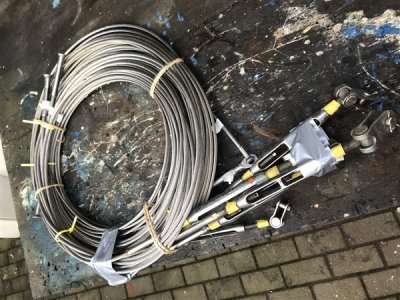
I have a complete set of second hand rigging that just needs the tops cutting & the required fittings fitted
It has been used for 10 years & is complete with all the bottle screws etc
If the OP is interested he can PM me when he gets his new mast then a rigger may be able to set it up for him
IMG_1659 (600 x 450).jpg
 
Last edited:
I'm with the others who say any repair to that mast is a job for a professional. I've been a boat owner for over 20 years, and consider myself to be a fairly practical, but I wouldn't try it.

It shouldn't be too hard to source a replacement for not a lot of money. A local club may well have something that's cluttering up the yard. Getting a rigger to put it all together will cost a bit, but shouldn't be too bad. What will cost will be replacing the roller furler. You may get lucky and only need a length or two of foil, but I'd budget for a new one.

Good luck!
 
The principal reason he needs to know why it happened is to prevent repetition of the mistake.
But knowing what caused that mast to fall down isn't what matters - knowing why masts fall down in general is surely the important thing - masts/standing rigging fail because of corrosion, fatigue, insecure fittings working loose, and badly set up rigging (and probably other reasons like a part that is damaged or bent and ignored). The repaired/replaced mast needs to be rigged to avoid all of those, if this was a missing split pin it doesn't mean a repair using the same rigging with fresh split pins isn't going to fail for a different reason next month. Ultimately the preventable root cause here is likely to be that the new owner didn't get the rigging inspected by someone who understood yacht rigging.
 
There was a post placed in YBW a few years ago about loosening rigging at the end of the sail to preserve its life. The consensus was that loose rigging was at risk from fatigue, work hardening rapidly as the mast flopped about and the practice would rapidly shorten the life of the rigging. Indeed, a contributor to the thread stated that loosening the rig used to be his practice and one day it failed on the mooring with fatigue, work hardening the reported cause.
 
What a shame - that's a bad and very unlucky turn of events for a new starter. Sorry to hear it.

If you have full insurance rather than just 3rd party, try the insurers first with just the facts - I don't think they need any speculation about whether anything might have not been ok. Fixing this without insurance might, sadly, be a big fraction of the theoretical value of the boat. That doesn't mean it's not worth doing, but you do need to work it out carefully.

I would swap a mast for a close match myself but not attempt to repair an existing one purely DIY - and I am pretty handy. And a new mast is very expensive. Fortunately there are probably quite a few old masts that should work OK, available lurking in the back of yards around the country. I can think of somewhere to look, in fact.

Can you give us any clues as to what part of the country you are in? (sorry if you said and I missed it)

Save roller furler parts carefully if you can - they can be quite expensive.
 
... Also any best tips moving forward to get up and running.. the front jib wire is snapped off about 4 metres of cable and in the water with just the cable and nothing else attached ...

Recover the mast and remove all the fittings to transfer to the replacement mast. Measure, where the parts are fitted so you can match up on the replacement spar, measure the rigging diameter and lengths and ask in the "Wanted" section of the forum for that wire size. For example, I have some 12m lengths of new stainless wire around 5mm diameter (need to measure) and I notice that @Daydream believer has offered a set.

Assuming UK based, as others have said, finding a mast section may not be that difficult. Also second hand boat spares: -

Welcome to Boatscrapyard - Boatscrapyard
Buying Used Boat Parts in the UK
Chandlery Barge | sells new, secondhand and redundant chandlery
Also eBay and Apollo Duck, Boats and Outboards could be good sources for second hand parts

Clubs and marinas may also have old items kicking about.

If dealing with your insurance company, as others have stated, don't offer any comment on state of mast and rigging, or assumptions on what may have happened or cause, stick to the facts.
 
There was a post placed in YBW a few years ago about loosening rigging at the end of the sail to preserve its life. The consensus was that loose rigging was at risk from fatigue, work hardening rapidly as the mast flopped about and the practice would rapidly shorten the life of the rigging. Indeed, a contributor to the thread stated that loosening the rig used to be his practice and one day it failed on the mooring with fatigue, work hardening the reported cause.
In the XOD class, we tie our rigs up nearly twanging taut and the end of a race. Your rigging will definitely fail if you don’t. Unless the stem pulls out and your boat sinks first.
 
My Westerly 24 was beaten up a bit by storm Amy.

Mast down.... Hanging on but underwater.

What would have caused this damage.

Was it a rigging issue (tightness or bad fixture), or mast base cassette issue , or just bad luck in the strong winds issue.

She was on the swing mooring in a fairly sheltered area.

Also any best tips moving forward to get up and running.. the front jib wire is snapped off about 4 metres of cable and in the water with just the cable and nothing else attached

Was looking to get out for a first sail with an experienced friend of family, went to check up following the winds and seen the damage sadly.

New to sailing so trying my best with the terminology.
Is the boat actually a Westerly 24? The only 24 ft Westerly is the GK24 and the photos are all wrong for that.

If an insurance claim the insurer just might write off the boat, unless you can find a suitable used mast as part of the process. You will unfortunately be horrified by the cost of a new mast and rigging, plus professional fitting and set-up. Sorry to bring bad news.
 
Realistically the boat is a write off. You can buy one for less than the cost of a mast. Even the basic stays, bottle screws and furler will add up to more than half the cost of a complete boat. The chances of finding a used mast are very small and as has been noted the current mast is probably beyond repair. Even if it is insured for all risks the payout will not cover the cost of repairs.
 
Tend to agree re costs here unless you can salvage one from an old Westerly and I suspect even that will be somewhat impaired. Maybe though a trip to a yacht breakage yard (I thought there was one outside Portsmouth ) or an old boatyard might reveal a replacement. That’s really half the battle but as a Westerly 24 is so rare I guess well before the era of centaurs etc it might be a labour of love (much like restoring say an Anderson 22 or suchlike) . Maybe another forumite has a Westerly 24 ?
 
Realistically the boat is a write off. You can buy one for less than the cost of a mast. Even the basic stays, bottle screws and furler will add up to more than half the cost of a complete boat. The chances of finding a used mast are very small and as has been noted the current mast is probably beyond repair. Even if it is insured for all risks the payout will not cover the cost of repairs.
It’s that cheerful outlook that keeps you going, right? ( joking, we all love our boats don’t we 😊)

I certainly wouldn’t chuck in the towel until exploring all options of a free/ spare/ available secondhand mast or rig or even sister ship. They’re out there but yiu have to spread the word wherever you can.

Condolences, it is horrid.
After each Caribbean hurricane there are a lot of people in the same situation and yet somehow, with persistence, some of them. manage to move forward.
With a newly set up rig I can’t see you needing to worry about the Why, or the Would it happen again.
Best luck
 
Thanks for all the input. Really appreciate everybody chiming in. You're all amazing. I was hoping I could salvage by taking the bottom few inches off the mast and living with a shorter mast. Pending an inspection of the mast when I remove it from underwater. The riggings seemed to be in a good clean working condition when I looked round the boat. The boat was well maintained before I bought her but she had stood In the boatyard before. Unfortunately as it was a recent purchase I had not sorted insurance yet. This was coming fast on to do list but not yet done . I have a feeling the rigging may have not been tight enough or equalised at the turnbuckles, but that's just a thought. When I seen the boat from the shore I thought more damage would have been possible like to the roof etc.. so could have been worse but still , it's a dilemma I would rather have not coming in the week I finally get the sails up. Had about a half dozen motor excursions which have been great for first time on water on a sailing boat. I may have some likers or hater but I input some data into an ai model and got back a report. Just to give a bit more explanation of possibilities based on words I am getting used to. But looking over the report and everybody's input I think at very least a short mast , or replaced mast might work with new rigging pending a inspection once the mast setup is out the water. May just need to bite the bullet and use her a a motor boat. But will see how things go.
 
Marine Incident Report – Mast Failure during Storm Amy

Vessel: Westerly Pageant 23 (23 ft bilge-keel sailing cruiser)
Location: Rhu Marina Swinging Mooring, Firth of Clyde, Scotland
Date of Incident: October 2025 (during Storm Amy)
Prepared by: Skipper


---

1 Summary of Event

During the passage of Storm Amy, which brought gale- to storm-force winds exceeding 60 knots, the Westerly Pageant 23 was secured on her regular swinging mooring at Rhu.
At some point during the height of the storm the mast collapsed to starboard, entering the water and remaining partially submerged.

Subsequent inspection showed that the forestay wire inside the roller-furling foil had snapped about 3–4 metres above the lower swaged terminal.
The furling foil assembly and headsail were no longer visible above the waterline and are believed to be submerged, possibly still attached to halyards or sheets.

The port upper shroud was found detached from its wire terminal, while the starboard shroud and backstay remained intact.
The mast base fitting on the port side was distorted and cracked, and the lower section of the mast showed buckling consistent with compression failure under lateral load.


---

2 Probable Sequence of Events

1. Progressive weakening of forestay wire – Moisture trapped inside the furling foil likely caused internal corrosion of the stainless wire strands.


2. Fatigue crack propagation – Repeated motion on the mooring produced micro-fractures at the high-stress mid-span area (≈3–4 m up).


3. Sudden forestay failure – Under a peak gust or mooring swing, the corroded section parted, allowing the furling foil and sail to drop and removing forward support.


4. Secondary overload of port upper shroud – With no forestay tension, the mast whipped aft and to port, over-loading that shroud until it detached.


5. Mast collapse to starboard – Once both forward and port support were lost, the mast fell diagonally to starboard, damaging the mast-step bracket and lower section.


---

3 Possible Contributing Factors

3.1 Material and Structural Factors

Internal corrosion within foil – trapped water and salt accelerate rusting.

Hidden crevice corrosion – especially inside swaged ends.

Metal fatigue – cyclic stress from wind oscillation.

Age of standing rigging – wires over 8–10 years old become fatigue-susceptible.

Defective swage or strand fracture – prior over-tightening or mis-crimping.

Electrolytic / galvanic corrosion – dissimilar-metal contact in damp foil.


3.2 Environmental Factors

Severe gusts and direction shifts – complex lateral forces during Storm Amy.

Wave surge and mooring swing – constant cyclic pitching on a swinging mooring.

Resonant vibration – sustained oscillation under wind can amplify stress.

Prior bending strain – any kink or uneven tension could have formed stress risers.


3.3 Maintenance and Rig Tuning Factors

Blocked drainage holes in foil – allows water retention.

Hidden corrosion not visible on inspection – foil conceals wire condition.

Aging fittings – chainplates, tangs, or terminals may have loosened.

Over-tensioning of stays – increases standing stress and reduces fatigue life.

Under-tensioning of rigging (possible factor) –
If shrouds or stays were not tight enough, the mast could have pumped and flexed excessively at the mooring.
Slack rigging allows lateral oscillation, causing repeated shock loads and fatigue at the wire’s mid-section.
In heavy winds this “pumping” can double the stress cycles experienced by the forestay, accelerating failure.

Lack of comprehensive rig-tension checks – periodic tension measurement with a gauge may not have been performed.


---

4 Damage Summary

Forestay wire fractured ≈3–4 m above deck, inside foil.

Roller-furling foil not visible; believed submerged.

Port upper shroud detached; starboard shroud intact.

Lower mast bent and cracked; port mast-step bracket distorted.

Minor secondary damage to halyards, pulpit, spreader base, and deck fittings.

Furling drum separated from foil extrusion (likely underwater).


---

5 Immediate Actions Taken

Vessel secured and inspected post-storm.

Mast stabilised to prevent further damage.

All rigging photographed for insurer/surveyor.

Fractured wire ends preserved for metallurgical analysis.

Furling system to be recovered for inspection.

Insurance company and surveyor notified.


---

6 Further Recommendations

1. Recover foil and fractured wire for laboratory or magnified examination—look for corrosion pitting, strand colour changes, or fatigue beach marks.


2. Replace all standing rigging (forestay, backstay, cap and lower shrouds).


3. Inspect chainplates, mast tangs, mast step, and deck core for elongation or cracking.


4. Check mast compression post for deformation.


5. Strip, clean, and re-assemble furling system with free drainage holes.


6. Isolate dissimilar metals using non-conductive washers.


7. Re-tune rigging with a tension gauge to manufacturer-recommended values.


8. Establish rig-inspection log with annual checks and a complete replacement interval (typically 8–10 years).


---

7 Conclusion

The mast failure aboard the Westerly Pageant 23 resulted from a combination of hidden corrosion, metal fatigue, rig-tuning factors, and extreme storm loading.
The initiating event was the fracture of the forestay wire concealed inside the roller-furling foil, followed by secondary overload of the port shroud and collapse of the mast.

While corrosion and fatigue were primary causes, it is also plausible that the rigging was insufficiently tensioned, allowing the mast and forestay to oscillate under wind load, greatly accelerating fatigue in the wire.

The incident is consistent with catastrophic rigging failure under extraordinary environmental stress, compounded by unseen internal deterioration and possibly sub-optimal rig tension.
 
Marine Incident Report – Mast Failure during Storm Amy

Vessel: Westerly Pageant 23 (23 ft bilge-keel sailing cruiser)
Location: Rhu Marina Swinging Mooring, Firth of Clyde, Scotland
Date of Incident: October 2025 (during Storm Amy)
Prepared by: Skipper


---

1 Summary of Event

During the passage of Storm Amy, which brought gale- to storm-force winds exceeding 60 knots, the Westerly Pageant 23 was secured on her regular swinging mooring at Rhu.
At some point during the height of the storm the mast collapsed to starboard, entering the water and remaining partially submerged.

Subsequent inspection showed that the forestay wire inside the roller-furling foil had snapped about 3–4 metres above the lower swaged terminal.
The furling foil assembly and headsail were no longer visible above the waterline and are believed to be submerged, possibly still attached to halyards or sheets.

The port upper shroud was found detached from its wire terminal, while the starboard shroud and backstay remained intact.
The mast base fitting on the port side was distorted and cracked, and the lower section of the mast showed buckling consistent with compression failure under lateral load.


---

2 Probable Sequence of Events

1. Progressive weakening of forestay wire – Moisture trapped inside the furling foil likely caused internal corrosion of the stainless wire strands.


2. Fatigue crack propagation – Repeated motion on the mooring produced micro-fractures at the high-stress mid-span area (≈3–4 m up).


3. Sudden forestay failure – Under a peak gust or mooring swing, the corroded section parted, allowing the furling foil and sail to drop and removing forward support.


4. Secondary overload of port upper shroud – With no forestay tension, the mast whipped aft and to port, over-loading that shroud until it detached.


5. Mast collapse to starboard – Once both forward and port support were lost, the mast fell diagonally to starboard, damaging the mast-step bracket and lower section.


---

3 Possible Contributing Factors

3.1 Material and Structural Factors

Internal corrosion within foil – trapped water and salt accelerate rusting.

Hidden crevice corrosion – especially inside swaged ends.

Metal fatigue – cyclic stress from wind oscillation.

Age of standing rigging – wires over 8–10 years old become fatigue-susceptible.

Defective swage or strand fracture – prior over-tightening or mis-crimping.

Electrolytic / galvanic corrosion – dissimilar-metal contact in damp foil.


3.2 Environmental Factors

Severe gusts and direction shifts – complex lateral forces during Storm Amy.

Wave surge and mooring swing – constant cyclic pitching on a swinging mooring.

Resonant vibration – sustained oscillation under wind can amplify stress.

Prior bending strain – any kink or uneven tension could have formed stress risers.


3.3 Maintenance and Rig Tuning Factors

Blocked drainage holes in foil – allows water retention.

Hidden corrosion not visible on inspection – foil conceals wire condition.

Aging fittings – chainplates, tangs, or terminals may have loosened.

Over-tensioning of stays – increases standing stress and reduces fatigue life.

Under-tensioning of rigging (possible factor) –
If shrouds or stays were not tight enough, the mast could have pumped and flexed excessively at the mooring.
Slack rigging allows lateral oscillation, causing repeated shock loads and fatigue at the wire’s mid-section.
In heavy winds this “pumping” can double the stress cycles experienced by the forestay, accelerating failure.

Lack of comprehensive rig-tension checks – periodic tension measurement with a gauge may not have been performed.


---

4 Damage Summary

Forestay wire fractured ≈3–4 m above deck, inside foil.

Roller-furling foil not visible; believed submerged.

Port upper shroud detached; starboard shroud intact.

Lower mast bent and cracked; port mast-step bracket distorted.

Minor secondary damage to halyards, pulpit, spreader base, and deck fittings.

Furling drum separated from foil extrusion (likely underwater).


---

5 Immediate Actions Taken

Vessel secured and inspected post-storm.

Mast stabilised to prevent further damage.

All rigging photographed for insurer/surveyor.

Fractured wire ends preserved for metallurgical analysis.

Furling system to be recovered for inspection.

Insurance company and surveyor notified.


---

6 Further Recommendations

1. Recover foil and fractured wire for laboratory or magnified examination—look for corrosion pitting, strand colour changes, or fatigue beach marks.


2. Replace all standing rigging (forestay, backstay, cap and lower shrouds).


3. Inspect chainplates, mast tangs, mast step, and deck core for elongation or cracking.


4. Check mast compression post for deformation.


5. Strip, clean, and re-assemble furling system with free drainage holes.


6. Isolate dissimilar metals using non-conductive washers.


7. Re-tune rigging with a tension gauge to manufacturer-recommended values.


8. Establish rig-inspection log with annual checks and a complete replacement interval (typically 8–10 years).


---

7 Conclusion

The mast failure aboard the Westerly Pageant 23 resulted from a combination of hidden corrosion, metal fatigue, rig-tuning factors, and extreme storm loading.
The initiating event was the fracture of the forestay wire concealed inside the roller-furling foil, followed by secondary overload of the port shroud and collapse of the mast.

While corrosion and fatigue were primary causes, it is also plausible that the rigging was insufficiently tensioned, allowing the mast and forestay to oscillate under wind load, greatly accelerating fatigue in the wire.

The incident is consistent with catastrophic rigging failure under extraordinary environmental stress, compounded by unseen internal deterioration and possibly sub-optimal rig tension.

Is this report about your boat? :unsure:
 
Thanks for all the input. Really appreciate everybody chiming in. You're all amazing. I was hoping I could salvage by taking the bottom few inches off the mast and living with a shorter mast. Pending an inspection of the mast when I remove it from underwater. The riggings seemed to be in a good clean working condition when I looked round the boat. The boat was well maintained before I bought her but she had stood In the boatyard before. Unfortunately as it was a recent purchase I had not sorted insurance yet. This was coming fast on to do list but not yet done . I have a feeling the rigging may have not been tight enough or equalised at the turnbuckles, but that's just a thought. When I seen the boat from the shore I thought more damage would have been possible like to the roof etc.. so could have been worse but still , it's a dilemma I would rather have not coming in the week I finally get the sails up. Had about a half dozen motor excursions which have been great for first time on water on a sailing boat. I may have some likers or hater but I input some data into an ai model and got back a report. Just to give a bit more explanation of possibilities based on words I am getting used to. But looking over the report and everybody's input I think at very least a short mast , or replaced mast might work with new rigging pending a inspection once the mast setup is out the water. May just need to bite the bullet and use her a a motor boat. But will see how things go.
The bit that honestly confuses me is that you've been out to the boat but not hauled the mast out of the water, just left it there. Quite apart from the indesirability of having a mast and rigging that youmight want to re-use at least part of left underwater, leaving it in the water risks it scraping the hull with the sharp broken section, in extremis holing the hull, and then you really are in trouble.

I also think the insurance bit is probably moot. I cannot imagine a marine insurer who couldn't point to a failure in maintenance etc when the mast just falls down. However windy it was.

Here I agree with Tranona. If you can source a replacement second hand mast, then great. But your bills won't stop there with a re-rigging. Otherwise, as much as it might pain you, the better financial option is probably to scrap this boat and look for another. The market is such that older small boats are almost being given away.
 
That "report" is pretty much speculation, no different from anyone here voicing an opinion. I've never seen corrosion inside a foil for instance, but seen fatigue failures, almost always from insufficient rig tension. The boat's on a mooring, so will have been bow to the wind pitching fore/aft. A slightly slack fore (or back) stay and you'd get huge snatch loads. The forestay may well have worked it's way slack by the bottlescrew not being secured, but it might have been slack already. Once the forestay is gone the mast is coming down, finding the weakest points to break loose on the way down. None of this makes a one jot of difference - the only thing that matters is what to do next.

I disagree with those saying scrap it and get another - scrapping boats costs money too - quite substantial amounts compared to finding a mast and putting some hours in over the winter.

As Wansy said in post #2 - ask around the local clubs and yards. The mast for a 23'er isn't a huge thing, there will be one lying around somewhere. Our club have just had a cleanout and 4 mast sections went to the scrap man, with a variety of bits to make them work. Get the wreckage out of the water and use it as a template for the replacement.
 
Top