Standing Rigging 'swollen swage fittings'

jimbo

Member
Joined
12 Jun 2004
Messages
37
Visit site
I have just had a rigging check on my 9 year old Jeanneau with Dyform rigging and the surveyor flagged up an issue with the swage fittings having swelled slightly (19.75mm at their narrowest point rather than the recommended max 18.75mm) and this was an indicator of corrosion inside the swage fitting (rust taking up more space than clean steel) - and the rig needs replacing. Does anyone know where I can find some data on what the max tolerances are for this? I cannot find anything about this 'swelling' issue on-line, any information about it would be appreciated. There were other issues as well which point to the rig needing replacing but this 'swollen' swage fitting was a new one to me.
 
New to me too. Difficult to understand how water could penetrate sufficiently to corrode inside a swaged fitting. The usual corrosion failure mechanism is stress corrosion cracking that starts on the top surface. If you abrade the swage can you see cracking in the form of a tree, multiple branches? Will post a photo.
 
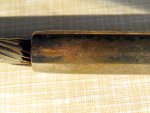
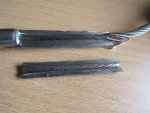
The top photo shows a swage cut open. The soft metal of the swage extrudes into the lay of the wire, work hardening and strengthening in the process. Although Dyform has a smooth outer surface the final result will not be a great deal different. Difficult to imagine how significant amounts of water could penetrate inside a well-made swage.

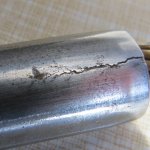
The other photos show stress corrosion cracking of a swaged fitting in the original and abraded condition. These branched cracks are typical of SCC and a fairly common mode of failure in rigging. Once cracked water can get inside and I suppose swelling might result.

IMG_0694 small.jpg

swage 1 small.jpgswage scc.jpg
 
Sounds a bit iffy TBH ....

Swage fittings if done properly should go on for many years ............ if its failed at 9yrs ?? Somethings VERY wrong. Either Surveyor is blowing smoke trying to be smart ... or whoever did the swages was not good at all.
 
Looking at the design water can easily enter the fitting. The wires are round & there are microscopic gaps between each strand as they are packed in together. It stands to reason that 2 circles must have gaps with its partner. Capilliary action would draw the moisture up in to the fitting over time, where it will lay & assist electrolitic action if conditions permit.
But Refueler's comment above is highly relevant. 9 years is well within normal use.
It may be that cloned fittings were used & not those of the original manufacturer. That is quite possible & the rigger may well have been duped.
 
It would be interesting to learn where the surveyor obtained the specific data for the specific make of terminal as the finished size is surely a function of the original size and the die that made the swage. I would be inclined to contact a swage terminal manufacturer and ask for some guidence on particular modes of failure indicators.
 
I have just had a rigging check on my 9 year old Jeanneau with Dyform rigging and the surveyor flagged up an issue with the swage fittings having swelled slightly (19.75mm at their narrowest point rather than the recommended max 18.75mm) and this was an indicator of corrosion inside the swage fitting (rust taking up more space than clean steel) - and the rig needs replacing. Does anyone know where I can find some data on what the max tolerances are for this? I cannot find anything about this 'swelling' issue on-line, any information about it would be appreciated. There were other issues as well which point to the rig needing replacing but this 'swollen' swage fitting was a new one to me.

It is usual to use stainless Dyform wire in rigging so there should be no corrosion as you describe in the swages. Is your wire just carbon steel? Dyform is mainly used in lifting applications where it brings advantages when used over sheaves etc however the main advantage when used on yachts is that it provides a an increase in strength for a given diameter and has a relatively smooth outer surface and so less abrasion on running rigging .

Perhaps you could put a picture of one of these fittings on this forum.

Below are links to two constructions of Dyform wire. Which is similar to yours.?

Dyform as used on lifting equipment.

Steel Wire Rope Dyform 6 | Certex Finland

Dyform as used on rigging and usually a single strand made up with numerous wires

1x19 Dyform Stainless Steel Wire Rope | S3i Group
 
There may be a modification as the OP used Dyform cable as opposed to standard 1 x 19 I think.
This partly answers my question however Is your Dyform Carbon steel? A magnet may help confirming this. Normally stainless is used on a yacht so why is there corrosion?
 
I have never heard of the swage swelling. Strangely I was at a talk by a sailmaker recently and a comment was made about a company that will check a rig for £50. They are well known to find non-existant faults to ensure you have your boat rerigged. Could this be the case?

Most rig failures are due to fractured wire at a swage fitting. The best way to check for fractures is to use some cotton wool. It will only snag if the wire is fracturing and leaves a few threads in the break. Dye testing kits used in engineering to check for cracks and fractures can also be useful, These cost about £30 for a full kit and is large enough to make multiple tests on the whole rig.
 
Last edited:
New to me too. Difficult to understand how water could penetrate sufficiently to corrode inside a swaged fitting. The usual corrosion failure mechanism is stress corrosion cracking that starts on the top surface. If you abrade the swage can you see cracking in the form of a tree, multiple branches? Will post a photo.

Many thanks for the info and the photos which helpful. More investigation and maybe a call to Sta-lok for their thoughts is required.
 
Sounds a bit iffy TBH ....

Swage fittings if done properly should go on for many years ............ if its failed at 9yrs ?? Somethings VERY wrong. Either Surveyor is blowing smoke trying to be smart ... or whoever did the swages was not good at all.

I've been trawling the net and seems 8-12 years and 25000nm is a typical lifespan - mine is 9 years and 20000+ nm so a little disappointing but not wildly outside the range. I know there are boats that havent changed their rigging for 20 years or more but that probably invalidates their insurance amogst other issues. The swages are look fine to my unskilled eye and have not been picked up in any of the previous rig surveys as a problem. I am a little sceptical of the rather negative survey tbh.
 
Looking at the design water can easily enter the fitting. The wires are round & there are microscopic gaps between each strand as they are packed in together. It stands to reason that 2 circles must have gaps with its partner. Capilliary action would draw the moisture up in to the fitting over time, where it will lay & assist electrolitic action if conditions permit.
But Refueler's comment above is highly relevant. 9 years is well within normal use.
It may be that cloned fittings were used & not those of the original manufacturer. That is quite possible & the rigger may well have been duped.

These are the original factory fittings and in 316 ss. Dyform uses hexagonal section wire so it is denser and thus stronger than 19 strand but there would still be room for moisture to get in
 
Top