Stanchion Ferrules/Bushing Supplier?

In conditions where I might go cartwheeling over the guardrails you’d find me crawling up the deck. Nothing wrong with that; John Goode himself extolled the virtues of keeping low and crawling if necessary.

Well maintained guard rails (even at 600mm) are a good last line of defence against a lost grip or slip when you’re low down.

Surely the strength comes mainly from the wires being tensioned between pushpit and pulpit. The stanchion holds the wire up and in place.
 
  • Like
Reactions: pvb
In conditions where I might go cartwheeling over the guardrails you’d find me crawling up the deck. Nothing wrong with that; John Goode himself extolled the virtues of keeping low and crawling if necessary.

Well maintained guard rails (even at 600mm) are a good last line of defence against a lost grip or slip when you’re low down.

Surely the strength comes mainly from the wires being tensioned between pushpit and pulpit. The stanchion holds the wire up and in place.

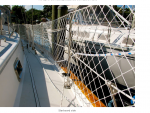
I wouldn't argue with what you say but as one author of an article pointed out (can't find the article now) if you are on a cabin top (lying low down) you are probably close to the top of the stanchions.

I've made up 900mm stanchions therefore the gap between the cables is 450mm (18in) whereas the gap would only be 300mm (12in) on a production boat. As the weight of the netting would be negligible and the cost is insignificant I believe it would be good from a safety point-of-view.

The author of Windtraveller says he has seen three people go overboard (including himself) all in calm seas when they were least expecting it.

Screenshot 2021-09-02 at 13-27-32 Installing Lifeline Netting.png

Installing Lifeline Netting
 
"Look around almost any anchorage and you can spot the serious long-distance voyager. You know, the boat with the extra fuel cans tied to the deck, wind generator, solar panels, and a couple of bicycles strapped to the pushpit. Look closer and you might also spot some netting strung between the lifelines and toe rails. "

I don't recollect " serious long distance voyagers " such as Eric & Susan Hiscock, the Pyes, Conor O'brien, Mulhauser, et al cluttering up their yachts with all that stuff.
However did they manage without it?
;)
 
I don't recollect " serious long distance voyagers " such as Eric & Susan Hiscock, the Pyes, Conor O'brien, Mulhauser, et al cluttering up their yachts with all that stuff.
However did they manage without it?
;)
Yep they did without a whole lot of other things too as flensdorf points out!

Hello this is my first posting here.
Just finished "Around the world in Wanderer III". Reading all the other books.
To my dismay the UK authorities did not stop Mr and Mrs Hiscock leaving the UK for a circumnavigation 1952-1954!! I was one years old when they started.
Only a
30 feet wooden yacht!!!
NO ais
NO ssb radio
NO gribfiles
NO sat-com
NO fridge
NO vindwane steering
NO roller headsail
NO shower
NO ipad
NO computer
NO diesel engine
NO aux. generator
NO solar panels
NO vhf
NO gps
NO ....
No ....
But they had (only)
a sextant
a ships clock
a walker trailing log
a shortwave reciever
a 2 stroke engine 4 HP generating 40W
no reverse gear only forward.

The Hiscocks, Eric and Susan remains a big inspiration for me!

Was the waves and weather different in the 1950ies??

Lets see what you sail gurus think?

Have a happy and healthy 2012 lots of fun and lots of sailing!
Erland
 
Of course, to look at it another way, the Hiscocks are famous because they were almost completely alone in what they did at the time. These days there are so many people doing it you couldn't keep up with all the ones who have YouTube channels, let alone caring what the names of the other thousands are. There's a reason for all the extra people doing it.
 
My stanchions are alloy and the guardwires are stainless so I've used short lengths of shrink on insulation in two layers to provide separation .The wires are marked insitu and then removed for the application of the shrink - on by placing in boiling water in a saucespan - this gives a perfect fit that I can't guarantee with a flame.
 
My stanchions are alloy and the guardwires are stainless so I've used short lengths of shrink on insulation in two layers to provide separation .The wires are marked insitu and then removed for the application of the shrink - on by placing in boiling water in a saucespan - this gives a perfect fit that I can't guarantee with a flame.
A hot air gun works very well too.
 
My stanchions are alloy and the guardwires are stainless so I've used short lengths of shrink on insulation in two layers to provide separation .The wires are marked insitu and then removed for the application of the shrink - on by placing in boiling water in a saucespan - this gives a perfect fit that I can't guarantee with a flame.
Surely this traps moisture in next to the stainless which could probably lead to crevice corrosion which will be covered over, therefore worse than PVC coated stainless wires. I'd consider stripping that off and putting something in place that allows air to the stainless more easily while not trapping moisture
 
Surely this traps moisture in next to the stainless which could probably lead to crevice corrosion which will be covered over, therefore worse than PVC coated stainless wires. I'd consider stripping that off and putting something in place that allows air to the stainless more easily while not trapping moisture
I use the shrink on that's got glue inside that melts into and seals the heat shrink onto the wire. No moisture can get in. Whilst re-laying the deck last lay up, I had to remove the pushpit and hence the guard wires. There's no sign of any water or corrosion or crevice corrosion under where the heat shrink with glue was fitted.
 
Another question which I don't think is too of topic is what sealant should be used when bolting the stanchion to the deck?
My intuition tells me I must torque the mounting bolts up quite firmly to the deck otherwise the stanchion would move. (I might also put a decent nylon backing plate under the f/g deck as well for each stanchion)

I considered butyl tape and Sika flex but I thought if I got some rubber (like an old car tube) that would be more appropriate.
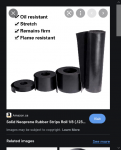
I did a google on "stanchion/deck rubber gasket" and lo and behold there is such a thing sold by Rig-rite.

Screenshot 2021-09-02 at 18-47-31 Rig Rite 1 16 rubber sheet gaskets - Google Search.png
 
Last edited:
Some slight drift.

This is 2 takes on lifelines and netting.

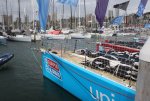
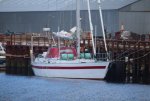
The top picture is of a Clipper yacht. The top life line appears to be braided. The stanchions are overly high and netted. The netting did not stop the loss of crew members overboard. Netting does not offer a 100% guarantee, but then neither does a harness and tether. The netting is extremely well secured. The second picture is of Pelagic in Port Stanley, the same over high stanchions, but no netting (though the netting could have been removed). The emphasis on Pelagic are .... shore lines


IMG_6693.jpeg
IMG_6597 2.jpeg

Jonathan
 
I should have added that my wires were replaced because the previous pvc coating was damaged and unsightly around the tops of the stanchions and the wires bent by the tying of fender lines .I expect to remove examine and renew the sleeves with other inspections and avoid tying fenders onto the wire.
 
Neeves thanks for that.

I think if a lifeline did break the netting would save the day (I suppose that is negative thinking) I have some 5mm(?) plastic coated cable which I am having second thoughts installing.
 
Some slight drift.

This is 2 takes on lifelines and netting.

The top picture is of a Clipper yacht. The top life line appears to be braided. The stanchions are overly high and netted. The netting did not stop the loss of crew members overboard. Netting does not offer a 100% guarantee, but then neither does a harness and tether. The netting is extremely well secured. The second picture is of Pelagic in Port Stanley, the same over high stanchions, but no netting (though the netting could have been removed). The emphasis on Pelagic are .... shore lines
The stanchions on that clipper probably extend a foot below the deck too, allowing them to be high and strong. Leisure boats usually bolt a stick to the top of the deck so even standard length stanchions will have sufficient leverage to rip them out if you fall against them. The important thing is to know whether your stanchions were designed for safety or looks. Similarly with grab rails which might be well bolted steel or washed out thin teak strips. If you're trusting your life to something, be sure that something is intended to save it!
 
Neeves thanks for that.

I think if a lifeline did break the netting would save the day (I suppose that is negative thinking) I have some 5mm(?) plastic coated cable which I am having second thoughts installing.
Of course, the very thin netting could just as easily cause deep lacerations to your hands and face as your entire body weight at several Gs rests against a 3mm poly line. I'm not arguing against adding netting, just that the nettings plan should be for saving a sail from being washed overboard during a change, not stopping a 90KG human from washing over. You're right, it probably would help a little but I still wouldn't point to it as a safety feature.
 
Of course, the very thin netting could just as easily cause deep lacerations to your hands and face as your entire body weight at several Gs rests against a 3mm poly line.
But you don't - you rest against lots and lots of line with a lot of give in it. Bit like lying in a hammock. You are probably more likely to suffer minor injury from the guardrail itself without netting - but we don't hear of that being a particular problem.

Plenty of examples of people with tethers going overboard. Netting may well have stopped some of them. Can't see why netting would not significantly contribute to safety, especially doing foredeck work.
 
The stanchions on that clipper probably extend a foot below the deck too, allowing them to be high and strong. Leisure boats usually bolt a stick to the top of the deck so even standard length stanchions will have sufficient leverage to rip them out if you fall against them. The important thing is to know whether your stanchions were designed for safety or looks. Similarly with grab rails which might be well bolted steel or washed out thin teak strips. If you're trusting your life to something, be sure that something is intended to save it!
They would only rip out if the wire between pushpin and pulpit wasn't stretched taught. I agree that a heavy person falling on them wouldn't do them any good, but I'm not convinced they'd rip totally out of the deck and give way.
 
I think lifelines (and what they are made from), stanchions, jackstays, hard points, netting - and being very strict about using hardnesses and tethers is a total package. Not one single item is guaranteed to save someone going overboard.

But this does not mean you should not take each item and its location seriously. The worst or best example is the loss of life due to use of inadequately designed tether hooks - don't rely on a manufacturer, nor the specifier, getting it right (which is why in rough weather we use two tethers providing 3 hooks on each tether (one for the harness, two for the strong points or jackstays).

If you want to research tethers use the search function on YBW or look at Practical Sailor - google 'tether hooks' and 'Practical Sailor'. It makes seriously chilling reading (and researched by Thinwater).

If you have a simple philosophy - if you go over board you WILL die (and your body may never be recovered) - then it makes sense to have as many options as possible to keep you 'inside' the toe rail as possible.

Netting has the advantage it also saves things other than people going overboard (and personally I like devices that have more than one use).

In rough weather walking to the bow to me is risking your own life and that of the crew - you have knees, they are good for crawling - you seldom use them for crawling, and possibly not since you were 6 months old_ - use them. And your foul weather gear has reinforced knees for a reason - get your money's worth.


But don't become over anxious - most people don't experience such awful weather that they need to crawl to the bow. Its a leisure activity, meant to be a pleasure - and if Force 8 is forecast - mow the lawn - don't take the kids for a sail! Keep it all in proportion. If you are preparing to cross the Atlantic or Pacoific - look at it seriously, do the research and maybe start a thread here.

Take care, stay safe

Jonathan
 
They would only rip out if the wire between pushpin and pulpit wasn't stretched taught. I agree that a heavy person falling on them wouldn't do them any good, but I'm not convinced they'd rip totally out of the deck and give way.

I agree with you John (and Neeves) that if the lifelines are (relatively) taut the loads would be spread across several stanchions.

As far as getting lacerations from the net that would be the least of my worries just as getting a fractured rib from my car seat belt in a car crash.

I think I'll use the plastic coated lifeline down near the toe rail and stretch the netting from the top lifeline. Apparently the stanchion bracing at the base of the stanchion can be used as an anchor point for my safety harness. (The stanchions are 880mm high)

imgonline-com-ua-resize-5MdQgrmlWLW.jpg
 
Top