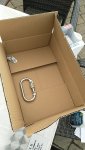
Stainless Steel Karabiner

davidpbo

Well-Known Member
Joined
14 Aug 2005
Messages
4,886
Location
Boatless in Cheshire. Formerly 23ft Jeanneau Tonic
myweb.tiscali.co.uk
When mooring to a buoy overnight I sometimes use a short length of chain attached by a screw gate karabiner to the riser chain under the buoy. Said chain is connected to a mooring strop over a samson post on the bow. Usually backed up by a slack mooring line ring attached elsewhere on the buoy or chain.

The screw gate karabiner (Obviously not stainless)I have been using rusted solid over winter and needs to be replaced. I am considering stainless steel, what gauge/breaking strain should I be looking for? Boat is 23ft <2000Kg trailerable sailing boat.

Something like this or this? I think they are strong enough, are they? This is for short term moorings overnight etc. whilst using the boat.
 
  • Main Axis Load: 60kN
That's a bit over 6 tons. You could pick up three of your boats without overloading it. I'm no expert on climbing gear, but I'd expect the breaking strain to be several (10?) times that. If that lets go, your backup line won't stand a chance!
 
What size chain are you using?

The query I have is what is the spring for the gate made from and the pin that forms the hinge. If they may corrode then you will need to watch and replace. As Stemar says - they are way over strength.

I assume you want to use a carabiner because its easy to attach and detach. I also assume you don't want to use a rope for fear of abrasion (it will need to be really uncomfortable for most ropes to abrade through overnight. You are going to be on the boat when moored - if its that uncomfortable - you won't be there.

You might be over thinking this.

Jonathan
 
The side strength of a carabiner is much less than end strength. The gate cannot take side strain without distorting and if it pops open you are off! Soa possible problem is that once underwater you cant see how it is sitting. Obviously a much bigger "crab" can give greater margin, and the plain steel is better than stainless.

I am puzzled however why you would not simply attach to the mooring ring on top of the mooring buoy, or to the strops already attached with shackles?

A crab does however seem ok for fair weather.
 
  • Like
Reactions: Ink
  • Main Axis Load: 60kN
That's a bit over 6 tons. You could pick up three of your boats without overloading it. I'm no expert on climbing gear, but I'd expect the breaking strain to be several (10?) times that. If that lets go, your backup line won't stand a chance!

Important to check if the advertised figures are working load. It's an internet trick to quote breaking strength because it's a bigger number!
 
When mooring to a buoy overnight I sometimes use a short length of chain attached by a screw gate karabiner to the riser chain under the buoy. Said chain is connected to a mooring strop over a samson post on the bow. Usually backed up by a slack mooring line ring attached elsewhere on the buoy or chain.

The screw gate karabiner (Obviously not stainless)I have been using rusted solid over winter and needs to be replaced. I am considering stainless steel, what gauge/breaking strain should I be looking for? Boat is 23ft <2000Kg trailerable sailing boat.

Something like this or this? I think they are strong enough, are they? This is for short term moorings overnight etc. whilst using the boat.
Use a soft shackle easy to make and stronger than s/s
 
Its also worth remembering that shock loads may exceed static loads. 20kN is needed for a 75Kg climber falling maybe 20m. Usually the climbing rope stretches to take the strain so crab does not see 20kN- sadly sometimes it doesnt go right due to poor setup and things snap and folks die.

2000kg boat can jerk an anchor chain and generate 60kN force. Normally catenary on chain acts as snubber, but in very high wind the chain is taut so no catenary thus rope snubbers needed or chain and cleats may fail.

Hence rope warps best for mooring - as used by OP
 
Its also worth remembering that shock loads may exceed static loads. 20kN is needed for a 75Kg climber falling maybe 20m. Usually the climbing rope stretches to take the strain so crab does not see 20kN- sadly sometimes it doesnt go right due to poor setup and things snap and folks die.

2000kg boat can jerk an anchor chain and generate 60kN force. Normally catenary on chain acts as snubber, but in very high wind the chain is taut so no catenary thus rope snubbers needed or chain and cleats may fail.

Hence rope warps best for mooring - as used by OP

I really don't think a 2,000kg yacht will ever generate a 60kN snatch load but I am happy to be shown I'm wrong. The exception might be if it is dropped from a hoist and for some reason there was a back up lifting strop and it was allowed to free fall before the back up strop was expected to take the impact.

I would hope the mooring has some device, simple stuff like heavy chain on the seabed, to reduce snatch loads anyway but a 60kN tension maybe in a 50' x 20t yacht but not a 2t yacht. Nothing on a 2,000kg yacht will have been designed to take such a tension - the bow will fail before the crab.

I set up to measure tension in the rode and at 35 knots with a short rode at 2.5:1 I recorded snatch loads of 650kg on a 6t x 38' cat. The 'impact' was like driving into a brick wall - I stopped measuring for fear of what might break if the loads went higher.

The OP advises he s going to be on his yacht and I can assure you with snatch loads of 'only' 650kg he will have moved to somewhere slightly more comfortable. If he has crew on board they will swear never to be with him again. Its that bad (only 650kg).
 
Last edited:
This is the same bit as OTT as the discussion that was held the other day regarding closing up a die-stamped shackle by some 3mm.
As I remember from my climbing days, an aluminium screw gate carabine would hold 2500kg in linear load and some 600kg in traverse.
For a boat of 2000kg displacement, 2500 kg would exceed by some margin the holding power of his ground tackle. Considering that mooring buoys are generally put down in relatively sheltered locations, I wouldn't think twice about using this set-up, never mind for an overnight stay. Before that carabine fails, the cleats would have long departed company with the deck.
 
This is the same bit as OTT as the discussion that was held the other day regarding closing up a die-stamped shackle by some 3mm.
As I remember from my climbing days, an aluminium screw gate carabine would hold 2500kg in linear load and some 600kg in traverse.
For a boat of 2000kg displacement, 2500 kg would exceed by some margin the holding power of his ground tackle. Considering that mooring buoys are generally put down in relatively sheltered locations, I wouldn't think twice about using this set-up, never mind for an overnight stay. Before that carabine fails, the cleats would have long departed company with the deck.
My response was technical concerning the crab, I had already suggested that a crab, particularly the plain steel one was sufficient for the OPs task. Not all mooring buoys are in sheltered locations however and some are placed where anchoring might not be quite so adequate. I doubt many would choose the OPs arrangment there however - the 'trawler buoy' off Lundy comes to mind and quite frightening in F7
 
The OP seems to have disappeared, maybe waiting for all the suggestions to come in.

My interpretation has been the OP wants to use a 'courtesy' mooring for overnight stays in a 23' x 2,000kg yacht. The yacht is a trailer sailor and the chosen cruising grounds appear to be 'Cumbria). He has mentioned that his previous crab rusted solid (I assume left to corrode in the bottom of a locker).

He is asking if a stainless 60kN would be adequate, and he also has a rope back up.

I have assumed that in a 22' yacht the OP is unlikely to be using the gear if the forecast is not 'benign; - and its its not benign it is gong to be mentally taxing in a 22' yacht.

I have wondered why the choice of a carabiner - and I assume it has been chosen because it can be applied single handed, when leaning forward from the bow.

I think the OP hopes that a stainless shackle might not rust solid.

There must be lots of options - but they must be applicable single handed. and based on the limited info the OP provided I suspect he is not going to using the mooring in a F9, or even maybe a F6.


As another option.

Take an appropriate mooring warp (one that fits the link size of the chain of the mooring) attach to a, or the, bow cleat. Run warp outside everything to the transom. Approach buoy such that the transom kisses the buoy. Then thread warp through link (this can be done easily - you should be able to simply hold the buoy in the conditions suggested (the yacht is hardly heavy) thread warp, take in warp and secure to bow cleat.

Attach back up as approrpa

Easy to release, easy to see if there is any abrasion damage.

Does not engender fear and panic.

Comments

Jonathan
 
Take an appropriate mooring warp (one that fits the link size of the chain of the mooring) attach to a, or the, bow cleat. Run warp outside everything to the transom. Approach buoy such that the transom kisses the buoy. Then thread warp through link (this can be done easily - you should be able to simply hold the buoy in the conditions suggested (the yacht is hardly heavy) thread warp, take in warp and secure to bow cleat.

Attach back up as approrpa

Easy to release, easy to see if there is any abrasion damage.

Does not engender fear and panic.
Works for me.

I have a line with a snap shackle that normally lives clipped to the pushpit, runs forward outside everything to a block at the bow, then back to a cockpit cleat. It does double duty as a mainsail preventer when running and allows me to pick up a buoy from the cockpit when things are getting nasty. Once when I used it, it was blowing so hard, it took me nearly half an hour to pull it in to get the mooring chain over the samson post. I tried using the winch on the mast, but didn't like the way the mast was bending ?

Important to check if the advertised figures are working load. It's an internet trick to quote breaking strength because it's a bigger number!
Yes, but I don't think "main axis load" can have any meaning other than safe load in this context, especially from Kong. "Strength 60KN", OTOH, could mean anything. If it was on Wish, I'd hesitate to use it for a child's swing!
 
The OP seems to have disappeared, maybe waiting for all the suggestions to come in.

My interpretation has been the OP wants to use a 'courtesy' mooring for overnight stays in a 23' x 2,000kg yacht. The yacht is a trailer sailor and the chosen cruising grounds appear to be 'Cumbria). He has mentioned that his previous crab rusted solid (I assume left to corrode in the bottom of a locker).

He is asking if a stainless 60kN would be adequate, and he also has a rope back up.

I have assumed that in a 22' yacht the OP is unlikely to be using the gear if the forecast is not 'benign; - and its its not benign it is gong to be mentally taxing in a 22' yacht.

I have wondered why the choice of a carabiner - and I assume it has been chosen because it can be applied single handed, when leaning forward from the bow.

I think the OP hopes that a stainless shackle might not rust solid.

There must be lots of options - but they must be applicable single handed. and based on the limited info the OP provided I suspect he is not going to using the mooring in a F9, or even maybe a F6.


As another option.

Take an appropriate mooring warp (one that fits the link size of the chain of the mooring) attach to a, or the, bow cleat. Run warp outside everything to the transom. Approach buoy such that the transom kisses the buoy. Then thread warp through link (this can be done easily - you should be able to simply hold the buoy in the conditions suggested (the yacht is hardly heavy) thread warp, take in warp and secure to bow cleat.

Attach back up as approrpa

Easy to release, easy to see if there is any abrasion damage.

Does not engender fear and panic.

Comments

Jonathan

The OP had not disappeared but was otherwise occupied.

Your interpretation is by and large correct. I started using the Karabiner on Windermere if we were stopping on the buoy for more than a few hours and maybe leaving the boat for a few hours or more. At that time the visitors buoys did not have pick up buoys and Idon't think had rings so it was a case of lassooing the buoy, pulling it up and either putting a rope through the rusty chain or a shackle and rope or chain. The Karabiner to a short length of old mooring chain and rope with a loop for the samson post was instead of threading a rope through the riser chain. I would then release the tension on the lassoo rope and maybe wrap a futher slack turn around the buoy and the rope left in place until the time came to depart, it varied depending on weather and circumstances as it does now. We are no longer on Windermere and will be trailing up the the Clyde again this year.

We have used it a few times up there but many buoys have pick up buoys now. As with many things particularly with sailing you change what you do according to the circumstances but I am wary of ropes around rusty chain.

If you want OTT the shackle (And to some extent the strops) I sometimes use for launching is a good example. It doesn't give officialdom much of an opening regarding fitnesss for purpose.
 
Last edited:
I started something here didn't ?.

Out of interest would or might a screw gate Karabiner have a higher side loading than other? Certainly the steel one I was using never distorted.
Yes, and that is precisely the reason we used it for certain applications in mountaineering and rescue operations when a clear loading pattern could not be determined with any certainty. Screw gates are also stronger under longitudinal loading. Cross load is about 35% - 40% of closed longitudinal and about the same as crossloading if the gate is open.
 
Top