Stainless steel drilling

wizard

Well-Known Member
Joined
24 Jan 2003
Messages
1,735
Location
Portland
Visit site
I wish to drill 4 holes 19-20mm dia in my Volvo stainless steel instrument panel for some new switches.

What is the neatest way to achieve this without causing any collateral damage.
 
How thick is it?
do you want to shop for tools or crack on with what you have?

You should be able to do a good job with some small drills and files or a Dremel, well before any gadget you order turns up.

The people who make switch panels might use a punch set, or they might laser cut it.
A tank cutter in a pillar drill or milling machine might be my choice if the metal is thin and prone to getting distorted when attacked with a drill.
Or a CNC PCB router, but that does seem a little elaborate for a few round holes in a bit of boat....
 
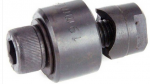
The neatest and easiest way is a sheet metal punch as long as the metal is not too thick.
This will handle up to 1.6mm steel hole punch
View attachment 127728
This is easily the best method for a thin panel. I have a 19mm one which I have used on 1mm stainless sheet. Whatever such a tool will cut through in mild steel needs to be reduced to about 2/3rds or 3/4 for stainless. For the one illustrated, 1mm stainless is fine and it will probably be OK on 1.2mm stainless but I would not consider it for anything thicker.
 
I can get hole saws locally.
But, for now I will measure the thickness tomorrow and come back here with the result in case it makes a difference of what to use.
 
I’ve used tungsten tipped hole saws many times for holes upto 3mm stainless easily, largest I’ve done was 28mm, just keep it cutting slow with pressure
 
Best - panel Punch as above
OK - Hole saw with high pressure and slow speed. If your drill doesn't go really slowly, beg borrow or steel one that does.
Worst - Dont attempt this with a twist drill. It will make a mess of it*

*Unless you can sandwich the panel between two bits of hard wood clamped tightly together and drill through the lot with a drill press. Line up using 6 mm pilot drill holes through each piece of the sandwich. Even then I would want to do a test piece.
 
This is easily the best method for a thin panel. I have a 19mm one which I have used on 1mm stainless sheet. Whatever such a tool will cut through in mild steel needs to be reduced to about 2/3rds or 3/4 for stainless. For the one illustrated, 1mm stainless is fine and it will probably be OK on 1.2mm stainless but I would not consider it for anything thicker.
I have used them (Greenlee make) on Schneider enclosures of 304 stainless 1.5mm thick. It took a bit of effort and leverage but still cut nice holes.
 
Slow speed. Steady pressure, sharp and new, but no special steel for the drill, lots of coolant. That’s the recipe.
 
Finally got to the boat and the thickness of the steel is 1.66mm.

Also I have managed to borrow a pillar drill. So am I ok to go ahead with a hole-saw type drill?
 
One method that works well to avoid chatter is to drill a hole in a bit of scrap ply with the cutter, then clamp the metal between that ply and another bit. Guides it well. Again, as slow as the drill will go and loads of cutting fluid.
Also, you don't need the pilot drill.
 
I have not had much success with standard bi-metal holesaws in stainless but you might be OK with a new good quality one with lots of cutting fluid. I have had better results with TCT holesaws on stainless like these.Starrett TCT
 
I have not had much success with standard bi-metal holesaws in stainless but you might be OK with a new good quality one with lots of cutting fluid. I have had better results with TCT holesaws on stainless like these.Starrett TCT
Depends on the thickness, if thin, then a decent bimetal hole saw.
I used Starret bimetal ones to drill a lot of 50mm holes in 6mm SS. But I re-jigged the pillar drill to half it's normal slowest speed. Not worth it for a couple of holes. I would have used TCT ones, but not then available any where near.
 
Slight thread drift, but I needed to drill a number of holes in 2-3mm SS for strengthening the hounds on my mast, and knew that it'd be a problem, as I didn't have the 'stuff' to do it properly.
I'm staring at this and trying to think of a way around it, when my mobile rang.
An ROV company was interested in hiring me for a couple of days to prepare a very small ROV to take metal thickness readings, and then demo it at a test tank.
"Do you have a workshop with a pillar drill?" was pretty much my only question.
Better than that, they'd 'proper' workshop engineer's, for whom my problem was childishly simple. A day rate was agreed, they put me up in a good enough hotel, and didn't bitch about my bar bill.
Their equipment was 'plug & play' (which they didn't realise), their engineer drilled the holes perfectly in minutes, and the demo was a doddle, so everyone was a winner!
 
Top