Stainless Steel 'corrosion'?

Neeves

Brittleness

https://en.wikipedia.org/wiki/Brittleness

The first line states.

A material is brittle if, when subjected to stress, it breaks without significant plastic deformation. Brittle materials absorb relatively little energy prior to fracture, even those of high strength.

Brittleness and ductility are opposite side of the same issue

Ductility is the ability of a material to withstand tensile force when it is applied upon it as it undergoes plastic deformation whereas Brittleness is the opposite of ductility as it refers to the ability of materials to break into pieces upon application of tensile force without any elongation or plastic deformation.


Now as a general guidance where there are shock loads you want a ductile material that will stand the maximum load that is applied before you get "plastic deformation" (yield point). To increase the yield point you go for a higher strength but in doing so you run the risk of loosing ductility. The sword makers of long ago found composite metals gave a better strength and ductility than single metals

Why do we tend to use nylon for mooring lines and have a snubber in out anchor chains. This is to increase the ductility og the system by introducing composite materials to absorb the energy without forfeiting maximum strength. Overload prevention by reducing the snatch load is another reason.

I agree lifting equipment "should" not be subject to snatch loading, but any one who had worked in a medium to heavy engineering shop will know different.
 
Johnathan,

I am not a metallurgist, but my limited understanding of what I have been told amounts to this:

1. Wrought iron corrodes remarkably slowly in a marine environment. Of course, there is very little of it about but you can get it - when replacing keelbolts on the ex boat I used wrought iron bolts to replace the mild steel ones. Her wrought iron floors were still good after sixty years. Mild steel corrodes faster than wrought iron and higher tensile steels corrode faster still, so the working assumption is that the rate of corrosion is related to the carbon content, but I am sure it's far more complicated than that.

2. Again, this is my limited understanding of what I have been told - higher tensile steels can be more prone to fatigue failure from cyclical stresses, such as wave impact on the side shell plating of a merchant ship, and once a crack starts it can propagate very fast, so shipbuilding is quite concerned, at the detail design level, with crack stopping. If a crack is not stopped, this can happen rather quickly:
BNBRF-uCQAAHMQi-635x423.jpeg


3. There was an episode of fluke failures on merchant ship "HHP" ("high holding power" - higher tensile steel) anchors some years ago but so far as I am aware it was resolved.

4. Ocean going tugs use high tensile chain in the fairleads of the tow, as do SBMs to which tankers secure - and indeed a Smit bracket and an AKD stopper are both made to fit chain. These chains are replaced regularly.

So far as yacht chains are concerned, obviously if the galvanising is sufficiently intact to be working then the corrosion will be very limited; if and when the galvanising has "had it", a higher tensile smaller section chain is going to rust out faster than a thicker one. If you are within easy reach of a chain supplier and have a credit card handy, this isn't an issue, of course. Lifting gear is also subject to certification, inspection and replacement.

I would not expect a yacht anchor chain to be subject to high levels of cyclical stresses. I would be concerned about corrosion rates, though.
 
I would not expect a yacht anchor chain to be subject to high levels of cyclical stresses. I would be concerned about corrosion rates, though.


You cannot galvanised High Tensile chain with conventional Hot Dipped Galvanising HDG. There are alternatives called Thermal Diffusion Galvanising which is conducted at lower temperatures. I know of 3 processes - all based on the original Sheradizing. I have tested the TDG coatings against HDG and provided the coatings are thick enough the TDG coatings have longer life, when abraded on a silicon sand seabed, than HDG. The TDG coatings have a greater hardness than HDG which is advantageous. Though Vyv points out that the exterior (soft) zinc, on HDG but missing on TDG, has positive attributes.

TDG also re-tempers HT chain and extension to break of coated G80 and G100 is around 22% (and some American G30 tested at just less than 15% - having mentioned this - there are no comments about American chain being brittle (or any anchor chain being brittle). Dashew has been using a spruiking G70 for decades, since the 70's, and he continues to use it on his larger expedition motor boats. G70 is very niche but a bit more popular in America than Europe.

What I did not test for is whether changing from 8mm to 6mm (or 12mm to 10mm), and this is the object of using HT chain, resulted in the smaller chain abrading more quickly. My initial thought was that this was a major omission on my part but then its difficult to test for as the smaller chain spends less time on the seabed anyway ('less' catenary) - basically I don't know how you would test - except by using it, which I have been doing since Nov 2015 - though my conclusions will be subjective.

Similar issues develop with G70 and G70 is more commonplace than my 6mm G80 TDG (as there is only one rode so far) - so it seemed sensible to solicit the views of G70 users - who sadly were less than I thought, or less willing to share their experiences.

As far as I am aware commercial ships anchors are all cast, individually. HHP anchors would not necessarily be HT steels - but cast components come under very tight scrutiny of the CS - if anchors failed its poor casting and poor testing - as all anchors would be Proof Tested, even if nothing else.

Jonathan
 
Almost the first professional job I ever did, many years ago, was the failure of a joining link in an anchor chain. A Kenter shackle if I remember correctly. I found that a shipyard had heated it red hot to separate it. It had then been re-used and failed in service. This was a big thing the size of a large dinner plate, and had been hardened and tempered. Heating it converted it from HT to LT, which was why it failed.
 
Almost the first professional job I ever did, many years ago, was the failure of a joining link in an anchor chain. A Kenter shackle if I remember correctly. I found that a shipyard had heated it red hot to separate it. It had then been re-used and failed in service. This was a big thing the size of a large dinner plate, and had been hardened and tempered. Heating it converted it from HT to LT, which was why it failed.

Off topic again but I can remember replacing "old style" joining shackles with Kenters, long ago. A great Step Forward!

Which leads me to another point - does anybody make a good, reliable, joining link in yacht sizes? I've read Vyv's report on his tests on C links and they don't inspire confidence!
 
Last edited:
Which leads me to another point - does anybody make a good, reliable, joining link in yacht sizes? I've read Vyv's report on his tests on C links and they don't inspire confidence!

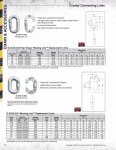
Not sure why that would be the case. Crosby links are perfectly OK, exceed the spec for g30 chain and are used by the ultra conservative lifting and hoisting industry. The only problem with them is the poor coating that has a short life.
 
Not sure why that would be the case. Crosby links are perfectly OK, exceed the spec for g30 chain and are used by the ultra conservative lifting and hoisting industry. The only problem with them is the poor coating that has a short life.

That was the reservation. But I suppose they are cheap enough to be considered as more or less disposable items.
 
Not sure why that would be the case. Crosby links are perfectly OK, exceed the spec for g30 chain and are used by the ultra conservative lifting and hoisting industry. The only problem with them is the poor coating that has a short life.

I have used the crosby riveted links before but was not very happy with the riveting method so welded the link together. This will have affected the heat treatment and galvanizing but I was going to re galvanize anyway.

I note the small print that says :not to be used for overhead lifting

crosby link.jpg
 
But the riveting during fitting will still damage the galvanizing.

The area damaged will be quite small and protected by the near proximity to 'good' zinc.

Its inevitable that as you are going to hammer them together the gal will be damaged, which is why you would galvanise a pair and keep one as a spare. You would skulk around waiting for a re-gal thread to develop (or have a quiet word with someone at Highland Galvanising).

Here - it depends on how many links you are going to galvanise (assuming a very small lot) and the size of the company that runs the gal plant but a few beers usually does the trick.
 
Getting back to the OPs question about staining on stainless steel I would point out this is a common problem. The surface of stainless needs to be passivated after being worked. There are various ways to passivate including electro polishing, polushing and acid treatment. Occasionally in outdoor applications further polishing or passivating is required.
It is very difficult to passivate large structures and if any rust forms it is self propagating until completely passivated. I suspect your handrails will continue to look a bu**er
 
Top