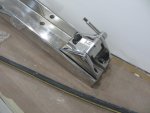
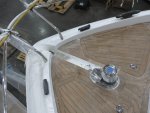
Stainless steel anchor chain

To ensure the anchor comes up the right way round, lift it off the bottom a few feet, then inspect the chain on deck. It must lay in a straight line with at most a 45 deg twist from the windlass to the bow roller. If there is any more than this, then twist the length chain above the bow roller by hand hard whilst lowering or raising it with the windlass to correct the lay. Check it isn't swinging around or turning as you leave the water, if so drop it in bit, wait a sec until stabilised and carry on. It will go easier if the boat is not moving.

Exceptional health and safety procedures, caveats, warnings and exclusions of liability apply here. There is clearly a risk of mega injury if things go wrong.
 
Last edited:
As usual, I don't have anything of much interest to add, however I have noticed that this thread has already attracted nearly 12,000 views!

I hadn't realised that anchor chain could be that interesting.:cool::sleeping:
 
Last edited:
As there appear to be inconsistencies in the ways that the same design of anchor presents itself on recovery on board, I wonder if one of the other components in the process could be very small, but consistent, imperfections in the way that chain is made.

Really big anchor chain undergoes multiple QC checks

https://www.youtube.com/watch?v=z0_hKcPtu-I

but it is neither cost-effective nor practical to check every link in a small chain. The forming and induction process seems to have many points at which an unwanted degree of freedom could arise.

A video in Youtube illustrates the point that a small amount of wear in a die or press could make a small, say 1/2 degree alignment error which would be replicated in successive links

https://www.youtube.com/watch?v=oBS4vzvy1bA

You can spot multiple opportunities where wear could take place and create a natural and incremental 'cast' in the chain as more and more links are made. Have a look at 5:19 for what appears to be a misalignment - which may or may not be critical.


I wonder if any of the big mobo people have hung up (say) a sample 20ft length of chain and seen a tendency for the alignment to be less that normal (i.e. 90.000 degrees) between links, leading to an accumulated error after a couple of hundred links. Enough perhaps to cause an anchor to rotate out of the required and desired approach angle

(Re)- alignment on board takes place at the chainwheel; that's understood..
 
Last edited:
...trip the circuit breaker so I'm reliant on the missus on the foredeck to stop lifting the chain when it gets taut and wait for the boat to settle or point me to move the bow with the engines. The whole idea of her being on the foredeck and operate the winch from there is to ensure that we lift the chain with minimum load on the winch and to direct me to go astern to right the anchor if necessary
. My winch is driven by a hydraulic motor fed by the main sleipner system (engine ptos), so I can be brutal with the winch
 
. My winch is driven by a hydraulic motor fed by the main sleipner system (engine ptos), so I can be brutal with the winch

Hydraulics is definitely the way to go. Unfortunately the rest of us have to fanny around with sensitive electrical stuff:)
 
To ensure the anchor comes up the right way round, lift it off the bottom a few feet, then inspect the chain on deck. It must lay in a straight line with at most a 45 deg twist from the windlass to the bow roller. If there is any more than this, then twist the length chain above the bow roller by hand hard whilst lowering or raising it with the windlass to correct the lay. Check it isn't swinging around or turning as you leave the water, if so drop it in bit, wait a sec until stabilised and carry on

What a faff, why not just fit a "twist"?
 
What a faff, why not just fit a "twist"?
It's actually not a faff at all. It takes a fraction of the time to do than to explain what to do. 5 seconds out of perhaps one in 5 anchor raising events.

With some swivels you have to knock round an anchor that has pulled up the anchor the wrong way round anyway.

I don't have confidence in swivels as I read a good few horror stories of failures. Simpler is better here I think.
 
I have to agree. Set you chain up so that the anchor is the right way round, its a Faff, but you only do it once. Then retrieve and if every time you let the torque from the twists (and gravity) to allow the chain to untwist - you will have no issues but you might need to let the anchor hang with 1m of chain. A Boomerang, bent link will allow you to do it in one smooth retrieve - but if you have patience you can save a few dollars.

In the anchor rode swivels, cheap ones, are the most common point of failure, followed by cheap shackles. There is no point, you are wasting your money - buying an expensive chain if you then use a cheap swivel (and this includes most swivels) and a cheap shackle. You cannot tell the difference in quality for most stainless shackles, unless they are branded. So unless you are willing to buy top quality stick to rated gal shackles and no swivel.
 
Oh, I don't know, it's all good reading. To swivel or not to swivel, to snub or bridle. People on opposite sides of the argument will swear blind that their way is best. Makes interesting reading for an ignoramus like me. :encouragement:
 
Top