Stainless corrosion below the waterline

Trident

Well-Known Member
Joined
21 Sep 2012
Messages
2,872
Location
Somewhere, nowhere
Visit site
If I completely encase stainless in epoxy below the waterline does this make it immune from corrosion as no oxygen can reach the metal (provided that the epoxy does not break down )

 
Not in my view as the epoxy will crack and any epoxy needs a proper grit blasted surface for any epoxy to adhere.

Most stainless is polished and epoxy will not stick for long to polished stainless.

Ensure you have the correct grade of stainless below the waterline all my skin fittings are 316 stainless with no issues as long as the threads are fully sealed with sealent

This is what I did to my steel boat and below the waterline is fine after 15 years in the water
 
Yes I know it needs roughing up and the correct epoxy product (oil rig paint companies recommend epoxy primer, epoxy paint and then a high build epoxy and finally a PU coating) but if that is done is there any way it can corrode ?
 
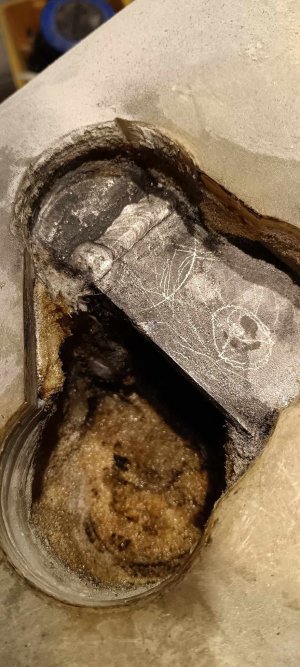
I have just drilled an exploratory hole on my rudder to check the tangs for corrosion. Although there is moisture in the rudder and omotic blisters, the 44 year old 316 stainless steel is in perfect condition. No corrosion at all
 
I have just drilled an exploratory hole on my rudder to check the tangs for corrosion. Although there is moisture in the rudder and omotic blisters, the 44 year old 316 stainless steel is in perfect condition. No corrosion at all


Did you check where the tangs are welded to the rudder shaft as that was where the corrosion took place on my ferro boat GRP rudder due to chromium migration at the weld site
 
But does anyone know the answer to my question?
I can't give you an academic response, I can only tell, you that my rudder shaft has been encased in epoxy and is corrosion free after 44 years. I do however, believe that the stainless steel is a far higher grade than that which is now sold as 316 grade. My experience with new 316 has not been good
 
Last edited:
316 is more expensive than ordinary commercial grade 304, Unfortunately some companies use the cheap stuff & pass it off as 316. Colour code on bar end is red for 304, light turquoise for 316, often plate or flat bar will also be stencilled with the number
I found this some years back when stanchions kept going rusty. I also needed some plate & bought some offcuts from a stainless fabricator not far from here, everything in their scrap bin was 304

I use Speed alloys if i ever need any and you will get what you ask for!

Im not sure about other Marcon boats but too many Sabre 27's had stainless rudder shafts with mild steel tangs welded on. When i split my rudder i found just a 4mm length of weld left on the bottom one & none at all on the top two which were totally rusted away. I can say that rudder failure was iminent!
 
Yes, if stainless steel is completely encased in epoxy and no water or oxygen can reach the metal, it should be effectively protected from corrosion. Stainless steel resists corrosion mainly due to a thin oxide layer that forms when it reacts with oxygen. Below the waterline, where oxygen levels are low, stainless can be more prone to corrosion if exposed to water directly.
 
If I completely encase stainless in epoxy below the waterline does this make it immune from corrosion as no oxygen can reach the metal (provided that the epoxy does not break down )
I did suffer crevice corrosion one time.
Two stainless studs underwater holding a bronze spigot to the GRP deadwood for the prop shaft.
They were tapped directly into fibreglass and were about 50% gone when I withdrew them.
 
Last edited:
But does anyone know the answer to my question?
Epoxy is not impervious to O2 or water penetration. It is used to prevent osmosis as a barrier coat, but it still lets stuff through. The thicker and the more coats the better, but you won’t get hardly anything to last forever. Just look at the Roman Colosseum or the Pyramids. They are ruins and few structures have lasted longer.
 
Yes, if stainless steel is completely encased in epoxy and no water or oxygen can reach the metal, it should be effectively protected from corrosion. Stainless steel resists corrosion mainly due to a thin oxide layer that forms when it reacts with oxygen. Below the waterline, where oxygen levels are low, stainless can be more prone to corrosion if exposed to water directly.
There is plenty of dissolved oxygen in seawater. Marine life exists even at tremendous depths. Corrosion occurs where differential oxygenation occurs, such as crevices and pits.
 
I looked into various epoxies with regard to how hydroscopic the epoxy was (water Absorbtion)

I found epoxy tar was the least hydroscopic but still allowed water to penetrate the epoxy.

My main interest was to protect my mild steel boat from any water penetration to prevent rusting and to ensure paint adhesion to the steel hull
 
If I completely encase stainless in epoxy below the waterline does this make it immune from corrosion as no oxygen can reach the metal (provided that the epoxy does not break down )

If I completely encase stainless in epoxy below the waterline does this make it immune from corrosion as no oxygen can reach the metal (provided that the epoxy does not break down )
I think the answer is that if you encase stainless in epoxy then some water may get through and it likely won’t have enough oxygen to prevent corrosion. Probably not a good idea as without oxygen stainless will corrode
 
This is exactly why I am trying to get a definitive answer

In well oxygenated water 316L stainless will last decades
But for very expensive application they sell paint systems that etch prime, epoxy prime, high built prime and top coat to protect stainless . If that will genuinely keep out all water and air its great but if not it messes with the chromium oxide formation.

So hopefully someone her will know if it really works
 
Top