Spinnaker sheeting

Greenheart

Well-Known Member
Joined
29 Dec 2010
Messages
10,384
Visit site
Ah, October...this is the month when, according to a long tradition, I discuss my keenness to use my spinnaker, late enough in the season to put it off till next year, by which time I need all summer just to get used to the white sails again. :rolleyes:

A few weeks ago I sailed an XOD keelboat with a mate who easily hoisted, gybed and dropped his spinnaker singlehanded as we raced. Unfortunately I didn't watch closely how he secured the tails of the sheets.

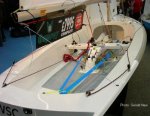
It may not be very relevant to the Osprey's spinn sheeting, since the XOD shares little with the dinghy, having half a tonne of ballast and only about half the Osprey spinnaker's size. But I was recalled to my boat's big blue balloon lying under the bed, awaiting the day I dare to hoist it at sea. Picture below is from an early try without all lines rigged...

Screenshot_2016-12-10-17-41-39_zpsnoaoqllw.png


Looking again at the Osprey's deck fittings, I've had to guess at how it's all meant to fit together. I can make (some) sense of the 'twings' as I believe they're called, which effectively turn the lazy sheets into guys, by routing them close by the shroud-bases...

...and mostly by imagination, I've created a bridle for the pole with port and starboard standup blocks just ahead of the mast, taking the downhaul adjusters to cleats on both side-decks.

But the sheets...I'm hazier there. I guess the tails go to the turning blocks on the aft-deck, then come forward...

...(please forgive the rough sketch over the photo below, and the fact I've coloured starboard red and port green)...

2018-10-01%2020.06.32_zpsyveqztcb.png


...I'm not sure whether the tails should run diagonally as I've indicated there. And, there'll be loads of friction as the sheets rub forward over the edge of the aft deck, down to the fairleads below the camcleats. Also, if my diagram is correct, it'll necessarily mean ankle-snagging lines a few inches off the deck at the helmsman's feet...my feet... :hopeless:

...and, if the lazy sheet (which I believe is called into service as the guy) is cleated on the leeward side of the cockpit, how will it be possible in a sudden gust, when I'm perched or trapezing on the high side, to "blow the guy" in order to ditch the spinnaker's power?

Hard to believe that letting go the twing (or tweaker, or whatever they're known as - it seems to be basically a barber-hauler which diverts the lazy-sheet to deck level), will release enough tension for the spinnaker to blow right round into the shadow of the mainsail.

In situations such as seen below, if the decision is made to "blow the guy", does somebody have to leap across the cockpit (shifting their ballast to the wrong side, where the lazy sheet is cleated) in order to depower the kite? Wouldn't it be beneficial in a breeze, to have some means of de-cleating the guy remotely, from the windward gunwale?

Osprey%20under%20spinnaker_zpsdehpevxt.jpg


Thanks for reading. Accounts of spinnaker-work are always helpful to me, so I'll read all replies with interest.

Apologies if there aren't several photos above, in this post...they were there for a while, but Photobucket is erratic.
 
Last edited:
I'd want the guy next to me, so bring it forward along the edge of the sidedeck, and the sheet coming at me directly across from where I'm sitting, so also brought back along the edge of the other sidedeck. I'd have captive camcleats angled so that getting the sheet in isn't easy, but getting it out is, which would probably mean that you'd be 'pushing' the guy downwards on your side of the boat. Need to play with that to get it right. Tricky on the guy if you're out on the wire - a rotating mainsheet type cleats maybe?

On my keelboat they both come out of the side decks at the front crew's position, and that means I have to sit well forward for the offwind bits when I'm on my own, if I was optimising for that I'd move them back a couple of feet.

I'm not sure I'd be worrying about blowing the guy as a means to keeping the boat upright - spi sheet and main should cover that, but you do want the guy close by for the gybes and the drop.
 
You don't blow the guy to depower the boat in a gust.

Ease spinnaker sheet. Keep easing if necessary, even if the kite rags.
Easing the guy will power up the boat and move the centre of effort aft, making the boat round up more.
 
You need to lightly bribe a friend that can use a spinnaker to come sailing with you on a nice, light day.

Mention to him that you'll be using the spinnaker and he/she will be pleased to come along and impriove your spinnaker line setup whilst you are watching (for next time). There's nothing scary about a spinnaker broad reach on a light day and it will be a revelation to use one with an experienced person who isn't scared of it.

I started using spinnakers about the age of 12. Huge, nasty things and bad tempered too. That mirror dinghy had the world's biggest and bad tempered spinnaker in a force 4. A couple of years later the spinnaker on the 505 and International 14 were no problem. Mind you, there was a bit of swimming in that time :)

The more you use the spinnaker, the better you'll get and the more confidence you will develop. Having a regular sailing partner helps too: you will learn to do things together and work as a team, halving any hassle. Soon you'll look forward to 'taking on' a spinnaker on a blowy day, knowing that it is you in charge of it.
 
The rigging is about right.

You would normally have a rope that runs across the dinghy from shroud to shroud. The rope would pass through a cleat each side of the shroud and then to a ring through which the sheet or guy pass. This enables you to pull down the rope to the spinnaker on which ever side the pole is rigged so the guy is not in your way on the trapeze. Also the sheet and guy would usually run through a block with cleat on each side of the centre seat. It looks like there may be some blocks there already. This is so the sheet runs across the dinghy to the crew. You can see in your photo how the guy is pulled down to the deck. There may even be some tackle on the deck, but it isnt clear in the photo.

This setup is pretty much the norm for any dinghy and works great. Adding a couple of ratchet blocks each side of the seat is usually a very good idea as the loads, especially on an Osprey, are reasonably large in anything above a F4.

Easing the sheet, sometimes dramatcially, is the way to depower the spinnaker, as well as hopefully the helm bearing away (sometimes dramatically) in the gusts.

Rigging to enable the height of the pole to be adjusted is common, as is some form of pump up for the spinnaker hoist, especially if racing.

While techniques vary, usually the helm hoists the spinnaker, the crew engages the pole and immediately sheets down the guy and pulls the guy back through the cleat so the pole is at the correct angle, makes sure the sheet side is uncleated, grabs the sheet and off you go. Gybing consists of releasing the guy by the shroud, taking down, or end to ending the pole, enacting the gybe, pole out, pulled back and cleated, and powering off on the new gybe.
 
PS - you will need somewhere to put the chute. I cant see from the photo or recall (I have sailed an Osprey) if they have a spinnaker chute. If not, then bags are the norm each side of the mast. Where you have the option, bags are usually seen as more efficient (for example you will not see many Fireballs with chutes), but chutes are probably easier to use for the novice crew. Chutes also tend to take some water down the chute and are much harsher on the fabric of the spinnaker.

PS the Osprey is a lovely dinghy, the only drawback is its weight, so as long as you have a good spot to launch its superb. I am sure you enjoy her very much.
 
How about joining the Osprey association and ideally going along to one of their open events (or the RYA Dinghy Show in March) to discuss with other Osprey sailors and see how they set things up.
It would be fun to have a browse, even if you decide to do things differently. Whilst the latest boats will be set up in grand prix mode, many of the sailors are enthusiasts and familiar with the classic Osprey boats and setup as well.
Wheel reinvention is an inefficient process, whereas looking at others experience can make life easier
 
Dan

Obviously this is for a Fireball so there are some minor differences but everything is the same in principle.

http://www.draycotewater.co.uk/fleets/fireball/html/rigging__articles___info.html

You will need twinners...if you don't you can't hold the pole back off the forestay, and the guy will also get in the way of where you are sitting...especially if you trapeze.

You want one continuous sheet, not two. The FB article was written a few years ago and tech has moved on a bit. I now use Excel Fusion 7mm, tapered down to reduce weight (so the kite will fly in a zephyr rather than the clews being weighed down by the sheets). Buy it from a yacht chandlery as it will be much cheaper than a dinghy place. Or try Ian Turnbull at rope4boats and tell him Iain C sent you. He'll do the tapers for you if you want too. You need 60' for a Fireball so probably more for an Osprey.

Good luck.
 
As others have said, the two sheets should run straight forwards along the side-decks, not diagonally. Often this would be under the side-deck but your setup doesn't seem to allow that. They then need turning blocks somewhere in the vicinity of the jib turning blocks. The guy is cleated, and you play the sheet across the boat, with the option to cleat it too if desired. It looks like you need to fit all this hardware.

The small block to port on the floor is probably for the halyard, allowing the helm to hoist by pulling upward.

You also don't seem to have any bags to recover the kite into, these would normally go on either side of the mast, so you can grab a clew and stuff the sail into the bag. It should then be possible to hoist directly out of the bag.
 
Gentlemen, I'm very glad I asked. So much clarity in just a few replies, I'm very grateful.

I was wary of starting the thread because it must appear that I keep asking without learning, and that I don't really want to learn. That's not the case...I can only plead failure of comprehension, owing to the system's inherent complexity…although it starts to feel simpler after reading your replies.

Looking at photos of dinghies under spinnaker, I'd noticed that the tail of the guy is often trailing in the water, not under tension...which strongly suggested that it doesn't get cleated on the windward side of the boat as I had assumed, and hence never needs anyone to go across to uncleat it, to 'blow the guy'...

...the simple answer which I wouldn’t have thought of, is fabulously clear in the photo in Iain's link…bobbles to stop the guy running free...hence no need for extra cleats, and the twing controls the guy, and the tail of the guy trails in the water as often observed.

You don't blow the guy to depower the boat in a gust...Easing the guy will power up the boat and move the centre of effort aft, making the boat round up more.

Thanks BBG. Actually I was recalling (and misinterpreting) some very sound advice you gave me a couple of years back…

If all goes bad you just blow the guy and the halyard and pull in on the sheet and in 20 seconds you will have the kite in the boat again.

…so I was thinking the guy shouldn’t be locked-off on the leeward side-deck…but thanks to the bobbles, it doesn’t need to be.

You would normally have a rope that runs across the dinghy from shroud to shroud. The rope would pass through a cleat each side of the shroud and then to a ring through which the sheet or guy pass. This enables you to pull down the rope on whichever side the pole is rigged so the guy is not in your way on the trapeze.

Interesting. I had inferred the purpose of the lines, one each side, and I arranged each with a nice (overweight) ball-bearing block through which the guy could run freely, yet be hauled down to the deck beside the shroud bases (thank God those fairleads and cleats were already in place, or I’d really have been at sea)…

…but it hadn’t occurred to me to use a single line for both – is that to make either side de-cleatable from the opposite deck, if it hasn’t already been freed? I can see it helps to keep them within reach and a single twinning line won’t so easily go astray.

I've switched the blocks for antal rings too. Actually, I can now remember finding two small stainless rings amongst the kit that came with the boat, but I've long since mislaid them.

Regarding the bag/chute question, I've given up on making it easier by retrofitting socks and chutes where Ian Proctor didn't intend them to go, at least aboard the mk 2 - I'm content to try using a bag. I'm only going to dare to hoist the spinnaker in very gentle breezes, so I expect some considerations which mitigate difficulty in windy situations, are slightly less likely to be necessary.

You want one continuous sheet, not two.

I believe you, but why?

Thanks for the tip, re. ropes and Ian Turnbull.

The Fireball descriptions and photos in that Draycote link, really help a lot. I was surprised by how many twists the sheet takes in order to stay within reach without getting in the way. I'm thinking maybe I should redirect my sheets so they don't criss-cross under my feet in the cockpit...though that's a lot of cash on new blocks, to clear the deck for force 2 situations where there won't be much risk.

I'm off, to look at the boat. Thanks for all the advice. :encouragement:
 
As others have said, the two sheets should run straight forwards along the side-decks, not diagonally. Often this would be under the side-deck but your setup doesn't seem to allow that. They then need turning blocks somewhere in the vicinity of the jib turning blocks. The guy is cleated, and you play the sheet across the boat, with the option to cleat it too if desired. It looks like you need to fit all this hardware.

Right...that makes sense...I'm still only just seeing how it ought to be...but if the sheets should run straight back along the same side-deck, I wonder why the fairleads on the floor aren't close to the cockpit sides? That's what made me think the sheets should run diagonally forward from the turning blocks - because the fairleads are on a nearly-straight line across to the opposite camcleats.

I'm off to the boat for a think.
 
This is how mine is. The sheets come out of the side deck by the after pair of camcleats (the forward ccleats are for the twinning lines which weren't in at the time). What you can't see is that they come round a pair of ratchet blocks before emerging, so it's generally only the guy that actually gets cleated. When I'm on my own I have to use a foot to jam the sheet if I want/need to.

The sheets are one piece continuous and I have mixed feelings about it. Good because we know that it's the red rope and having picked it up it's soon apparent which end you'll be wanting to play with. Bad because when we want to pull the whole lot round to change sides hoisting on the other gybe there's a lot of friction and there's always someone standing on it.

atMS8c2CP4zIhPO8V1D0-B1EZ7_2eJ7iIpcO01VBF92COzDZe97J8uFRH1vLDKIprnkFSVmofiPrNvTK9LvyQzRh9ftkeyosIhi4PWWim5f_z9ourtAVvhfTZMIiB9LdzWbGSAXslckwQktYvo3XiRqK_wcJ0_k9x1IHSkHu22bih3uJvsmQCdWaGYPC6lbiQMtPlI3R0Q2KAL40om0vOkv4O3KYeeMXsjKtvQFNrdO4LU7Sp9zydSGBt7fLW80PCikujSBJyNPMVhmmzExW6MsFjPu8eunp08WjpuorX_sQZzUfXPbpIRVn2ck7Lztx1HX3YmcKKWfm9OBSEnMdq8o2_e0vnm9j7ZLEHImmAxGLqZY12VFv8BkbVe3J5NeJgtLhp1NYxSxq0iCcqWAFvwo3iNG9cOPUpyI76yIFk9MI7Pf7oW7yfHMlkq68Cn14vd9sXCtTUV2LvN_lT74mCtBEywgVgz-uLc80TWawATNCnaVgpKtjjGNvSq5u0BKuq0UEVJVvVJYSbM1vEwwJ9HDFCCQQmS5bIS1ZzDGJiSS5yzozNHb580Ao_YPutpFHAV6j0S_CBv8vNn7z-jq5a6FZ1knkKdDa_oGIA56gb6K-ooUDWnaDedYiS9YliXA=w426-h758-no
 
The twining lines are continous for exactly the reason you have said - they can be "handled" from either side and flicked out of the cleat to release the guy (for example before gybing) and thus it avoids an end getting lost somewhere in the dinghy.

The guy and sheet are usually continous for exactly the same reason. You can always grab a bit of the rope where it goes through the block by the seat and thus have control over both the guy and sheet because it is a continous piece. Also I guess it prevents the end being 'lost" somewhere on the floor of the dinghy. Finally, overall it probably makes for less rope and the absence of ends to get taggled up on the floor.
 
Thanks for this. I'm getting there...

...a few minutes looking at the cockpit this afternoon, and with the benefit of you gents' advice, it all started to make sense.

Mainly, I had to reverse the lesson I'd unfortunately learned, that one basically cleats the sheet off and focuses on tweaking the guy.

As soon as I realised that the sheet should be available for continuous adjustment, the diagonal tripwire made no sense because in that case, the camcleats above the blocks aren't the reason the sheets are led there...they're actually taken to the blocks so the sheet is available to the paws of the crew opposite. That really hadn't occurred to me. So, something like the red rope in this mock-up...

20181002_182404_zps5en7pvs7.jpg


...sorry, lousy photo, but it was going dark. The sheet comes forward from the aft turning blocks, along the sidedeck to the thwart...then through another block, and straight across the cockpit to be held by hands there. Which only led me to wonder, what are the cam cleats for, directly above the blocks? And, shouldn't there be an option to cleat the sheet on the windward sidedeck?

Below, amid the mess, is a section of my pole-downhaul. Is it as and where it should be? I couldn't fit the pole bridle in the pic.

20181002_182610_1538513412108_zpsv95ptixf.jpg
 
That's looking better, and seems to fit with other Osprey thinking. Shame about the lead over the aft deck, but some slippery tape as used on bicycle chainstays etc might help. It would be nice if the last blocks had ratchets.

med_dinghyP1000659x600.jpg

The camcleat above the block is for the guy so that you've got a really good upwards pull before you cleat it.

Pole downhaul looks fine, but obviously will be angled fwds a lot once attached to the middle of a bridle.
 
Thanks BBG. Actually I was recalling (and misinterpreting) some very sound advice you gave me a couple of years back…


…so I was thinking the guy shouldn’t be locked-off on the leeward side-deck…but thanks to the bobbles, it doesn’t need to be.

I think you really need to go out with someone who knows how to fly a kite. In specific response to "blowing the guy"
- if you are in danger of rounding up you ease the spi sheet and if necessary the main sheet.
- if you have broached and everything has gone tits up, and you need to get rid of the spi, you can grab the sheet, blow the guy and halyard and pull in the sheet as hard and fast as you can, before the kite gets wet
- neither the sheet nor the guy should ever have stopper knots in them, nor "bobbles". They have to be free to run - all the way out if necessary. That is why it is a good idea to have VERY long sheets. It sounds like a typical arrangement on your kind of boat is to have a continuous sheet.

As someone said earlier in the thread, find someone who knows how to fly a kite to go out with you. There is no need to try to re-invent the wheel. It has all been done before. Alternatively, find someone else with your kind of boat and offer to go out with them.
 
Agreed, I need to sail with someone who's used all the spinnaker kit before.
I'm just keen to understand the principles (and equip the boat) in advance.

...neither the sheet nor the guy should ever have stopper knots in them, nor "bobbles". They have to be free to run - all the way out if necessary.

This sounds smart to me - but equally, I had been reading and believing the description on the Draycote Fireball site...

Bobble%20explanation_zpsmvncdo17.jpg


...and it seems to me to explain the fact that I often see the tail of the guy trailing behind dinghies...I guess the twinning line is holding the windward corner of the sail, and the whole length of the guy behind the bobble, is slack.

Anoccasionalyachtsman has above explained why my camcleats are positioned above the block...the point being, I had thought they were positioned there for cleating the sheet, not the guy...so, now that I see my boat was set up to have the guy cleated (whilst still being adjustable, it being on the windward sidedeck), there is as you say BBG, no need for a stopper in the sheet/guy.

I'm getting there. My misleading diagonal assumption in post 1, really derailed me.

One thing I think nobody has answered yet...

...is there a reason not to use shockcord as the pole uphaul? I figured that the sail will mostly create lift, so the downhaul is the part that will need to be worked against the pole's upward inclination...so why complicate the system with another adjustable tackle which makes the pole do something it wants to do anyway? Shockcord takes up the slack, so I only need a downhaul. Wrong?

Link to that Fireball site: http://www.draycotewater.co.uk/fleets/fireball/html/rigging_-_spinnakers_-_common_.html
 
Last edited:
OK - never sailed a boat like that so maybe that is the way they rig that up.

Another reason to go out with someone who knows how to rig a kite on your kind of boat. As I say, if you can get onto someone else's boat and see how they do it, you will learn a lot.
 
Shock-cord would be fine for the uphaul if it went to a ring, not sure how well that would work with a bridle. Where will you stow the pole? If along the boom, will the shock-cord try to launch the pole?

I foresee two problems with the bobble/twinning system:
- The bobble only holds the guy in one position (at the forestay), you therefore need to cleat it to bring the pole back. Given this, why not just always cleat it?
- You will need additional slack in the guy to get the sail into a bag at the mast. With a bobble this would require a very long twinning line (at least reaching the forestay).

One reason you may have seen guys trailing in the water is that some (smaller) dinghies have clam cleats at the shroud bases instead of twinning lines. As these hold the guy tight there is no need to cleat the tail.
 
Shock cord isn't a good idea for the uphaul. It's remarkable how quickly a boat will stop with the pole attached to the mast at one end and the other in the water, jammed back against the shrouds. Trust me on this.
 
Top