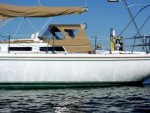
Solid sprayhoods

I didn't want to divert the thread on sprayhood canvas so....Has anyone made a solid sprayhood/dodger/cuddy - call it what you like.

TimBennet posted "... you can make the sprayhood (at least) out of GRP or aluminium. Replicating the panel lay out from a canvas one makes them the most aesthetically pleasing (IMHO), although with more flat areas like the Halberg Rassey ones, allow you to use real glass which increases their hassle free longevity even further."

I wondered if anyone had tried this, and with what success? If so, how did you do it? And if you haven't done it, how would you go about it?

I saw them being advertised by Vetus (in a yotmag) but they de not figure in their catalogue. They have a range for popular boat models.
 
Bobc
The only thing is I would put ply around the windows so that I can bolt the windows in if you wanted to.

You can bolt through fibreglass which would be the thing to do. Or do you mean screw? In which case embedding ply would give you something to screw to but that would not be as strong. if it is to take some heavy weather I would recess the window frames in the mould, have plexiglass windows cut to the size of the recess then bond in to make an invisible flush join.
 
Salar

"I would recess the window frames in the mould, have plexiglass windows cut to the size of the recess then bond in to make an invisible flush join."

I would do that too but I would use toughened glass. (I'm having 4 made up right now for the fore-cabin)

As far as the timber around the windows was concerned we were both talking about a cored f/g dodger. And you can't bolt the window onto a cored laminate as the core will crush. So I thought I would put some marine ply into the laminate instead of core material around the windows. The alternative would be to lay up extra 4 or 5 layers of CSM to to give the window something substantial to bolt onto.
 
Last edited:
Bobc

I've done lots of fiber-glassing and I'll go along with what you saying: my approach will be similar. The structure you are suggesting would be light and stiff. I'd give special attention to how it was attached to the coach-house as I would want it to detach without doing doing damage in the event the yacht taking a freak wave over the deck. The only thing is I would put ply around the windows so that I can bolt the windows in if you wanted to.

I have read that if you want to sail in tropical/hot climates the dodger needs ventilation at the front and the top otherwise it becomes intolerably hot. (I have two Houdini hatches (500mm X 500mm) spare so I'll put use them)

https://www.google.com.au/search?q=...a=X&ei=QXRyVMafM8bsmAWcjoGoBQ&ved=0CAYQ_AUoAQ

https://www.google.com.au/search?q=...d=0CAYQ_AUoAQ#tbm=isch&q=solid+yacht+dodgers+

https://www.google.com.au/search?q=...UoAQ#tbm=isch&q=canvas+yacht+dodgers&imgdii=_

You're absolutely right about putting wooden pads in. If you bolt through foam sandwich, you can crush the foam, and if you screw into it with self-tappers, you've only got a couple of layers of lam to bit into. The way to do the pads is once you've got the outer layer laminated, you turn it over and where you want the wood pads, you cut the foam out and glue hardwood (or ply) pads in before laminating the inside. Again, that's how you put things like shroud plates and pads for fittings into a dinghy hull.
 
Bobc

You obviously have "been there/done that". What are your thoughts about fixing it to the deck/coach house?
 
Bobc

You obviously have "been there/done that". What are your thoughts about fixing it to the deck/coach house?

I would probably put a lip around the inside of the bottom edge or make up some tidy looking brackets, and then bolt it down and glue it down with Sika.
 
Bobc

Maybe I worry too much as the dodger needn't be all that "exposed" ( It need only be 3 ft above deck) I can use brackets as you suggest to secure the dodger as there are plenty of ply inserts for winches, cleats in the deck as well as the bulkhead that I can pick-up. Cheers
 
I have made a few of these over the years and find the following a good way to get things started in the right direction.

Design:
Take a few pictures from the side and rear of the boat, blow them to A4 size and print them on plain paper in black and white.
Now take a pencil and do a few drawings of what you think you need.

You will soon realise that what you thought looked cool in your head looks **** on paper, but after a few more sometimes small changes it evolves into a more practical and better looking article.

Try to duplicate angles and structural features that already exist so the new section will blend in and look like an add on.

Construction:
It needs to be both strong and light with perhaps a few enhancements to improve the look and practical use or refinements.
By using a foam core you get better insulation, less noise when it rains, and best of all no mold too build.

Here in Oz and in the tropics we rarely need a windscreen or even side protection, they slow down the air flow. But you can add clip on side panels and a roll down clear forward section if you think you need one.

A good foundation is critical so we installed 50 mm stainless steel thick wall tubing for the angled uprights and top box frame, then a grid of 25 mm stainless tubing inside that.

We Started with sheet of 'closed cell' foam about 15 mm thick, placed between two timbers to get the right curve, this was glassed with an epoxy and a few temporary braces to control the shape. Flipped over and more foam added to what will be the top side was added to the edges at the front and both sides. This was to prevent any rain running off and blowing into the cockpit. The foam was simply stuck to the existing foam, rounded to shape with a sander ready to glass.
Cables for speakers, lights and antenna were run in small tubing inside the foam. we also added a shelf to store life jackets. The two rear support poles doubled as water collection pipes from the gutter, water being stored below deck in a tank with overflow vent, used for washing the deck via an installed pump.
To enhance the look of the structure the foam on the top sides was thicker ant the front and tapered to almost nothing at the stern with a nice rounded front and edge.

Next the epoxy cloth and resin was added to whole structure, then a thin layer of micro balloons and a good sanding down followed a coat of long chain polymer Two part paint.

I should point out that this new cover was required because the original cockpit cover was destroyed in a Cyclone. We have since had some pretty severe storms but no sign of any damage.

Good luck and fair winds. :)
 
see post #50.

Thanks for that.

I have no problem with your method. I made all my hatches by making a female mold out of MDF (or ply). I then waxed the mold, layed up 3 CSM then used Divilette (a paste type resin) to attached the divynycell core to the lay-up and then layed 2 CSM over the core. The hatch covers are incredibly strong and I'm certain a heavy person could jump on them without doing damage. If you want strength then a core is the way to go.
 
I saw a very pretty and well made hardtop on a catamaran that the owner said had been the feature of a PBO/YM write up a few years ago. I think that one was foam cored with a gelcoat outer and flowcoat inside finish and the article covered all the stages in the making of it. The boat name was Rumpleteazer and it was an Aristocrat Catamaran. I think he made the mould and a GRP shop laminated it all up to a high standard but there will be god tips and I imagine there are not many GRP units geared up to do this sort of one off, so maybe useful contacts also. I think the cost in total was £1000, but this also had opening hatches built in but this was pretty wide and large, being a catamaran. (PBO July 2009 by John Waller is the article 5 pages.)
 
Last edited:
Doesn't anyone sail with their sprayhood folded down on nice days? Bit like owning a convertible sports car and never lowering the roof. Solid dogers are for sissies who secretly hanker for a MoBo. :)
 
Doesn't anyone sail with their sprayhood folded down on nice days? Bit like owning a convertible sports car and never lowering the roof. Solid dogers are for sissies who secretly hanker for a MoBo. :)

In the N uk I think a hardtop/sprayhood is necessary apart from the odd fine day when yes it would be good to get the top down. It probably depends also on the boat-perhaps a larger boat where you are several feet above the water it become less of an issue i.e. not getting waves in the face!
 
Top