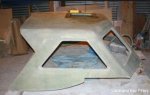
Solid sprayhoods

Both the two I've seen were made by returning circumnavigators.
Both had done the same using the sprayhood frame and clothing it in thin ply as a former and then GRPolyester with gel coat on the outside, To ensure fairness of the gel-coat they'd used cling film.
One was on a Rival 36, the other a hard chine steel boat, both improved the look of the boat and both had multiple curves as one would expect from a canvas sprayhood.

V interesting. Hadn't thought of using the existing frame as a former.

Never done this, so I'm guessing here (advice from a GRP worker would be helpful)..... you'd 'wrap' the existing frame in thin, bendy ply panels which you would tack together temporarily with tape?
What's the next step? Do you them cover the outside with GRP, then gelcoat. You now have a solid structure( when it's dry). Then remove it from the frame and cover the inside with GRP and gelcoat?
Is that how you would do it?
Is ply the best stuff to make the core?
 
The solid spray top or aka hard top has been making pretty boats look ugly since 1855, just take a look at a Hallberg Rassy 48,54,55,62,64. Similar size Oysters which They will have you believe are dry boats" dont have hard tops. These Oyster crews wear drysuits to keep warm but in no means dry in the face.

So why have a hard top: sail over to 'live-aboards' and they might say " it gives you another room", "its of no worry when a gail comes through" the head room isnt wonderful but its dry and safe'
 
I've considered it as I hate canvas ones, and I think that if I ever do get to go cruising properly, I'll make one before I go.

I would make it from closed cell foam (Dyvinicell), something like about 10mm, and then laminate it with 3 or 4 layers of 300g glass mat both sides, then fair and paint (the same way as you would build a foam sandwich boat).

I'd start by drawing some plans and then making a softwood/plywood jig to built it over. then you cut and shape the foam (with a stanley knife and sandpaper), and tie it onto the jig with thin copper wire. Once you have all the foam on (and glued together down the joins), you simply laminate the outside with your 3/4 layers, then take it off the jig, trn it upside down, and laminate the inside. Then once it's all cured, cut out the holes for the windows, fair it (with hibuild), and spray it.

Simples.
 
what a nice looking craft!
Thanks!

Here's another couple of pics that show her better

phoenix_under_sail.jpg


e210a1cf5356ccb408128fedfc1908e4.jpg


Anyway, back to the OP.... We have a bimini that clips to the trailing edge of the dog house, and is far enough below the boom, that you can comfortably sail with it up.... mainsheet is behind the back of the bimini, and foresail sheets are also located aft of the cockpit.... best of both worlds... like a deck saloon or pilot house, but removable!
 
Phoenix - nice little ship! Puts me in mind of the smaller Nic' 38'.


ov..... I'm no expert but have seen some expert jobs and some bodge jobs done ... some thoughts....

How about Roger 'the dodger' - excuse the pun - for advice? http://www.thesimplesailor.com/video.html

I like some of the glass upside down fish bowls for a good view all round? Anything useful on here?https://www.google.co.uk/search?q=a...NXVMI2LaM3RgZAD&ved=0CFkQsAQ&biw=1113&bih=735
PBO has been doing a whole series of good articles on fibreglass etc etc....

Some of the F/G companies like West System do some very useful videos. http://www.westsystem.com/ss/how-to-use-demos/

If you want to do it in F/G there are a few ways of doing it. Will you cover a former and leave it like that. Will you build a plug or male or female mould etc.....

To get real strength long term have you considered bonding the hood to the existing GRP of the deck etc..?

S.
 
Last edited:
Over at SailingAnarchy on the web

there are photos of ugly boat

ugly dodgers too (sprayhoods)


Only ask questions on SA if can provide the required photo !!!!

Hint t***

Made our (dodger sprayhood that is)

from ugly 3 mm plywood (door skins) cheap too

and then stood back a way and observed just how ugly it was...

3 alterations later it appeared less ugly and more as though it were built along with the original design of the boat.

Carted the reinforced (with wood 2 X 2 inches reinforcinbg marked do not use) to the welders
(don't ask about the deck section model we had welded up - lucky we visited the welding shop before it was completed!)

Get quotes on making in 3 mm aluminium....

Cost about 1000 UK pounds.

What I learned

(1) the front window could be expensive unless flat ( bending polycarbonate acylic or glass !)

(2) a solar panel could be aded to the top (ours is a 40 watt Kyocera in a aluminium frame with 12 mm acrylic protecting the solar panel from winch handles and feet while reefing)

(3) height is very important (a) standing height under (b) lower than chin height so that vision is over for some/ all / most of crew )

(4) add hand holds (stainless on outside - beware some do not have room for a gloved hand)

(5) add wide feet to structure in places wheree it can be bolted down ( our webs are over the acorn nuts welded into deck during construction) Use 1/2 inch or 12 mm bolts at least 3 each side with huge backing plates if not a metal boat)

(6) Powder coat entire structure before adding glass/acrylic/polycarbonate

(7) If glass research toughned and laminated

(8) Stand back and admire and hope not to added to the ugly boat collection on SailingAnarchy
 
Last edited:
Solid Sprayhood

I made mine a couple of years ago.
P7010072.jpgP7010080.jpg
I put masking tape on the cockpit and deck and put 2 layers of 2oz as a strip to form the bottom flange of the sprayhood. I then used 18 thick chipboard cut to the profile of the old tubes helb in place with 2 x 1 wooden battens. I then used small screws to fix 3 thick hardboard to the chipboard.Body filler at the corners and sanded to the right profiles with a angle grinder.
Coated the outer surface of the hardboard with 2 layers of 2oz mat.
I then lifted off the structure from the boat, trimmed the chipboard to leave it about 30 mm wide and radiused the corners and filled the inside corners with body filler. Applied 2 layers 2 oz to the inside . I should have used a temporary strip between the back 2 corners to stop it spaying out!
Cut out the window openings and sanded the whole lot down.
Applied 2 coats white flowcoat.
Fixed 3mm thick perspex into rubber window seals.
The chipboard and hardboard remain as the core.
The whole lot was then bolted down to the deck.
It does make a great top to the cockpit.
I've since added a canvas cockpit extension.
 
Last edited:
V interesting. Hadn't thought of using the existing frame as a former.

Never done this, so I'm guessing here (advice from a GRP worker would be helpful)..... you'd 'wrap' the existing frame in thin, bendy ply panels which you would tack together temporarily with tape?
What's the next step? Do you them cover the outside with GRP, then gelcoat. You now have a solid structure( when it's dry). Then remove it from the frame and cover the inside with GRP and gelcoat?
Is that how you would do it?
Is ply the best stuff to make the core?

Straining the memory - the one I remember best only had gelcoat on the exterior and the interior you could see the original SS tubes covered by csm and polyester which was then emulsioned over.
Because the operation was carried out in the W Pacific (ironically because he couldn't source acrylic canvass), he had to make do with locally available materials and the 2mm ply became, by default, core material. The windows, being acrylic, could only have a curvature in one plane, manipulated over a former using a hot air gun (her hairdryer). That last was the least pretty part of the structure, his preference, in a more sophisticated area would have been to use car windscreen and windows from local breakers and rubber mouldings.
 
I made mine a couple of years ago.
View attachment 47185View attachment 47186
I put masking tape on the cockpit and deck and put 2 layers of 2oz as a strip to form the bottom flange of the sprayhood. I then used 18 thick chipboard cut to the profile of the old tubes helb in place with 2 x 1 wooden battens. I then used small screws to fix 3 thick hardboard to the chipboard.Body filler at the corners and sanded to the right profiles with a angle grinder.
Coated the outer surface of the hardboard with 2 layers of 2oz mat.
I then lifted off the structure from the boat, trimmed the chipboard to leave it about 30 mm wide and radiused the corners and filled the inside corners with body filler. Applied 2 layers 2 oz to the inside . I should have used a temporary strip between the back 2 corners to stop it spaying out!
Cut out the window openings and sanded the whole lot down.
Applied 2 coats white flowcoat.
Fixed 3mm thick perspex into rubber window seals.
The chipboard and hardboard remain as the core.
The whole lot was then bolted down to the deck.
It does make a great top to the cockpit.
I've since added a canvas cockpit extension.


very, very good. Looks nice to me. When you say 18 thick chipboard, I assume you mean 18mm. If so, isn't that quite difficult to bend to shape?
 
Sorry , yes the chipboard was 18mm thick.
The chipboard was used as the frame to give the curve that the tubes would give to a canvas sprayhood. Only the outside curve was cut out on the sheet first. Then the hardboard fixed to the edge of the chipboard and grp applied to the outside. The inside curve was cut when it was off the boat.
The hardboard was used to give the curve of the canvas.
Forgot to mention that I did grp tab the frames to the hardboard on the inside before lifting it off the boat to give it some strength.
 
if you put a canvas hood up as normal then brushed on the resin would it not set hard enough to lay up matting on ?

imho.....
I think there's something in that. if the canvas was covered in a protective sheeting (?) and then a wax applied (?) the original canvas hood, if of a suitable shape, would act as the mould / plug.
I do still have concerns and as already mentioned by another poster, that perhaps if there are survival requirements to be considered for ocean sailing, then strength, methods of attachment and shape to streamline off the big waves may be major considerations.
I'm not afraid of GRP work but did get an expert in the trade to advise and oversee every step on laying up fresh epoxy and grp on my deck after taking off the teak. It can work and be extremely successful so obviously get experts in the trade to advise when dealing with the materials chosen.
S.
 
Last edited:
imho.....
I think there's something in that. if the canvas was covered in a protective sheeting (?) and then a wax applied (?) the original canvas hood, if of a suitable shape, would act as the mould / plug.
I do still have concerns and as already mentioned by another poster, that perhaps if there are survival requirements to be considered for ocean sailing, then strength, methods of attachment and shape to streamline off the big waves may be major considerations.
I'm not afraid of GRP work but did get an expert in the trade to advise and oversee every step on laying up fresh epoxy and grp on my deck after taking off the teak. It can work and be extremely successful so obviously get experts in the trade to advise when dealing with the materials chosen.
S.
IMO I think some are over-thinking/worrying about this aspect.

If you are in a modern'ish grp yacht on which the sprayhood (dodger) is an afterthought/extra (i.e. it makes life more comfortable to have one in adverse/unpleasant conditions) then it does not matter a jot if the whole thing is swept away - the integrity of the coachroof should remain, it just becomes more disagreeable for the crew to be exposed to the prevailing conditions - but this itself is not uncommon in ocean racing.

Going back a bit in time, in the case of the Smeetons, the construction of their (wooden) yacht meant that the doghouse-type coachroof was a weakness and rupture/loss of that compromised the integrity of the yacht - I can't recall reading about a modern, ocean-going, GRP yacht being affected in the same way by a breaking sea (I expect to be corrected :D ) - hatches, washboards maybe, but not the coachroof itself.

Having said the above, I've admired many a yacht with a well-designed 'hardtop' and can see the attraction for everyday use.
 
MDF makes an excellent mould and you can get "bendy" MDF for curves. You would need to make a female mould with MDF in a frame. The inner radiuses would be formed with plasticene, you can get a tool to make the fillet consistent. The MDF will need a good release agent and expect to dismantle the mould to get at the finished item, but it is ideal for a one-off. All the extra mouldings for my Harley 25 were made that way http://harley25refit.blogspot.co.uk/2014/01/at-last.html by the guy that is currently building an impressive fishing cat in his shed. It is a long thread but the method is described here http://www.worldseafishing.com/forums/threads/new-project.1976015/
 
There are two circumnavigators in our club (Sweden) and both of them simply GRP'ed over the whole canvas sprayhood canvas and all. The blue canvas makes a good headlining for the solid sprayhood.

After all there is no point in keeping the old sprayhood if you intend to use a solid one.

No doubt carefully blue tacking narrow strips of plastic sheet to the canvas will allow it to be dismantled and stowed away for re-sale.

Just remembered there is a HR Monsun in RÅÅ museum. It was donated by a quite famous Swede when he retired after a few non-stop circumnavigations. He did exactly that to glass a sprayhood from the old. Name was Kurt somebody can't recall. No doubt there are photos on the HR Monsun web pages.
 
Bobc

I've done lots of fiber-glassing and I'll go along with what you saying: my approach will be similar. The structure you are suggesting would be light and stiff. I'd give special attention to how it was attached to the coach-house as I would want it to detach without doing doing damage in the event the yacht taking a freak wave over the deck. The only thing is I would put ply around the windows so that I can bolt the windows in if you wanted to.

I have read that if you want to sail in tropical/hot climates the dodger needs ventilation at the front and the top otherwise it becomes intolerably hot. (I have two Houdini hatches (500mm X 500mm) spare so I'll put use them)

https://www.google.com.au/search?q=...a=X&ei=QXRyVMafM8bsmAWcjoGoBQ&ved=0CAYQ_AUoAQ

https://www.google.com.au/search?q=...d=0CAYQ_AUoAQ#tbm=isch&q=solid+yacht+dodgers+

https://www.google.com.au/search?q=...UoAQ#tbm=isch&q=canvas+yacht+dodgers&imgdii=_
 
Last edited:
Top