Solar panels - yes, yet again!

Bikeboy

New Member
Joined
10 Jun 2015
Messages
4
Visit site
Hi everybody.
Advice sought from persons with hands on experience of the following.
I'm taking my 31ft yacht to the Med next year and am in the process of upgrading my electrics. For 20+ years I've coped with a very low electrical consumption and have no real desire to change. My Halfords 12v starting battery has been kept live by way of a £10 Maplins solar trickle charger, but with the intention of adding two Trojan T105 domestics I'll need to increase my charging power.
My first thoughts are for two 50W panels which, from opinions expressed in previous threads, my well be bog standard Ebay ones at £48 each from Friendly Green Giant.
I don't really want to have them in fixed positions, and one idea noted on an adjacent boat in Cherbourg marina, is to have two hooks riveted to the frame and then to hang them over the guardrails or other suitable spots to chase the sun. One query I have is whether the cable connections could cope with regular movement and, if they were to be stowed below when necessary, would a suitable deck plug be practicable.
That's all for now but depending on advice received I'll probably be back with more questions as I find this forum so very helpful for those problems that arise when anything new crops up.
 
I have one 30W flexible glued to the coachroof top, just forward of the spray hood. This has kept my 110Ah house and 70Ah engine batteries well topped up all summer in the UK via a dual charge controller. I am also a very light electricity user - I have LED saloon lighting and the most thirsty load is my laptop. No fridge.
 
You say you have a low consumption regime but 100w of solar is quite small. We have 180w for laptops, tv and fridge etc. In strong sunlight we can generate see 11 AH during mid day. However, during the rain in August after a couple of days at anchor we had to run the engine. For the med you will presumably be upgrading the insulation for the fridge and fitting fans in the cabin.
How about upping the panels to a pair of 100w as solar panels have come down in price over the last few years. We do have a 60w suitcase folding panel and a long lead which connects into a socket under the spray hood. It was second hand when we bought it and after several years still going strong. Our other 2 panels are permanently mounted btw. If you are going to rig something up, then make it sufficiently big enough you don't have to go back later and upgrade it.
 
I would question the need for 50w panels. By all means the bigger the panels the better but it is the mounting of them and stowage that becomes a problem. I would suggest perhaps 10 or 20 w might do the job of keeping the batteries up when not in use. I have a small 5w panel that I strap to the outside of the boom/mainsail cover. I reckon I could fit 2x 10 w panels in this manner. However for me the sun is much closer to overhead in summer. (32S Lat.)
Your idea of hanging the panels from stern rail or guard wires may be OK but I feel may need to be orientated to about 45 degrees for best current. You would need bigger panels for adequate charge.
You have not mentioned if you are on a swing mooring or fixed orientation mooring. The latter makes it much easier to orient the panels to South.
So my suggestions is 10w panels no regulator one for each battery. Don't forget a fuse at the battery end of the cable. Yes an external plug would work well for DC connection and no I don't think a huge problem of the cables flexing when fitting/ removing. If you buy smaller panels and decide they are not adequate then you can easily add to them just wire in parallel. While it is cheaper per watt to buy larger panel the difference is not so much.
I have some friends who simply lay a panel on the cokpit seat for adequate maintenance charge.
An alternative is one 20w panel and 2 diodes to 2 batteries no regulator. More than 10w per battery would need regulators.
good luck olewill
 
Hi everybody.
Advice sought from persons with hands on experience of the following.
I'm taking my 31ft yacht to the Med next year and am in the process of upgrading my electrics. For 20+ years I've coped with a very low electrical consumption and have no real desire to change. My Halfords 12v starting battery has been kept live by way of a £10 Maplins solar trickle charger, but with the intention of adding two Trojan T105 domestics I'll need to increase my charging power.
My first thoughts are for two 50W panels which, from opinions expressed in previous threads, my well be bog standard Ebay ones at £48 each from Friendly Green Giant.
I don't really want to have them in fixed positions, and one idea noted on an adjacent boat in Cherbourg marina, is to have two hooks riveted to the frame and then to hang them over the guardrails or other suitable spots to chase the sun. One query I have is whether the cable connections could cope with regular movement and, if they were to be stowed below when necessary, would a suitable deck plug be practicable.
That's all for now but depending on advice received I'll probably be back with more questions as I find this forum so very helpful for those problems that arise when anything new crops up.


we have some solar panels in fixed location that trickle charge all the time and some big 100w movable panels on plugs that can be deployed when we are at anchor for longer periods and consuming more power, the fixed panels are often partially shaded and not that effective , so I simply unplug them and put the two 100 watt panels in their place and watch the amps fly in !
 
Hi everybody.
Advice sought from persons with hands on experience of the following.

My first thoughts are for ........ bog standard Ebay ones at £48 each from Friendly Green Giant.

Leaving others to help with sizing and position, I would advise being careful about sourcing the eventual panels. I have mentioned my problems with my 60W panel on another thread and I am still waiting for a reply from the vendor/manufacturer.

In less than 18 summer months exposure (stored in the house over winter) the spade connectors inside the 'IP65' termination box completely rusted away and the connection leads became very loose. Happily, I can rebuild the terminations to an adequate standard and continue to use the panel. When I buy another panel, I will look for some guarantee of the use of materials suited to an outside environment and physically robust connections.

Good luck
Bob
 
Only you can decide how much battery capacity and charging you are going to need. If you're going to use marinas, you can plug in to shore power usually unmetered. In the Med you'll probably need a fridge and some fans. I personally don't like moveable panels or overhead gantries so I would go for fixed panels on the deck. As the sun is stronger than in the UK, you'll get better output from your panels and as its frequently calm, you'll use the engine more.
If you do an energy audit, that will be a good starting point.
 
Many thanks everyone.

I'll try to succinctly respond to every comment but speaking generally:-

1. I've no practical location for a fixed gantry, and I don't want deck/coachroof mounted panels with consequent hindrances to moving around the boat. Plus, from my experience of fitting an array of household panels I'm conscious of the desirability of optimising their positioning and aspect to a moving target, i.e. the sun. If, as now seems likely as a result of advice given, I opt for movable panels, I would be aiming to adjust their position as required and I would not just simply hang them vertically from a rail.

2. I think it will be difficult to carry out an energy audit at the present moment. What I am certain of (until experience dictates otherwise!!!) is that I will not have a fridge nor fan. I follow a very basic lifestyle and my electrics will be nav lights, radio, limited led cabin lights (my paraffin lamps work well), laptop and some instruments.

3. Hmm, two competing views on the size of panels. I think I'm better off erring on too much rather than too little. I don't think I would want to lug too large a panel around and the 50w panel is approximately 2ft square in old money, and weighs 5kg. and would be just about manageable for me. I've looked at the suitcase folding kits but I think I can produce the same at a lower cost with more flexibility.

4. I can work out the various ancillary elements to the system in due course but it is reassuring to hear that my suggested cabling/plug arrangement is viable.

5. Bob. Yes, I'm conscious of sourcing panels from a reliable manufacturer and it's a shame Sharp don't seem to do a 50w panel as our Sharp 4kw home array has worked well over a number of years. Bosch 50's are at about £80 so I will probably go for them.

Anyway, that's all for now and once again many thanks for all your comments and advice. For others with similar queries, I'll report back in due course.
 
Buy proper marine panels. The wiring and connectors on the non marine ones rust away or turn to green slime. I have Kyoceras and this is a common choice on boats. Mine are coming up for 8 years and still pushing out the same amps as new.

100 watts will not be enough if you want to run a fridge. Think 200 -250 watts minimum. I have 400 watts my fridge makes ice and keeps the beer icy cold.

Make sure that they are not shadowed and if at all possible arrange the mounting so they can be tilted to follow the sun. You nearly double the power generated in a day if you do this.
 
Last edited:
Buy proper marine panels. The wiring and connectors on the non marine ones rust away or turn to green slime. I have Kyoceras and this is a common choice on boats. Mine are coming up for 8 years and still pushing out the same amps as new.

100 watts will not be enough if you want to run a fridge. Think 200 -250 watts minimum. I have 400 watts my fridge makes ice and keeps the beer icy cold.
 
It's only slightly more expensive to use multiple smaller panels, which might give more options for mounting.

On my 31ft boat in the Med I have 4 x 25watt panels about 35cm x 50cm each which are arranged in an end to end line, framed in two pairs about 35cm x100cm each pair, so 2metres x 0.35metres in all.
This strip of panels is mounted athwartships above the stern on a gantry like a Greek letter pi, made up from straight 25mm stainless tubes and standard bimini fittings with the uprights clamped to the pushpit uprights. The tops of the uprights are also braced across to the top of the bimini support frame for rigidity with two more (22mm) tubes and standard fittings. The panel carrying frames are fixed to the "lintel" tube with U-bolts, so the panels can be tilted in one axis to follow the sun to a certain extent. Because the panels are arranged in this narrow shape they don't get in the way, and being farly high up they don't get too much shadowing.
My fridge is a Waeco CF25 compressor cool box, my cabin lights are all LED or fluorescent, I use a windscoop instead of fans and I find that 100W of panels is OK, but I could always buy another 25 watts or two if I wanted, if necessary making new frames and turning the individual panels through 90 degrees to make the strip 50cm wide instead of 35cm wide and fitting six in across the stern for a 150W array.
I know you said you didn't want to mount them permanently, but I find my setup quite convenient, and at least you don't have to find somwhere else to stow them when they're demounted.
I definitely wouldn't be without a bimini in the Med btw.
Bill
 
3. Hmm, two competing views on the size of panels. I think I'm better off erring on too much rather than too little. I don't think I would want to lug too large a panel around and the 50w panel is approximately 2ft square in old money, and weighs 5kg. and would be just about manageable for me. I've looked at the suitcase folding kits but I think I can produce the same at a lower cost with more flexibility.
If you're going to be away from shore power for a while then more is something your batteries will thank you for. I suspect few cruisers living on the hook actually get their batteries up to full charge very often, batts don't like that :)
 
I won't comment on your power needs but give an answer re hanging solar panels from your guardrails.
We have a single panel that we bought with this in mind. It was intended to augment power for an extended cruise to the Baltic. We had hung it from the side guardrails, from the guardrail between the quarter pushpits and when stationary sometimes placed it on deck. We had no problem with wire flexibility and treated it as a temporary measure. In the Baltic I think it worked well because the days are long (in the summer) and the sun is low. I think it would be much less effective in the Med. There are devices I have seen to angle panels out from the guardrails but would worry about these mooring stern to alongside other yachts where the panels would anyway be shielded. I suspect the best solution in the Med is horizontal.
 
Buy proper marine panels.

er, what are "proper marine panels"? I'm not sure there's any such thing.
From bitter experience with several different brands, however, I'd urge anyone not to buy semi-flexible panels unless they want to replace them every three years or so. (Granted much of that experience was in places with more UV than the UK.)
 
er, what are "proper marine panels"? I'm not sure there's any such thing.
From bitter experience with several different brands, however, I'd urge anyone not to buy semi-flexible panels unless they want to replace them every three years or so. (Granted much of that experience was in places with more UV than the UK.)

FYI - not all solar panels are created equal especially in Marine applications. Most solar PV panels of lower-cost are designed for use in residential applications. Beware these panels will not survive when installed on a vessel or near the water as they will delaminate, corrode or deteriorate and the manufacturer will not warranty their product accordingly. Our KYOCERA Solar PV Panels family of KCM solar panels have demonstrated successful and reliable operation over the years in a Marine environment and is backed up by the factory warranty. The Junction box is water resistant and we supply each unit with special watertight cable connectors leaving nothing to chance.
 
I have used a 100 watt panel from FGG on a similar "roving" principle - the temporary attachment was via 3M Dual lock velcro on the foredeck. Like others, I found the terminal box on the panel the weak point...I've had 2 fail. I'm now trying the Lensun 100W which seems more robust mechanically, though at a price. Time will tell. I don't think 100W alone will be enough to run a fridge 24/7 in the med.
 
FYI - Most solar PV panels of lower-cost are designed for use in residential applications.
Most? So, these must be the panels that are 'sold' to householders as good for 20 years+ on their roofs in the UK?
Beware these panels .... .

Really? The air around my home (the boat is kept 7 miles from the sea with no air pollution) attacks chrome and brass outdoor door handles - what chance these residential panels up on the roof?

Our KYOCERA ... panels have demonstrated successful and reliable operation over the years in a Marine environment and is backed up by the factory warranty. The Junction box is water resistant and we supply each unit with special watertight cable connectors leaving nothing to chance.

When a manufacturer fails to give a no quibble warranty for a stated number of years and falls back on the 'resistant' word alarms start ringing. At least you didn't use the 'Up to x years' phrase.

Originally Posted by macd : er, what are "proper marine panels"? I am +1 with macd.

Who knows of a panel that will give a 5 year unconditional warranty, contain no obviously inappropriate materials has a waterproof termination box?

Cheers
Bob
 
Bit of an update from reading newer posts and carrying out further research.

Despite my desire to not consider a fixed system, by coincidence, in the side panel yesterday was a link to an RNLI video showing a 'rescue' of a Golden Hind 31 similar to mine. The boat, 'Golden Morn' had a high gantry which appeared to support panels on a level above the boom. My ruling out of a gantry had stemmed from past experience of stern berthing in the Med and perhaps I should again look at such a system. We'll wait and see, but the advice already given has reassured me for a flexible and moveable system. Many thanks for that.

I'm sorry a bit of an edge has arisen in this thread and hopefully considered responses will prevail.

In my further reading I came across a site which purports to show panel comparisons and has some useful information generally:-

http://energyinformative.org/how-to-go-solar

Kyocera panels have been quoted in these posts but their efficiency level seems quite low. One producer, SunPower, is ahead and I have found a supplier in the UK who sell 50W panels for £90 and also Bosch for £75:-

http://www.midsummerenergy.co.uk/buy/framed_solar_panels/

There are of course a lot of Ebay suppliers, such as Friendly Green Giant selling at the £50 level but these seem to be 'no name' cells and I would prefer to know what I'm buying.

Longevity. As mentioned previously, our household array is still working very efficiently in a very exposed position and whilst they are not in a marine environment, I'd have no concerns in respect of a boat's more easily accessible and maintainable smaller panels.

Watch this space!
 
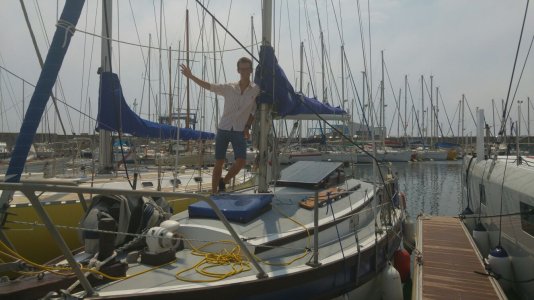
Many years later!! This is what we ended up with. I say 'we' but it was my son who took over the boat who set up the system. Lots of power hungry equipment onboard but the panel copes. Any queries I'll leave it to him to answer.
 

Attachments

  • IMG_0981.jpg
    IMG_0981.jpg
    179 KB · Views: 28

Other threads that may be of interest

Top