Solar Panel use and Inverter Use

petrolhead63

Well-Known Member
Joined
2 Mar 2015
Messages
116
Visit site
We are considering making our boat a little flexible, sorry for the list of questions/thoughts but here goes.
With the advent of more modern solar panels at reasonable cost we wonder what top up/trickle battery charging power can really be obtained from say a 100w panel on typical grey short days in the uk!
There are so many claims, but claim and reality often differs.
1) Does anybody know what typically could be got from lets say 100w panel on both a really good 12 hour sunshine day and a more common 6 hour dull grey day in the winter months.

2) To Inverters, how does 240v power, say 100w again relate to what is drawn from a 12v battery including the loss due to efficiency and running the inverter itself...with lights, panel etc.

3) I assume if we get perhaps 80% efficiency from the 12v battery we use 125W from the battery bank.....being near 10.5 Amps over an hour from the battery bank? is this correct??
Then to the battery bank....with a known A/H capacity, how much of this capacity can be used before the batteries are too flat and need recharging.

If there are electrical experts out there your help would be appreciated.
 
It really depends on what you have connected - what is going to draw power.
I think the best way to look at this is the number of amp hours that you can harvest over a daylight day (24 hours).
Then consider what is going to use that power.
If nothing - just to keep the batteries topped up then very little amp hours will be required - so just a small panel.

I suspect that a fridge is a likely device that will be drawing power.
If so, work out how many amp hours the fridge will consume over a 24 hour period.
Then you can determine if a solar panel will be big enough to replace the energy in the batteries (over a daylight day) that the fridge will consume over a 24 hour period.

I have 4 off 150 watt (600w nominal) solar panels on our 20m flybridge boat.
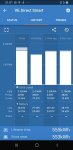
On a good day (in the Med sun, at anchor) those panels can harvest about 3000 amp hours per day.
My boat's load is about 5000 amp hours per day
So, you can see that there isn't enough solar panels to satisfy the boat's load.

I think you will be disappointed when you look at similar maths for your boat.
But I installed my panels for a different reason.
If you are away from shore supply for more than about 3 days, you will gradually reduce the working capacity of your batteries unless you finish fully charging them each day.
My scheme is to use the generator to "bang in" as much power in the morning over a couple of hours (over breakfast say) whilst the batteries can take it.
Remember that the charging curve is exponential - you can charge a lot faster when the batteries are at their least charge.
I could never replenish the 5000 amp hours during the day without running the generator for a much longer period.
I then let the solar panels finish the job during the rest of the day.
That way, I get to replace the full 5000 amp hours during the day.
I hope that makes sense.

So, when you have done your maths, you may find something similar works for you.
But, as I say, it is much easier if you are just going to use the panels to keep your batteries topped up without any other loads.

If you do go ahead, you will need an MPPT solar panel controller.
Victron offer them at reasonable prices.
Some of their controllers offer a Bluetooth connection to your mobile phone.
From the app on your phone, you can analyse the whole process.

Here's a screen dump of mine:-

Screenshot_20190929-210106.resized.jpg

I hope that helps
 
The first thing to do is to get a good estimate of your daily consumption in amps - fitting a battery monitor will help enormously. This gives you a good idea of the battery bank size you need - double the consumption between charging cycle is a good starting point. Lead acid batteries should not be discharged regularly below 50%. However recognise that the real capacity is lower than the advertised because it decays over time and it is not always easy to fully charge your batteries. That deals with point 3.

Now charging. Batteries will only accept what they need and the fuller they get the slower the acceptance rate. The good thing about solar is that it works all the time at relatively low charge rates, so good for topping up when you are not on the boat (although shorepower is generally quicker!). It does not produce enough to keep up with daily consumption - maybe 3-4 amps when you might be consuming 10-15.

Inverters to run 240v are in general not a good idea except for low power things like phone chargers, lap tops etc. High consumers like microwaves and kettles will kill your 12 v batteries or not even run because of high start up currents.

You don't say anything about your boat, engines and particularly your pattern of usage so difficult to be more specific beyond the principles.
 
The first thing to do is to get a good estimate of your daily consumption in amps - fitting a battery monitor will help enormously. This gives you a good idea of the battery bank size you need - double the consumption between charging cycle is a good starting point. Lead acid batteries should not be discharged regularly below 50%. However recognise that the real capacity is lower than the advertised because it decays over time and it is not always easy to fully charge your batteries. That deals with point 3.

Now charging. Batteries will only accept what they need and the fuller they get the slower the acceptance rate. The good thing about solar is that it works all the time at relatively low charge rates, so good for topping up when you are not on the boat (although shorepower is generally quicker!). It does not produce enough to keep up with daily consumption - maybe 3-4 amps when you might be consuming 10-15.

Inverters to run 240v are in general not a good idea except for low power things like phone chargers, lap tops etc. High consumers like microwaves and kettles will kill your 12 v batteries or not even run because of high start up currents.

You don't say anything about your boat, engines and particularly your pattern of usage so difficult to be more specific beyond the principles.
Agreed - definitely need to know the boat's consumption before considering anything else - inverters or solar panels.
 
If running inverters for anything with a serious power draw then generally AGM, normal deep cycle lead acid and even calcium batteries won’t cope unless your battery bank is enormous. You need to consider lithium for inverters and big power draws.
I have recently fitted the stand alone portable ecoflow delta max combined 168 lithium battery, 2400w sine wave inverter, super fast computer controlled charger and solar panel charge regulator. In combination with solar panels and 1 hour every second day recharge I am now using a compressor fridge and induction cooktop and even ran a fan heater for short bursts in a nearly6 week cruise we have just completed in midwinter here in South Australia.
 
I have 4 off 150 watt (600w nominal) solar panels on our 20m flybridge boat.
On a good day (in the Med sun, at anchor) those panels can harvest about 3000 amp hours per day.
My boat's load is about 5000 amp hours per day
So, you can see that there isn't enough solar panels to satisfy the boat's load.

[snip]

Here's a screen dump of mine:-

View attachment 140233

I hope that helps

Mike, I think there's a typo, surely you don't produce 3000Ah a day! more like 3000Wh max a day (on a good day)


OP can look at an EC resource that lets you calc how much certain solar panels, at certain angle will produce in different places in Europe.
JRC Photovoltaic Geographical Information System (PVGIS) - European Commission

leave the angle (slope) to 0, select your cruising area, add how much W panels you are getting and it does the calcs on a monthly or yearly basis. Monthly is more useful I think.

cheers

V.
 
Mike, I think there's a typo, surely you don't produce 3000Ah a day! more like 3000Wh max a day (on a good day)


OP can look at an EC resource that lets you calc how much certain solar panels, at certain angle will produce in different places in Europe.
JRC Photovoltaic Geographical Information System (PVGIS) - European Commission

leave the angle (slope) to 0, select your cruising area, add how much W panels you are getting and it does the calcs on a monthly or yearly basis. Monthly is more useful I think.

cheers

V.
No, it wasn't a type - it was a braino.
Of course the units are watt hours per day!! - indeed as it indicates in the attached screen dump from the Victron controller.
Age is getting to me!!

Thanks Vas - standby for another electronics thread about to come from me - another Raspberry Pi Project needs to be written up!!!
Just imagine the mistakes I can make posting that one - standby.
 
true, the only real reason I posted it was that I could see some very confused forumites trying to figure out why their system does 100-150Ah and yours does 3kAh :D
I don't want to even start listing the stupid logic and/or coding errors I've done over the years playing with computers and the last 5-6yrs arduinos and rasberries :)

ah, and to be on topic for a change, my 43ft f/b mobo with 2X300W rigid panels on the hardtop in the med, is generally self sufficient from May to Oct at least with two 80lt 12/24V fridges, 4G router, N2K bus with two dozen devices, 3kva multiplus running pcs and a few more things running 24/7. Sufficient as it gets everyday the batteries on 100% SoC by 4-5 in the afternoon with no engines/geny running at all. Limit for staying in a place in absolute silence is the 108lt black water tank really (a week for two of us careful use)

cheers
 
Top