Solar panel on swinging mooring...thoughts

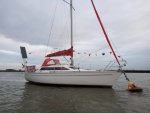
I have a 55W on the roof between the companionway and mast and the one on the NOA mount on the scoop is a 80w. when i leave the boat i bungee the panel to the NOA poles so it doesnt move by gusts. has been fine all year and always get back to the boat the house and engine battery are both charged, same with when i stay onboard and use the electrics all day and night before sleep by the time im awake batteries are back to top. even with the large 80w not angles flat. this is on a swing mooring on the thames. (though the boat is out the water now)
IMG_20191003_182627.jpg
 
If you have an adjustable mount, manually operated and forget to move it from evening to morning position, you'll probably lose more than you gained in the previous week. Surely a better bet is just to increase your panel area by say 25%.

I've got a lot more reading to do. I downloaded an excellent article yesterday on solar panels on a boat.
https://www.mysailing.com.au/news/solar-made-simple

From a very quick look at the article I discovered there are two types of solar cells: one loses most of the output when partially shaded while the other loses only 10%. I most certainly will increase the number of panels if I can.

I won't ask you to explain it as I am up to my neck trying to sort out the steering so I don't want to take on anything else demanding right now.

But your advice is certainly taken on board.
 
It would be a bit sad if the tracking devices used more power to track than the system produced!)

I suspect with small panels, tracking would use far more power than it saves. Land based is quite different as the mounting platform only has to cope with the very gradual change of sun position, whereas a boat on anchor or mooring is constantly moving a few degrees in pitch, roll and yaw, with wind variation and passing wash, as well as tide changes. I've only seen one land based tracking array and the controller knew where its starting point would be every morning. IIRC, the sensor had to be within a fairly narrow heading before it would track.
 
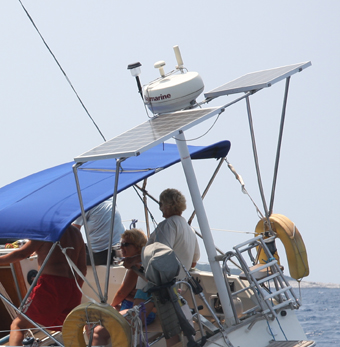
I originally designed my solar panel arch so that I could tilt the panels by sliding the aft part up and down, as shown here. In practice it made very little difference unless the stern of the boat was directly facing the sun, which hardly ever happened. So I did away with it and now have longer aft tubes extended down to the transom as in the second pic, making the whole thing more rigid.


Last edited:
I originally designed my solar panel arch so that I could tilt the panels by sliding the aft part up and down, as shown here. In practice it made very little difference unless the stern of the boat was directly facing the sun, which hardly ever happened. So I did away with it and now have longer aft tubes extended down to the transom as in the second pic, making the whole thing more rigid.

Thanks for that

Hopefully I'll have the steering just about sorted out in the next fortnight so I'll turn my attention to things like solar panels. I have so many questions on solar panels so I'll do a lot of reading and start off a new thread.

Nice yacht :)
 
I originally designed my solar panel arch so that I could tilt the panels by sliding the aft part up and down, as shown here. In practice it made very little difference unless the stern of the boat was directly facing the sun, which hardly ever happened.

Much depends on local conditions, unlike you we're in tidal waters. In our mooring location, we're held by tidal flow so usually pointing east or west except at slack water so, being able to tilt the panels fore or aft by about 35 degrees makes a noticeable difference in charge. Just have to reverse the tilt when the sun has gone down, ready for sunrise. If it's likely to be slack water at sunrise or we're at anchor or sailing during the day with sun on the beam, we just leave them flat.
 
I spent a year on Nauru Island (Central Pacific) and the winds blew relentlessly from the East (presumably the SE trades.). It was not possible to anchor there (because of the depth of water 1000M?) but I assume the yacht would have hung very steadily for months.

Screenshot_2019-11-27 Average Weather in Arijejen, Nauru, Year Round - Weather Spark.png
 
Much depends on local conditions, unlike you we're in tidal waters. In our mooring location, we're held by tidal flow so usually pointing east or west except at slack water so, being able to tilt the panels fore or aft by about 35 degrees makes a noticeable difference in charge. Just have to reverse the tilt when the sun has gone down, ready for sunrise. If it's likely to be slack water at sunrise or we're at anchor or sailing during the day with sun on the beam, we just leave them flat.

We do have the meltemi for much of the summer though. Not as predictable as tidal flow admittedly.
 
I originally designed my solar panel arch so that I could tilt the panels by sliding the aft part up and down, as shown here. In practice it made very little difference unless the stern of the boat was directly facing the sun, which hardly ever happened. So I did away with it and now have longer aft tubes extended down to the transom as in the second pic, making the whole thing more rigid.


I also considered tilting panels and decided to go for a simpler arrangement. Pretty certain tilting wouldn't have helped at anchor in the Guadiana as I'd lose output when the direction flipped each day, unless I returned to the boat in time. That was about the only place I anchored where direction was very predictable. In most cases I've found movement to be enough to give little real benefit from tilting panels.
 
AND
Originall posted by Seajet
[QUOTE I understand the desire to have ( sensible size) tracking panels, but I don't think them viable - they'd probably want a prime position on the boat, and the mechanism is begging to go wrong[/I].]

Mistroma the figure the experts have arrived at is a 30% gain in output by having them trackable. and I agree with Seajet that it is something more to go wrong.

My yacht is a ketch so there will be shadows from the main and mizzen sails. I think the only viable option is to mount a couple of smallish panels over the transom. (I note other ketch owners have done that) Maybe the best option is to mount them flat but have the ability of manually tracking the sun (say) X 3 times a day if I wanted to do..

But the other day I put in a ridiculous offer on eBay for a sun tracking controller (listed at $42?) and this morning it was knocked down to me for $17.50. I guess I've got plenty to do before I have to decide the way to go.

NOTE
I just checked to see what others were paying on eBay for these controllers and some bought for as little as $4 or $5. Never mind...... The "actuator" sells for around $80 so I suppose that is where they make their money.

Good to know that my guess of 25% agrees with the experts. I'd be interested to know which experts and conditions used during the tests. I assume it must have been over the summer months as winter skews the results hugely for sailors. I think average annual improvement was around 60% and summer only 40% in my calculations. Movement at anchor, delay in reacting to movement, losses powering a lot of movement etc. made me think 40% improvement wasn't a likely outcome and 25% felt more achievable. Do you have a link?

I came to the conclusion that fixed panels were adequate and even manual tilting was probably more trouble than it was worth. A fully automated system would be expensive, difficult to fit and more likely to fail than a manual system.
 
I know its a lot less than most people but I have a small 12Ah SLA that sits in my motorboat purely to power the auto bilge pump, nav lights and LED searchlight. That is kept charged by a simple 5W trickle solar panel. It sits on the transom flat and does a very good job.
Latvia is not the greatest solar panel place except height of summer when we get the short nights.
 
I agree the costs outweigh the benefits. I'm all for simplicity so if you need the extra 30% and you've got two panels, fit another one if you have room.
Good to know that my guess of 25% agrees with the experts. I'd be interested to know which experts and conditions used during the tests. I assume it must have been over the summer months as winter skews the results hugely for sailors. I think average annual improvement was around 60% and summer only 40% in my calculations. Movement at anchor, delay in reacting to movement, losses powering a lot of movement etc. made me think 40% improvement wasn't a likely outcome and 25% felt more achievable. Do you have a link?

I came to the conclusion that fixed panels were adequate and even manual tilting was probably more trouble than it was worth. A fully automated system would be expensive, difficult to fit and more likely to fail than a manual system.
 
I agree the costs outweigh the benefits. I'm all for simplicity so if you need the extra 30% and you've got two panels, fit another one if you have room.

My profile shows the kit I have and there's not much room for any more I'm afraid. About 355W is fine mid-summer and then I break out an extra 100W sem-flex. one towards either end of the season.

I wasn't thinking about an automated tracking system for my boat, simply supplying figures I'd produced for a friend's static system a while ago. Usual diminishing return but some form of tracking looked worthwhile for a land based system. I thought it might help others to get some idea of the increase in output. I reckon I'd get fewer panels with a tracking system on a boat and end up with less power.:D
 
Having spent a year on the equator I know the wind comes from a certain direction. I think if you look at this map you can work out where the equator is by looking at the wind direction.

https://www.ventusky.com/?p=-1;109;2&l=rain-3h

I'm not trying to convince anyone (or myself) that a tracking system is the way to go but maybe what applies in Europe doesn't necessarily apply in the tropics?
 
Last edited:
In the tropics, tipping/tracking the panels makes even less sense than in Europe. The sun's near enough overhead when the sun's at its strongest, so flat panels are never going to be far off the optimum angle.

So in the tropics the sun is always overhead? What about when it is sunrise or sunset?

(When I was on Nauru Island (which is 28 mile South of the equator) that was not my experience!)

This may interest some people.

https://www.rpc.com.au/information/faq/solar-power/trackers.html
 
Last edited:
So in the tropics the sun is always overhead? What about when it is sunrise or sunset?

(When I was on Nauru Island (which is 28 mile South of the equator) that was not my experience!)
The sun's near enough overhead when the sun's at its strongest

I really didn't think it was necessary to go into the fact that the sun rises and sets. If someone really needs every last watt hour of power from their panels, I suggest they they need to get more panels or find a way to use less power. Do they really need to run the watermaker for three showers a day, or serve melon on a bed of ice?
 
If someone really needs every last watt hour of power from their panels, I suggest they they need to get more panels or find a way to use less power. Do they really need to run the watermaker for three showers a day, or serve melon on a bed of ice?

Try it first.
Anchored up a trip or 3 or 4 a day to manually tilt the panels can significantly increase the power going into the batteries. Often in warmer climes the winds are quite regular so after sunset you can tilt them ready for the morning sun. Takes moments and satisfying to see another amp or 3 going into the ever hungry batteries.

Nothing to do with melons :rolleyes:
 
Top