Soft shackles

Re: Soft shackles [Video]

Just had some fun with inspiration from Snooks & co at YM, and a couple of the websites others have referred to in this thread.

My challenges were:
  • Even once a simpleton like me masters the diamond knot one evening by following the excellent diagrams in YM, I doubt I’ll remember it on board months later when I need it.
  • You have to leave shaggy ends hanging outside the knot if you don’t want to risk it unraveling
  • The diamond knot is apparently the weak point of the soft shackle: if you tension one to destruction, it almost always breaks at the diamond knot
  • Soft shackles can be fiddly to open

So I pulled together some variations from the Beth & Evans website, to get to a simple method I reckon I’ll be able to remember when I need it – and which I think produces an easier to use shackle. Here’s what I now do. I’d value any suggestions.

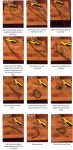
1. Put an eye half way along a length of 4mm dyneema. Say we label the ends so that end A is going through end B. This makes an eye (‘head eye’) in the middle of the length.
2. Mark the length of end A that I wanted to bury. It’s a few inches long.
3. Bury end B through end A with a fid
4. Milk the whole thing down and even out the ends by cutting the longer one. On each end, I marked the bury point for the end eye, and for shackles where I bothered to taper the buried end I marked three alternate pairs of fibre.
5. Separate the marked fibres. If you scrunch the end of the rope up a bit, you can pick them out really easily with the end of a fid.
6. Bury the tapered end back into the rope with the fid
7. Repeat with the other end, and milk both ends down. With this knot, the end eyes need to be really small – just enough to fit the rope through – or the knot can capsize under tension. So when milking the buried end, I held its eye open with the fid and milked it first up towards the eye to close the eye tight around the fid, before milking it back down the rope’s length.
8. Knot Part 1: Feed the head through both tail eyes using a fid two sizes larger.
9. Knot Part 2: Feed the head through the larger loop I’d just created.
10. Tighten the knot bit by bit, by hand. It’s easy to get the knot tight enough to use – but to make it really tight I put the soft shackle through a large steel washer held in a vice, and used a long rod through the head eye, levered off the back of the vice, to tighten the knot. When it’s really tight it sound like a piece of wood when you knock it on the table.

The attached pics illustrate. 11 shows the eye open and 12 the soft shackle closed.

I think it makes quite a nice soft shackle.


  • Having a short length of two lines near the head, Instead of burying one entirely into the other, makes it easier to open than a regular soft shackle.
  • The head eye closes with the slightest tension on the shackle, whereas you can have to knead a regular soft shackle to close it.
  • According to Beth & Evans’ research, using an endless knot increases the soft shackle’s breaking strain by shifting its weak point from the knot to elsewhere. In most of the soft shackles I’ve made so far I tapered both ends before burying them to form the end loops (the taper makes for a neater knot and avoids the sharp change in rope diameter creating a weak point). I suspect that someone who knows what he’s doing will say my tapers aren’t nearly long enough?
  • There are no rope ends sticking out of the knot to look hairy or risk pulling through.

I’ve made several using a few quids’ worth of dyneema and I’ll be ridding Belle Serene of a host of metalwork at the weekend.

Belle Serene soft shackle.jpg
 
Last edited:
Re: Soft shackles [Video]

I've just this afternoon done something rather similar, so we seem to be aiming at much the same objectives. Like you, remembering a diamond knot might be beyond me..... or even a Carrick Bend.

Where you passed the 'head-eye' through the pair of small spliced loops, then made a 'thumb knot', then worked it closed/firm.... I made a 'thumb knot' using the pair of small spliced loops, then passed the 'head eye' through the pair of small spliced loops, then worked it closed/firm.

Racking this hybrid stopper knot very tight/hard, I used a convenient flooring cramp. Same result!

I can't presume my way is any better, and I'd be pleased to hear from someone who can argue a case for either way.
 
Re: Soft shackles [Video]

.......it is something that has been about for years so i am surprised at the sudden response as though someone has just invented the wheel

I agree that soft shackles and Dyneema have been around for some time but I had never seen an article in a magazine about their construction and use and believe that our destructive testing of a variety of them is unique, at least on paper.

The fact that, as posted earlier, Force Four had sold out of them since the appearance of the article, suggests that many owners were unaware of their benefits but not prepared to make them themselves. You may define that as 'living in a bubble' but I suspect that very many owners obtain most of their information from the magazines rather than the internet.


I
 
Re: Soft shackles [Video]

I've just this afternoon done something rather similar, so we seem to be aiming at much the same objectives. Like you, remembering a diamond knot might be beyond me..... or even a Carrick Bend.

Where you passed the 'head-eye' through the pair of small spliced loops, then made a 'thumb knot', then worked it closed/firm.... I made a 'thumb knot' using the pair of small spliced loops, then passed the 'head eye' through the pair of small spliced loops, then worked it closed/firm.

Racking this hybrid stopper knot very tight/hard, I used a convenient flooring cramp. Same result!

I can't presume my way is any better, and I'd be pleased to hear from someone who can argue a case for either way.

Yes, that method is here [http://www.bethandevans.com/pdf/improvedsoftshackle.pdf] or the 'improved soft shackle A' here [http://www.bethandevans.com/load.htm]. I used the even simpler 'improved soft shackle B' method below that, which has the advantages of being even easier to make, and perhaps more importantly easier to tighten by hand. The disadvantage is that the knot is more liable to capsize under load if you don't make the end eyes small enough.

Apart from that difference in knot method, the other changes I made were to taper the braid inside the end buries for a more elegant and (I think?) strength, and to combine the regular shackle design in which one line runs inside the other all the way (making it hard to release), with the 'Kohlhoff' design which composes the shackle's loop of two separate lines all the way.

I too would value any views on the relative merits of variant methods.
 
So what do I use them for once I've made them ?

Think laterally
Think Soft
Think Shackles
Think Wrists
Drop that lady you are with tonight an extra £5 & she will soon show you what you can use them for
& the best think is that when the cleaner comes to release you in the morning you will not need to find the keys
 
Last edited:
Think laterally
Think Soft
Think Shackles
Think Wrists
Drop that lady you are with tonight an extra £5 & she will soon show you what you can use them for
& the best think is that when the cleaner comes to release you in the morning you will not need to find the keys

Cleaner of close friends of mine found a pair of handcuffs in their bedroom and put them on the bedside table. Considerable embarrassment ensued.
 
Double figure-of-eight with a safety half hitch for that, if I ever need one, like what the climbers use.

*climber hat* or, if you must use a bowline, put a yosemite finish in it.

However, the main reason climbers use the bowline at all is because it doesn't seize when you take a big fall on it, which a figure 8 tends to. This is less of a problem in a safety line.
 
+1, steel metal rigging stuff came about for a reason as did proper knots; fancy light twine jobs do not last long in real life situations.

The majority of Vendee boats make it round the world without dropping their rigs with nothing but fancy light twine holding them up.
 
I think Evans Starzinger did a load of testing for the link...

Interesting quote from him on Cruisers' Forum

I just read it . . Got to say I think they made a real mess somehow of their testing. Just for instance, one of their breaks was in the middle of the shackle (eg not at the knot nor at the noose) but it broke at a low load there - what - should never ever break there? That is very odd, suggests either a very very poorly made shackle (extremely uneven length legs) or a pulling procedure that but a really small bend radius on the shackle.

And the photos of the ones they said were to my design, were very very clearly not - because mine use two seperate legs and their photos show shackles with buried (single) legs.

Since they referred to me and my web site quite a bit, I wish they had contacted me.
 
Well, I've done my therapy, I suppose it's the nautical equivalent of basket weaving. Now I've just got to find a use for 15 soft shackles on the boat.:cool:
 
Brought lots of Dyneema ends from www.ropeloft.co.uk. I think they knew about this.

Now have a few 6mm and 4mm shakles.

Thanks Snooks - I think the winch tightening idea is brilliant.

I intend to exchange all my toerail shackles for soft ones (ali toe rail, SS shackles...) as well as a few others. www.ropeloft.co.uk sold me some green and red 6mm ... how vain!

Is there a calculator (metric) for different sizes and rope dims? I want to make some smaller looped/diameter shackles.
 
Is there a calculator (metric) for different sizes and rope dims? I want to make some smaller looped/diameter shackles.

No. Wouldn't be impossible to do, but not easy as it depends on variables such as the proportional contraction of a dyneema when you bury another length inside it, the length of bury you use and whether/ how you've tapered it, the size of loop you make, the type of knot you use... So unless you really standardise on a particular design, personal experimentation is probably more helpful than a formula. I now know that with my own design, regular-size soft shackles in 4mm dyneema take 80cm of line, but flexing any part of the design would change that.
 
Top