
Soapy water in fuel tank

pauldowrick

Well-Known Member
Joined
31 Dec 2020
Messages
88
Visit site
Morning all.

First some information

1: my fuel tank is in the keel and the lowest part of the boat
2: due to shower issue shampoo / soapy water has sat over the fuel tank
3: soapy water has got into the fuel tank and displaced some fuel which is now floating on the water layer (not very much though)

So my question is, has anybody else ever had this problem? There is a little fuel mixed in with the surface water and some of it seems to have formed a gel.

What kind of nastiness is waiting for me when I try to polish the fuel?

My horror vision is a tank full of diesel / water mayonnaise.

Luckily the engine has not been run, and I hope that a change of filters and a flushing of the downstream pipes will prevent any future issue.

All advice would be most welcome.

Thanks in advance.
 
You say polish the fuel - and that’s not a bad plan - but how much is in there and could you get it all out? 25L jerrycans aren’t that expensive new and can be found/borrowed relatively easily…

That’s what we did with 150L of 7 year old diesel we inherited with our current boat. Quite a different scenario I know. But it allowed us to empty the tank, allow the fuel to settle, visually inspect, filter (we filtered coming out and then again going back in), and ultimately re-use most of it in my van!
 
You say polish the fuel - and that’s not a bad plan - but how much is in there and could you get it all out? 25L jerrycans aren’t that expensive new and can be found/borrowed relatively easily…

That’s what we did with 150L of 7 year old diesel we inherited with our current boat. Quite a different scenario I know. But it allowed us to empty the tank, allow the fuel to settle, visually inspect, filter (we filtered coming out and then again going back in), and ultimately re-use most of it in my van!


Luckily the fuel tank is such a shape that I can easily get to the lowest point and start removing nastiness from there using a suction device that I have.
 
Morning all.

First some information

1: my fuel tank is in the keel and the lowest part of the boat
2: due to shower issue shampoo / soapy water has sat over the fuel tank
3: soapy water has got into the fuel tank and displaced some fuel which is now floating on the water layer (not very much though)

So my question is, has anybody else ever had this problem? There is a little fuel mixed in with the surface water and some of it seems to have formed a gel.

What kind of nastiness is waiting for me when I try to polish the fuel?

My horror vision is a tank full of diesel / water mayonnaise.

Luckily the engine has not been run, and I hope that a change of filters and a flushing of the downstream pipes will prevent any future issue.

All advice would be most welcome.

Thanks in advance.
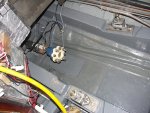
If soapy water has got into your fuel tank the only way it can get in (on my Nic39) is via the inspection hatch underneath the engine sump. I've only replaced the gasket when the engine was out. Wouldn't like to try doing it with the engine in place. Thinking about it, another source of ingress is the tank breather pipe where it enters the fibreglass tank or any other fitting that might have been inserted into the tank top by previous owners.

Edit: Memory fade - there is another inspection plate underneath the stern gland - see this photo - it's where my breather is fitted. Pic attached. Note the extra brass fitting bottom left - I presume it's for dipping or some such.
 

Attachments

  • PICT0009.jpg
    PICT0009.jpg
    208.3 KB · Views: 17
Last edited:
Luckily the fuel tank is such a shape that I can easily get to the lowest point and start removing nastiness from there using a suction device that I have.
Understood! And you correctly interpreted that a major factor behind my ‘removal’ method was having a hatchless tank with no obvious ‘sump’…

However, might polishing into (a) separate (containers) still be an option? Depends whether we’re talking 70L or 170L, really! Appreciate you don’t want dozens of cans of fuel all over the place.
 
Understood! And you correctly interpreted that a major factor behind my ‘removal’ method was having a hatchless tank with no obvious ‘sump’…

However, might polishing into (a) separate (containers) still be an option? Depends whether we’re talking 70L or 170L, really! Appreciate you don’t want dozens of cans of fuel all over the place.
definately
 
definately
We simply used a cheapie 12v Chinese fuel/oil pump and the ship’s own filters to ‘polish’ the fuel as it was pumped into containers. They say they shouldn’t run more than 10 minutes, but at <£10 delivered we let it go for half an hour at a time with no issues. Maybe 10 mins to filter 25L through the Racor with this method. You can even use the existing pickup/plumbing until you start to get to the dregs. You’ll likely be looking to discard the last X litres anyway.
 
If soapy water has got into your fuel tank the only way it can get in (on my Nic39) is via the inspection hatch underneath the engine sump. I've only replaced the gasket when the engine was out. Wouldn't like to try doing it with the engine in place. Thinking about it, another source of ingress is the tank breather pipe where it enters the fibreglass tank or any other fitting that might have been inserted into the tank top by previous owners.

Edit: Memory fade - there is another inspection plate underneath the stern gland - see this photo - it's where my breather is fitted. Pic attached. Note the extra brass fitting bottom left - I presume it's for dipping or some such.
I think it got in via some of the fittings on the inspection hatch. You can almost see where the fuel has leaked out as a gel has formed in those areas.
This implies that the fuel is at the very top of the tank. If it wasn't before then water has filled the tank from the bottom up until the tank is so full that the floating top layer of fuel starts to leak on the surface.
I will know more tonight when I remove a gallon of liquid (?) from the bottom of the tank.
 
Remember that that most of the water is not in suspension but settled to the bottom of the tank. Nearly all the water will be removed by lowering a suction pipe to the lowest art of the keel. and drawing it out with a Pela or similar without disturbing the fuel above. You do not want to risk stirring up the tank by polishing till all the water lying below the fuel is removed.
 
Remember that that most of the water is not in suspension but settled to the bottom of the tank. Nearly all the water will be removed by lowering a suction pipe to the lowest art of the keel. and drawing it out with a Pela or similar without disturbing the fuel above. You do not want to risk stirring up the tank by polishing till all the water lying below the fuel is removed.
This is my plan tonight. Get out the water from the bottom and a little fuel and see where I stand.
 
Luckily the fuel tank is such a shape that I can easily get to the lowest point and start removing nastiness from there using a suction device that I have.


That's the way ....

1. get the water part out FIRST .....

2. Then to separate containers pump out the fuel via a filter .... let settle ... decant fuel carefully leaving sh** behind.

3. Add some Enzyme based Bio ... let stand ... decant again.

If you don't mind wasting some fuel .... try 'washing' the tank with some of that from #3 .... suck out and disard.

Should be good to go with the #3 decanted fuel.
 
Top