So what else could it be..?

From the water side there maybe a place where you can pour water into the system to wet it out, I dont know the layout as for the oil side a few drops ov engine oil around the seal area.....I could of course be totally wrong.....but dry seals will have their edge taken of pretty quick.
I suppose I could fill from the top anode pocket.
 
pretty sure that all seawater pumps when refitted get a smear of lubricant that will last the first couple of mins if dry before water comes in.
I'd also point at a worn shaft not picked up by the rebuilder (which would be rather poor tbh!)
else, being gear driven I'd not dare think it's the cam or crank shaft end where possibly the mating gear is placed to blame...

I think Porto implied scrapping this pump and getting an external pulley driven pump fitted somewhere convenient and getting a blanking plate for the existing hole for it. Not very neat, bit messy getting another right size pulley for the crank and fitting it, get brackets fabricated, etc, etc.

if it fails again, I'd try another place for the rebuild and ask/demand they check/sleeve the shaft.
 
f it fails again, I'd try another place for the rebuild and ask/demand they check/sleeve the shaft.
The trouble is, the firm who have been doing it are the UK number one go to company. If I send it elsewhere it will just end up back at this same firm.
 
  • Sad
Reactions: vas
Just a thought but might a leaky head gasket or something similar be pressurising the water system to the point where the pump starts leaking?
 
Just a thought but might a leaky head gasket or something similar be pressurising the water system to the point where the pump starts leaking?
Forgetting about the oil leak, the water seal will only stand up to a given pressure, it could be that restrictions in circulation are raising the pressure to a point where a slightly worn seal leaks prematurely...it would be an idea to ensure that all waterways are unrestricted.
 
Forgetting about the oil leak, the water seal will only stand up to a given pressure, it could be that restrictions in circulation are raising the pressure to a point where a slightly worn seal leaks prematurely...it would be an idea to ensure that all waterways are unrestricted.
Water flows very freely, and only 2 seasons ago I stripped the cooling system and rydlimed (spelling) the whole thing. I don't think a blockage is the issue.
 
Just a thought but might a leaky head gasket or something similar be pressurising the water system to the point where the pump starts leaking?
I think the op said it was raw water pump, which unless it's a direct raw water cooling, the head gasket should not affect it.
The only possible connection the compressed gasses would come into the raw water system would be in the exhaust cooling, with an indirect system.
 
Without pics we can only generalise .A danger ( not ruled out ) is the leaky seals mixing fluids .It all depends on the design of the thing .Yet to be confirmed !!!

Oil in raw water is doable .How ever seawater in the oil is bad news .Have you checked the dip stick ? If it’s rising …..erh bad news .

A well engineered boat gear driven pump will have a gap , visible gap on the shaft .Two seals either side of said gap .So if the gear seal / oil leeks it’s drips oil through said sight gap and alerts you on your daily morning inspection tour .
Or it its the other end seawater drips along the shaft and stays out of the gear casing .

Below .Black oil route , blue water route .Hopefully they can’t by design meet each other .
3F10A2D4-9BC7-4590-AF9D-40D5723C3761.jpeg

Most pumps are identifiable.
FC57040D-59B0-4B67-ADE6-1426FFD0A18C.jpeg
FA51A5A6-9C52-4F62-838A-997DACA3A33B.jpegJabsco
13A4DBEF-B06E-45AF-BBED-BE5477B11AB1.jpeg
1A370B5D-0F45-4F3A-93C3-FABAC4352D1A.jpeg
^ all buttoned back up .


26DD24F5-3111-4566-82FE-9C1FB504768E.jpeg
The brand is self explanatory it’s on a Yanmar geny btw .Old pic belt driven .Note the weep hole slot behind that red sq .
Its shaft seals gone and you can see the product of corrosion on that L shaped beam . Wrong belt tension .
All fixed it bought a brand newie @ €180 . Not from Yanmar or Mase .Just from Johnson but theses are pretty ubiquitous.
 
Last edited:
Without pics we can only generalise .A danger ( not ruled out ) is the leaky seals mixing fluids .It all depends on the design of the thing .Yet to be confirmed !!!

Oil in raw water is doable .How ever seawater in the oil is bad news .Have you checked the dip stick ? If it’s rising …..erh bad news .

A well engineered boat gear driven pump will have a gap , visible gap on the shaft .Two seals either side of said gap .So if the gear seal / oil leeks it’s drips oil through said sight gap and alerts you on your daily morning inspection tour .
Or it its the other end seawater drips along the shaft and stays out of the gear casing .

Below .Black oil route , blue water route .Hopefully they can’t by design meet each other .
View attachment 148843

Most pumps are identifiable.
View attachment 148841
View attachment 148844Jabsco
View attachment 148845
View attachment 148846
^ all buttoned back up .


View attachment 148842
The brand is self explanatory it’s on a Yanmar geny btw .Old pic belt driven .Note the weep hole slot behind that red sq .
Its shaft seals gone and you can see the product of corrosion on that L shaped beam . Wrong belt tension .
All fixed it bought a brand newie @ €180 . Not from Yanmar or Mase .Just from Johnson but theses are pretty ubiquitous.
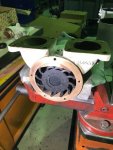
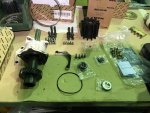
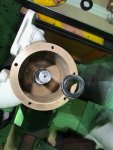
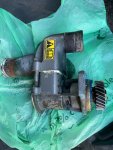
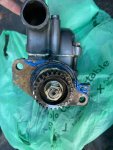
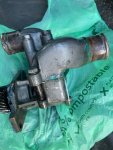
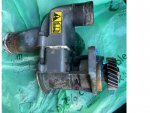
For you Porto, pics of pump before refurb.
154D2AB9-D92E-4574-B88C-353769B6927F.jpeg6C865DEB-116D-48A7-B86F-3BD0DC5D27EB.jpeg0D038085-2FC2-4EAF-A29D-C52F25DCAD32.jpeg
 
It’s got a weep hole .So no risk of mixing fluids .Good news .

I always worry of flanges with two ears ( the gear side ) because over tightening distorts the flange necessitating shed loads of that blue gunk ! = oil leak .If so the refurb guys are not to blame it needs ( as my first post ) replacing as it’s distorted.

Ideally you just need a thin gasket and very thin smear of gasket sealant hardly noticeable if the faces where true .
Looks chunky enough but I don’t understand why there so much blue gunk ?

The white stuff connecting the upper body does not look appealing either .
New one is the answer just find out exactly what it is ,

7588B66B-44FB-4E6B-BF28-0660EFC4C3D8.jpeg
 
Last edited:
Is there not an O-ring there to seal the oil? It looks like a groove.

Edit to add; there is one in that picture, no need for gasket goo as long as the sealing faces are clean and smooth and the O-ring is in good condition.
 
Is there not an O-ring there to seal the oil? It looks like a groove.

Edit to add; there is one in that picture, no need for gasket goo as long as the sealing faces are clean and smooth and the O-ring is in good condition.
This is the first time i had removed the pump, so I was not the one who applied the sealant. It certainly never gets any now. Being a plumbing and heating engineer I'm well versed in the area of clean joints mean leak free joints if fitted correctly, I never see the need for joint additives unless on a thread. This stuff must have been applied by the previous engineer who changed the impeller for me. Now I do it myself.
 
I will give this pump one last try, whilst saving for a new one. If it leaks again anytime soon then in the bin it goes.
 
This is the first time i had removed the pump, so I was not the one who applied the sealant. It certainly never gets any now. Being a plumbing and heating engineer I'm well versed in the area of clean joints mean leak free joints if fitted correctly, I never see the need for joint additives unless on a thread. This stuff must have been applied by the previous engineer who changed the impeller for me. Now I do it myself.
As you are a plumbing and heating engineer I have to assume you know the answer, and that is to take it apart, and repair it yourself.
I have now got to the age that it's very difficult to do my own fixing and live in fear of having to trust mechanics.
 
As you are a plumbing and heating engineer I have to assume you know the answer, and that is to take it apart, and repair it yourself.
I have now got to the age that it's very difficult to do my own fixing and live in fear of having to trust mechanics.
I do do the removal and install myself. I don't have a work bench or the tools to do the refurb however. I do most of the work on my engine myself, but when it gets too technical and specialist I turn to a pro.
 
I do do the removal and install myself. I don't have a work bench or the tools to do the refurb however. I do most of the work on my engine myself, but when it gets too technical and specialist I turn to a pro.
I understand that, is it not possible you can get a local garage mechanic/workshop to take it apart with you so you can inspect it?
 
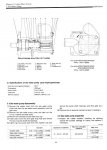
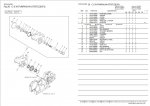
Looking at that diagram the only tools needed are a bench with a vice(a workmate might suffice), a mallet, hammer, brass drift and circlip pliers. I have done such things on kitchen tables before now, but only when responsible adults are not present! :ROFLMAO:

The repeated and premature failure of seals is a concern; is the shaft worn but not noticed by the refurbisher? Have they a particularly hamfisted apprentice who doesn't treat the mechanical seal as gently as it needs? They are not very robust and it's not hard to end up damaging the sealing faces while trying to wrestle them into position. If you aren't in a position to DIY it then unfortunately playing parcel tennis with the refurbisher is the only option if a seal fails again, their comment about it being an engine problem is just deflection with little merit.
 
  • Like
Reactions: vas
it being an engine problem is just deflection with little merit.
Yes, I did suspect this to be the case. Well, if it does go agin I'll be in for a full refund which I'll put toward a new pump!
Now that I'm safe in the knowledge that the engine won't be at fault I feel easier about the situation.
 
Top