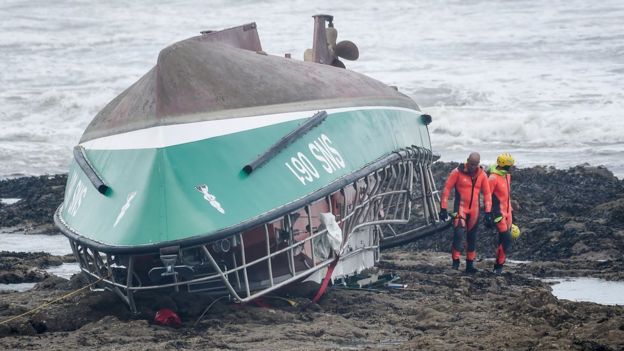
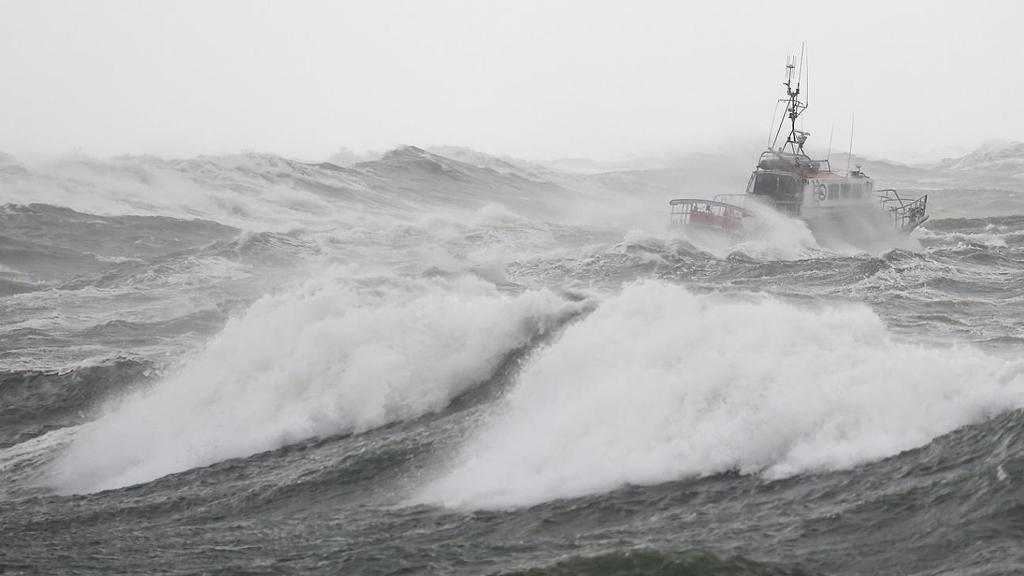
SNSM lifeboat lost

Hats off to those brave fellows. That is well above my pay rate. Its one thing to be caught out ib weather but setting out into that, is very very different

One of things which impresses and moves me most about the Penlee disaster is that the Sennen lifeboat spent some time vainly trying to get round Land's End to assist, despite knowing that a lifeboat had already been lost. These people are not like the rest of us.
 
Holy shit! That's nasty.

I have never been out in anything like that, but I have noticed from photographs and videos that when things get really nasty the sea seems to lose the short range confusion which is the worst I have seen and take on a sort of smooth, oily, evil intensity. That picture shows just what I mean. Yeugh.
 
What a tragedy for the crew and their family.

I grew up in a town which had recently experienced an RNLI lifeboat disaster, capsizing with the loss of all crew.
The picture of the upturned (Watson) lifeboat on the beach was very gut wrenching.
I hoped (and with improved boats came to expect) never to see another picture like that.

PS. i gather that a number of Cruising Association members were in the area at the time, and the CA are sending a message of condolences on our behalf
 
Last edited:
Please, please, please can we avoid the RNLI vs SNSM arguments? I worried they might arise when I started the thread.

Brave people died.

No attempt was made to have an argument, I simply stated that a seven class would have been a better design for these conditions. Just as every one else here I am appalled at the loss of life but men going out in inadequate equipment is awful.
 
No attempt was made to have an argument, I simply stated that a seven class would have been a better design for these conditions. Just as every one else here I am appalled at the loss of life but men going out in inadequate equipment is awful.

Sure, and sorry. I wasn't trying to get at you, just hoping the old animus wouldn't recur here and now. I wonder if any lifeboat would have been adequate for those conditions, particularly if they involved, as seems possible, the boat being slammed hard into the seabed while inverted in a roll.

By the way, as someone posted earlier, the normal lifeboat for Les Sable d'Olonne is a much bigger one, which took over three years ago from the one that was lost:

ob_dee4d4_nouveau-bateau-snsm-les-sables-d-olonn.JPG


(From http://www.lagazettedesolonnes.com/2016/11/nouveau-bateau-de-la-snsm-aux-sables-d-olonne.html)
 
I don't want this to hijack a very sad thread, but I have to admit, when I read about windows being smashed in on capsize, that was my first thought too, as sad as this is. I don't know much about design of the French lifeboat fleet, but RNLI do design to try and prevent that type of occurence, and Tamar and Severn Class should be capable of withstanding capsizing and breaking windows. No RNLI lifeboats have been lost that way since Penlee in 1981

At the time there were hurricane force winds 120kph. A breaking wave stove in the windows and the incoming water stalled the engines, according to the survivors. The three men on deck as well as one of the 4 men inside, made it back to shore by swimming. If you watch clips about rogue waves, waves such as this have an impact of many tons per m². A 50' foot wave is estimated to be 15 tons per m² whereas a rogue wave can be up to 100 tons per m². Architects designed ships to withstand a 50' wave but the relatively recent studies on rogue waves made them revise their copy.

No lifeboat windows, imho, would withstand a direct hit from a breaking wave in the conditions that were met with.

Personally having looked closely at the design parametres of the latest awbs they would be my preference in going to sea in very bad weather. The boat in this case, although perfectly maintained apparently dated from the mid 80's and was planned for replacement.

PS have just seen JD's post stating that it had already been replaced and the one lost must therefore have been a reserve while the other was being maintained.
 
Last edited:
Definitely self-righting ("autoredressable") but that relies on hull and cabin integrity. Internal flooding will compromise the self-righting capability of any lifeboat whatever its national design.

My heart goes out to the families of the men lost, and also to all the emergency services staff, and others watching from the shore, powerless to help.


What frightening photographs.

Local firemen turned out to help those who had escaped by swimming. They also went into the water to assist. ("Sécourir ou mourir")
 
My posts weren't in anyway meant to degrade the design or the crews of the boats, just an interested enquiry.

I have no idea of the RNLI boats 'behaviour' in a similar situation so not trying to compare.

W.
 
Re: SNSM Capsize.

The boat didn't self-right because the wheelhouse was ruptured and flooded; the air in the superstructure is what provides the righting buoyancy. That applies just as much to RNLI designs.

Supposedly this was the station's old boat, originally from the mid 80s, because the modern one was out of commission in some way.

EDIT: Someone seems to have merged and/or moved threads in a confusing way, which is why this summary now seems misplaced or pointless.

Pete
 
Last edited:
MY sympathy goes out to the families and friends of those who perished.
The surviving crew members memory’s will haunt them very badly. My thoughts will go out to them also.
All very brave men.
 
What a terribly tragic accident. And I echo the comments about bravery going out in seas like that.

Apologies for the tangent, what's the reason for the reverse bow on the new boat?

ob_dee4d4_nouveau-bateau-snsm-les-sables-d-olonn.JPG
 
Apologies for the tangent, what's the reason for the reverse bow on the new boat?

I'm not sure precisely, but it's very common, almost standard, on French fishing boats. From there it seems to have moved to various other craft in the area, such as the amphibious tripper-boat at St Vaast, so it's not surprising to see it on a French lifeboat.

Pete
 
I'm not sure precisely, but it's very common, almost standard, on French fishing boats. From there it seems to have moved to various other craft in the area, such as the amphibious tripper-boat at St Vaast, so it's not surprising to see it on a French lifeboat.

Some interesting stuff about it at https://fr.wikipedia.org/wiki/Étrave_polyédrique

As far as I can see, the idea is that in calm conditions you have a normal planing hull and when the waves get bigger the beak pierces through them, giving a smoother ride with less pitching.
 
Top