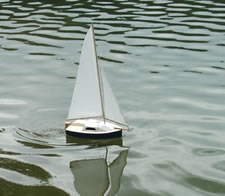
Smallest CQR?

The OP doesn't state the reason for the question, but for dinghy use one can get handy small folding grapnels which are a great deal easier to stow and carry.

Yup but IMHO you need precisely the right bottom type, wind direction and current to hold. Unless his boat is about this size?
Class4m02small.jpg

http://www.makeamodelboat.com/model-boat-plans/model-sailing-boats/4m-mini-yacht

I know its a delta but I guess this is close?

0000018280.jpg

http://www.marinesuperstore.com/item/99319489/lewmar-anchor-bottle-opener
 
Last edited:
I'm well aware of the pro's & cons of the grapnel, I was thinking one doesn't usually anchor ' seriously ' in a dinghy, if that is the purpose in mind; CQR's are awkward to stow and quite good at nipping fingers !
 
Anybody care to comment what the smallest genuine CQR produced? Was there something as small as 5lb?

I bought a 5 lb CQR to replace a totally useless folding grapnel on a cruising dinghy in about 1970, and I think it was a genuine one, though cast not drop-forged. With about 6 ft of quarter inch chain plus warp it did it's job.
 
Anybody care to comment what the smallest genuine CQR produced? Was there something as small as 5lb?

25 lbs is the smallest. Then 35, 45, 60, 75 and 105 lbs.

The OP used a past tense, and there certainly used to be CQRs smaller than 25lb. I have a 20lb one (genuine S-L) in my garage, for a start. I am pretty sure they did 10lb and 15lb too, perhaps smaller.
 
Thanks for the replies - I have got a 1960's SL catalogue somewhere & I'm sure that will give me the answer.

I'm having a 12' smacks boat built & thought it would go nicely with the general style of the boat, bearing in mind it's on the East Coast (East Coast = mud = CQR is a common refrain in these parts).
 
You have to realise that CQRs don't work anymore. They only worked for about 60 years and then suddenly stopped working in the 90's. (Yes, I have one. It has held in pretty demanding conditions, but I keep thinking I must modernise.)

[Apologies for the duff signature links don't seem to be able to edit my signature. Will take suggestions.]
 
Last edited:
The OP used a past tense, and there certainly used to be CQRs smaller than 25lb. I have a 20lb one (genuine S-L) in my garage, for a start. I am pretty sure they did 10lb and 15lb too, perhaps smaller.

The fact that the anchor was supplied by Simson Lawrence did not guarantee that it was a genuine CQR.

As already said the genuine has "Made in Scotland" on the drop-forged shank and (after the cast SL 25lb "CQR" copy had broken said shank) I got in touch with SL and was brought up to speed - the standard range started @ 25lbs as has been reported and went up to 100lbs (or so I was told) and they were designed for and deployed on Short flying boats.
 
Thanks for the replies - I have got a 1960's SL catalogue somewhere & I'm sure that will give me the answer.

I'm having a 12' smacks boat built & thought it would go nicely with the general style of the boat, bearing in mind it's on the East Coast (East Coast = mud = CQR is a common refrain in these parts).

I suspect you'll find one of the large-palm anchors (Danforth, Bugel) type work better in mud.
I have stuck with my (genuine) CQR which works much better than the SL copy I had.
I must admit it is not quite as idiot-proof as the "new" generation anchors, but cannot be equalled for holding power on coarse sand or shingle.
I do, however, appreciate that you're looking for an in-character accessory.
 
For tender use the Fortress/Gardian anchors are a good choice. The Gardian anchors are the same as the Fortress design (without the adjustable angle, lifetime warrantee and anodising) and go down to 1kg.

They are aluminium so the physical size is larger than the weight alone suggests, but they have high holding power and will not rust.

Cooper anchors (plastic coated) are also getting some good reports (for occasional use) in these small sizes. I have only seen these in the chandleries so I have no direct experience.
 
The fact that the anchor was supplied by Simson Lawrence did not guarantee that it was a genuine CQR.

As already said the genuine has "Made in Scotland" on the drop-forged shank and (after the cast SL 25lb "CQR" copy had broken said shank) I got in touch with SL and was brought up to speed - the standard range started @ 25lbs as has been reported and went up to 100lbs (or so I was told) and they were designed for and deployed on Short flying boats.

Simpson Lawrence were the manufacturers of genuine forged CQRs. They also made a range of cast plough anchors which can be distinguished from the forged ones because the weight, cast in the shank, has fractional pounds; 23 1/2 lb (from memory) rather than 25 lb. The anchor to which I was referring is without doubt a genuine 20lb forged CQR made by Simpson Lawrence and bought from them by my father, new, around 30 years ago. I still have the label it came with. On one side of the shank it says "Made in Scotland" and on the other "25lb CQR Patent <number>".

After Simpson Lawrence closed down, rights to the CQR design passed to Lewmar who make them still. The smallest in the range is currently the 15lb.

http://www.lewmar.com/products.asp?id=8713&lid=23545
 
Geoffrey Ingram Taylor's original paper describing the development of the CQR, published in YM in 1934, can be seen at http://www.petersmith.net.nz/boat-anchors/docs/taylor-the-holding-power-of-anchors-1934.pdf The final pragraph says: For the benefit of people who like to try new things, it is proposed to put this anchor on the market at the beginning of the coming season in three sizes, namely 20, 35 and 60 lb. These are intended to replace ordinary anchors up to double their weight.
 
Top