Small petrol generator

880Ah of lead acid is a lot on a 38ft boat, it's going to weigh circa 240Kg and cheap leisure batteries would cost close to £1000.

880 Ah of Lithium on the OPs boat would be far more than would be needed and if discharged to a low, but safe, SOC it would take something like 8 hours at 100A to charge them back up. There needs to be a reasonable balance between battery capacity and charging capabilities. 880Ah of lead acid gives a usable 440Ah. A pair of 280Ah Lithium packs would give a usable 450Ah and would only weigh 43Kg, cost for the cells alone would be £520, plus BMS DC-DC charger etc.
You can pump 0.5C to 1C into Lithium.

I.e. 440A to 880A for that bank.
You will be severely challenged to find a battery charger or alternator capable of delivering that.
 
You can pump 0.5C to 1C into Lithium.

I.e. 440A to 880A for that bank.
You will be severely challenged to find a battery charger or alternator capable of delivering that.
Not sure what your point is ?

I'm well aware of charge and discharge currents for Lithium, the cells i use are rated at 0.5C charge and 1C discharge, i set those parameters in the BMS.

My point was, fitting 880Ah of Lithium would not be appropriate for the OP, he doesn't need that level of storage and he can't reasonably charge them anyway, as you proved above.

Also, fitting a pair of 250A alternators to the engines is far from the correct answer. It would take 15-20HP to run those at a high rate and if you connected them to a Lithium bank without safe guards the batteries will take the full rated current of the alternators which they are not continuously rated for, consequently they will overheat and die. If you went the DC-DC charger route you would need to fit 5 50A chargers in parallel to limit the alternators to 50% of their max current, which would cost £1,300, plus £500 for the alternators and about £600 for the essential serpentine belt kit, total cost £2,400. The OP has twin engines so the total cost would be £4,800

You could, of course, choose not to fit DC-DC chargers and go for something like Balmar alternators with external regulators etc. a pair of these would cost about £3,000 per engine
 
Totally agree, we had 330A on our Freeman 26 based on the Thames.

On our Aquastar Ocean 38, we have 880A of house battery plus 110A for each engine and another 110A for the onboard, water cooled genset.

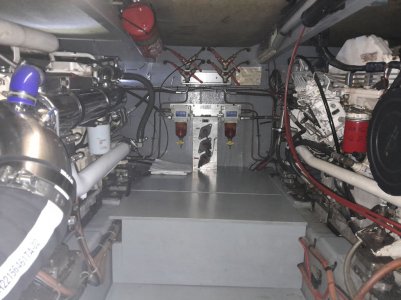
I'd be interested to know where your batteries are. On my AQ38 they are between the two engines at the forward end, so there's a step up housing over the top of them

.Engine room 1BB.jpg
 

Attachments

  • Engine room 1AA.jpg
    Engine room 1AA.jpg
    27.4 KB · Views: 3
Well in true forum style, this has morphed from which generator is good as a backup if I do an extended few days on the non wavy bits, to a full rework of the boat systems. :ROFLMAO:
If you're going for an upgrade, there's plenty of advice already.
You just need to choose which option fits best.
It's all a matter of choosing how long you want to last between shore power hookup's and how long you can tollerate the compromises in-between.
 
Well in true forum style, this has morphed from which generator is good as a backup if I do an extended few days on the non wavy bits, to a full rework of the boat systems. :ROFLMAO:
If you're going for an upgrade, there's plenty of advice already.
You just need to choose which option fits best.
It's all a matter of choosing how long you want to last between shore power hookup's and how long you can tollerate the compromises in-between.

Yep - that's how it goes ......
 
...but I am not sure about how much is hype
I have my doubts. Are there products that warn against sine wave impurity?

...while sensitive electronics say they need pure sine waves.
Living in countries that possibly have the
" dirtiest " Electricity on the planet,and all sorts of cobbled up engines and generators with all the normal world gadgets being used.
 
I have found that items that require clean sine wave - will just not work on square wave cheapo inverters etc.

As "billskip" - I have been in some countries where mains electric is 'rationed' ... unreliable as to its voltage ...

Do not forget also that the AC cycle whether 50 or 60Hz also can have items failing to work ... I used to carry a little Canon printer and it would refiuse to work in some countries where the Hz was not as per specs of the printer.
 
Some of these old small generators relied on a little " flapper control " regulated by a fan to control the throttle ...when it got dust and restricted air flow the output woud change and most wouldn't even realise.
 
I'd be interested to know where your batteries are. On my AQ38 they are between the two engines at the forward end, so there's a step up housing over the top of them

.View attachment 191938
We have twin 250hp Ford lumps, the batteries are housed between them similar to you but around 14" lower. The top of the battery compartment is the 'Floor' in-between the engines.
 
Top