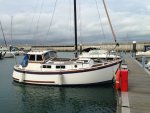
Small Motorsailer

The sloop rigged F25 has an SA/D of 9.5. With the best will in the world you are going to be motoring in F3 and below.

I wonder if there were voices raised at Northshore against producing the sloop version of the F25, which I think was a much later variant than the ketch? Presumably the taller sloop is somewhat 'tippier' than the stumpy little ketch...but I daresay Mr Ming is right that it's still under-powered...so how much taller a mast could one reasonably fit her with?
 
I wonder if there were voices raised at Northshore against producing the sloop version of the F25, which I think was a much later variant than the ketch? Presumably the taller sloop is somewhat 'tippier' than the stumpy little ketch...but I daresay Mr Ming is right that it's still under-powered...so how much taller a mast could one reasonably fit her with?

It's the weight of the boat rather than the size of the mast. If you look at the drawings the sloop rig doesn't look short at all. It's just that a 25' boat weighing 4.5 tons is a little unusual.
 
There was never any concern in my almost six years there in the 1990's. We built what the client wanted. Ketch was favouved over sloop probably because of the traditional looks. Never a request during my time there for taller rigs on tne 25.

The sloop would slow down significantly with less than 12 knots apparent. Lighter cut sails may have helped below this as std sails were heavy cut ocean going cloth.
 
I never thought I'd find a boat whose proportions make the Fisher 25 look sleek...but I think the CW28 is such a vessel!

At about 2 minutes 33 seconds into that film, the shape of the windows in the CW's wheelhouse suggests to me that they were the only ones the builder could lay hands on...they don't fit the shape of the wheelhouse. Is that a consequence of home-construction?

I don't know about other Colvics but I know (have the paperwork) that the hull and superstructure, windows, electrics, ballast, engine and g/box, masts and rigging on Rhoda Rose were all carried out by Colvic. Her interior was installed by the original owner, who I purchased her from after 18 years of ownership. She was designed as a two berth boat which suits us fine, lots of room below.

I think you could buy CW's with different levels of fit out.

Your drawing is completely different to the layout of Rhoda Rose.

The plan view belies her underwater profile, which is surprisingly sleek. I think her profile is rather pretty, in a trawler sort of way.

image.jpg
 
Last edited:
As someone with a propensity to seasickness, can I ask whether being in a wheelhouse/deck saloon is more like being in the cockpit or below, as far as the sick-making tendency goes?
 
I wondered about that too, as I can feel a bit queezy in a chop if below decks. Pleased to say I have had no problem in the wheelhouse yet, and been out in some lumpy weather this year. I guess it's the all around visibility that does the trick.

Rhoda Rose does roll in a seaway, as do many motorsailers of her type. Having at least the mizzen up when motoring helps a lot.
 
I think you could buy CW's with different levels of fit out.

Your drawing is completely different to the layout of Rhoda Rose
-------------------------------------------------------------------------

Nice video by the way and pleased you finally got her out to sea, mind it was flat!

The Colvic Watson' was designed for either a 'trawler Wheelhouse' or a 'sloping' wheelhouse throughout the range.

I have been following this post with interest and sadly love comments from some who obviously have never sailed a Fisher or Colvic Watson.

I have sailed (no engine running) all the CW sizes and also Fisher 25' & 30's and the Fisher sails fines when the sails are set right they can move along at a nice cruising speed, my record sailing a Fisher 25' was 7.3knots (main and Genoa) close hauled in a F5.

I have two close friends both with Fisher 25's and they are a fine boat plus both will tell you the interior layout of the Fisher 25' is not as roomy as the Colvic Watson 23'-6" as surprisingly both are almost the same size:

Fisher 25' CW 23'-6"
Length 7.7m CW 7.16m
W/Length 6.4m CW 6.4m
Beam 2.85m CW 2.67m

However the biggest difference in the two is there hull design and give me the Colvic Watson anyday in a heavy sea as the bow of the CW deflects head on seas much better due to the flare of the bow.

Mike

View attachment 46555
 
Mike is a proper expert on Motor Sailers and I would defer to his actual experience, rather than the opinions of those who pride themselves on being able to dismiss an entire genre of yacht with a single expert glance. He's sailed more MS's than anyone else on the forum and if you want advice on a particular one I'd ask him.

Like any yacht a MS needs you to tweek the sails and I confess that being in the wheelhouse I don't tweek like I should. Even sailing from the aft deck second steering position the easy motion makes me a bit lazy. LK is now a sloop and better for it because of the almost unique position of the mainmast, the mizzen put far too much sail area aft of the turning point and increased weather helm. I can recommend a large cruising chute, you can see from my earlier picture, over six knots through the water on an 11 knot reach. But we have starker limitations, it's not worth sailing a passage (rather than out for a fun sail) at less than 50 degrees, there's just too much leeway. In less than 50 and in less than a F4 passages ares motor sailed - it's what they are quite good at ;)

I got Z Spars to do the measurements for a taller mast and it was very revealing, because of the 5 tonnes of ballast you just can't go much taller, another 3.5 feet was all they were prepared to go and that wouldn't have transformed the performance.

Horses for courses and a young family suits a MS down to the ground. But prejudice and instant opinions will always be fixed.
 
These recent contributions are most interesting. I like the fact that the hefty motorsailers haven't had their seakindly hull-form compromised to make them faster in light winds.

And I'm not surprised that Northshore wasn't often asked about a more sail-orientated version, but I hope that needn't mean the subject is closed.

There seems to be agreement that the F25 sloop is better to sail, even if it isn't as cute as the little ketch.

I think the scorn often poured on motor-sailers by pure sail enthusiasts, stems from the fact that if a design has a biggish motor, there's often a token feel about the sails.

If serious consideration were given to the most effective possible sail-plan for the F25, even if the rig then required much more energetic, attentive input than most Northshore customers chose to give, I wonder how far from the original, tiny storm-proof ketch we might get? Perhaps even the motor-sailer naysayers might be confounded?

...because of the 5 tonnes of ballast you just can't go much taller, another 3.5 feet was all they were prepared to go and that wouldn't have transformed the performance.

With great respect Mr Kipper, I'm not sure I understand that. What's the reason why you couldn't get a taller mast? If you'd added six feet and 30% to the sail area, would the effect have been to dangerously destabilise the yacht, or simply to make her more demanding than most M-S owners want their boats to be?

Northshore seems to have decided that while the F25 should have sails, they shouldn't ever be allowed to bother the people on board. To my mind that approach needs some shaking up, before these characterful little boats can be as good as they could.
 
Last edited:
I must start by offering to any offended by thread drift but all this talk of motor sailers and trawler yachts reminded me of the first serious book I read about sailing called Sailing by Peter Heaton. It had illustrations, on consecutive pages, of a Spey 35, described as more of a 60:40, and the Nicholson 38 which is clearly more sail oriented; I used to dream about having one of these but not sure how I'd like it now.

http://www.boatshed.com/camper__nicholson_38_ketch-boat-170266.html
 
Last edited:
I think that a good example of a relatively tubby heavy boat that sails well would be exemplified by Pardys two boats, there is no reason why heaviest displacement sailing boats shouldn't perform well as cruising boats..its in the design.David Hillyard under canvas his motor sailing 9 tonnes but many of his designs have set plenty of sail, horses for courses.
 
Not sure what this is, saw it a couple of pontoons away, but seems to fall within the parameters -
 

Attachments

  • IMG_0119.jpg
    IMG_0119.jpg
    93.2 KB · Views: 0
Not sure what this is, saw it a couple of pontoons away, but seems to fall within the parameters -

Hi NEIL
Thats an IP 23, designed by Bill Waite. a nice little motorsailer but completely different in design from a Fisher 25 or Colvic Watson 23'-6" as the hull is more round and they are half the weight.
Mike
 
Might this be of interest? Nordic 8.1

Could probably do with a new engine as it is the original but if it ain't broke why fix it may apply?

It sort of makes me think of a Motor Sailer version of a Centaur! Has bilge plates as well.

http://yachts.apolloduck.co.uk/feature.phtml?id=372829

preview_372829_1.jpg
 
All nice boats...not sure I'd ever buy ferro though. That 47ft ketch appears to have been painted to look like a Hallberg Rassy!

I wasn't being derisive about the Colvic's windows in an earlier post, just observing that there seem to be inconsistencies in their fit-out, which factory-built boats generally don't show (to the untrained eye).
 
I notice in the adverts in November PBO that someone is selling a "Third Share" in a 25ft Colvic Watson for £1950. Whether that means one could buy the whole boat for £5850 or one is just sharing the costs, its certainly worth thinking about.
 
Last edited:
With great respect Mr Kipper, I'm not sure I understand that. What's the reason why you couldn't get a taller mast? If you'd added six feet and 30% to the sail area, would the effect have been to dangerously destabilise the yacht, or simply to make her more demanding than most M-S owners want their boats to be?

No, it's to stop the mast breaking. Imagine putting a mast with sail up on dry land, there would be no give in the mast to absorb the forces both continuous and more importantly shock loads in a gust. Now imagine that the mast is on dry land and is on a pivot with a large weight acting as a counterbalance, as the gust hits, the mast pivots and leans over, that introduces a shock absorber and as the sail leans over it spills lots of wind and the forces are less.

The problem with a Colvic Watson is that they were designed to be wonderful to be on, which means they have five tonnes of ballast - we have never reefed - the boat is remarkably stable, the children absolutely love it. But the consequence is there's much less shock absorbing capability, sailing along in 15 knots we are hit with a 22 knots gust, she heels about five or in a real big one, seven or eight degrees and stays there, little wind is spilled and we tramp along. The upshot of course is we are under canvassed, it's not an unwillingness of CW owners to reef, the rig has to be able to withstand a large gust without danger. As it is Z Spars reckon the designer was spot on, modern mast materials mean that there's scope to go a bit taller. Of course you could fit a much bigger mast section and massively beef up the chain plate fittings but then that would add thousands to the cost. We all own compromises.
 
I see. Thanks for that.

The idea of a boat which never needs reefing is pretty alien to me. I'll have to think about it (and imagine the hassle of rebuilding deck & rig to withstand the bigger area) before I attempt to promote the "RORC Fisher 25"... :o
 
Top