small engine room temperature

trondhindenes

New Member
Joined
28 Mar 2022
Messages
18
Visit site
Hi,
My 38-foot sailboat was upgraded to a Volvo Penta D2-40 just before I bought her and never really used after the motor was replaced. The engine room is quite cramped. I recently fitted a Ruuvi tag (bluetooth-based temperature sensor) towards the rear of the engine room - it sits about 10cm from the exhaust elbow. Over the summer I've kept the rear lid of the engine room off so that I could easily keep an eye on the saildrive (different issue).

I recently put everything back together, and with all engine room hatches closed (as they should be) I measured temps as high as 66 degrees celcius in there after running at 1800-2000 rpms for about an hour. The temperature seem to be stabilizing in the 65-70 deg celcius area.


Once I fit a blower I do expect slightly lower temps since the warm air can easier escape, but I don't think it will be a dramatic difference.
With the rear engine lid off I measure around 50 degrees in the engine room (the rear cabin is getting noticeably warm with this setup)

I know that engines use water and not air to cool themselves, so high ambient air temperature in the motor room isn't necessarily a bad thing. I'm also in the process of rewiring the air intake and fit a blower so that warm air can be easier replaced by cool air.
Still, I was a bit alarmed by how high the temps get. This being my first boat with an indoor diesel I guess my question is: Should I be worried? Have others made similar temperature measurements in their engine room and arrived at vastly different results?
 
That sounds about right - the engine runs at just under 100 degrees so 65 close to the hottest part where the gases and the hit coolant mix is plausible.
 
During a pros/cons of engine blowers discussion on here a while back, someone pointed out that with engine running it’s constantly sucking in very large amounts of cooler air from outside the engine bay as part of the combustion process. I’m sometimes worried by temp of engine bay after engine turned off, but then I consider that engine has run perfectly for 30 years that way, and shoes no signs off quitting anytime soon.
 
Fitting a blower brought ours to under 40°C. Before it sometimes was whatever the temperature is where plastic storage boxes get a bit soft and loose their shape, at least in one corner :)

It's bloody loud though! Probably should've fitted a 24V blower (on a 12V system) or add a motor speed regulator to it.

We put it on a separate switch, so we can run it after the engine is off (hooray for solar power). Helps not have a massive heat reservoir in the center of the boat on hot days.
 
By way of a comparison my engine bay fitted with an MD2040 runs at 40c something depending on the ambient temperature. It's enclosed but quite a bit more spacious than yours by the sound of it with the temperature sensor being about 25cm above the engine. This quickly rises when throttling right back or switching off the engine after a long run but I've an extractor fan that kicks in at 50c which limits the temperature to around 53c and usually runs for up to 20 minutes after I switch off. The localised temperatures you're seeing sound perfectly normal but there will be components that degrade more quickly with higher temperatures and I wouldn't suggest fitting an auto fire extinguisher if space is really tight :cool: From memory these fire at high 70 something
 
Last edited:
By way of a comparison my engine bay fitted with an MD2040 runs at 40c something depending on the ambient temperature. It's enclosed but quite a bit more spacious than yours by the sound of it with the temperature sensor being about 25cm above the engine. This quickly rises when throttling right back or switching off the engine after a long run but I've an extractor fan that kicks in at 50c which limits the temperature to around 53c and usually runs for up to 20 minutes after I switch off. The localised temperatures you're seeing sound perfectly normal but there will be components that degrade more quickly with higher temperatures and I wouldn't suggest fitting an auto fire extinguisher if space is really tight :cool: From memory these fire at high 70 something
I monitored the engine room temperature for a day or two when our blower failed. We got to 60degC in the Tropics. With the new fan installed sucking from the engine room at high level the temperature is held at circa 40degC.
 
thanks everyone for helping settle my nerves :)

So from your answers I guess I can conclude that mine's on the high side, but not terribly so. Hopefully I'll see a bit lower temps when I've re-routed the air intake pipe (I started on that tonight) and air vent/blower.

Thanks again, I appreciate it!
 
Fitting a blower brought ours to under 40°C. Before it sometimes was whatever the temperature is where plastic storage boxes get a bit soft and loose their shape, at least in one corner :)

It's bloody loud though! Probably should've fitted a 24V blower (on a 12V system) or add a motor speed regulator to it.

We put it on a separate switch, so we can run it after the engine is off (hooray for solar power). Helps not have a massive heat reservoir in the center of the boat on hot days.
Nice in the colder months, though, if you don't have any other form of heating!
 
The engine needs a lot of air to work, and the air supply to the room needs to be sufficient.

On a previous boat with twin petrol engines I fitted intake hoses for to each engine to take fresh air directly from the outside.
Helped the room temp somewhat and made engines run smoother. Hard to state but also should improve performance/consumption.
 
The engine needs a lot of air to work, and the air supply to the room needs to be sufficient.

On a previous boat with twin petrol engines I fitted intake hoses for to each engine to take fresh air directly from the outside.
Helped the room temp somewhat and made engines run smoother. Hard to state but also should improve performance/consumption.
The suction of the diesel engine compared to petrol is significant. Good air supply is not so Important for combustion. Air will find its way in to most installations from the bilges. For ventilation then mechanical extract at a high point with a free inlet at the bottom, ideally close to the alternator is the ultimate set up
 
The suction of the diesel engine compared to petrol is significant. Good air supply is not so Important for combustion. Air will find its way in to most installations from the bilges. For ventilation then mechanical extract at a high point with a free inlet at the bottom, ideally close to the alternator is the ultimate set up
thanks, yep the air intake moves air like a hoover. For now I've routed an air hose pulling air from the stern of the boat to a point right next to the engine's air intake. I've routed a fan-powered "air sucker" from near the heat exchanger back to another vent on the stern. Will test this setup today and report back any findings.

As for getting airflow nearer the alternator: good point, I've read that somewhere else too. I'll probably do some work on redesigning the airflow over the winter.
 
well that's interesting.
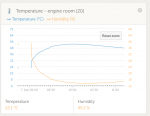
Here's from starting and running the engine at 1000-1200rpms yesterday while docked (this is before I redid the air pipes to the engine room, only "passive ventilation" here). Notice how the temps just straight up to 35-40 degrees in just a few minutes.
Screenshot from 2022-09-08 11-17-58.png

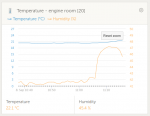
Here's from today, after fitting a vent pipe from the outside stern to right where the engine's air intake is, and a blower-equiped "air sucker" pipe tucked in the opposite corner (near the exhaust elbow). Started motor at 11, the jump in humidity is me quickly opening the engine room hatch and then closing it again:
Screenshot from 2022-09-08 11-18-15.png

So far the effects are far more substantial than I had imagined. Granted, yesterday's run was with slitghly higher rpms and more alternator load, but the fact that I'm no longer seeing a massive jump in temps only a few minutes in is interesting.

With my current configuration I'm very prone to flooding the engine room if I take a breaking wave on the stern so there's still work to do but I won't be going out into big seas for the rest of this season, so I'll keep the current setup and do more real-life testing.
 
Top