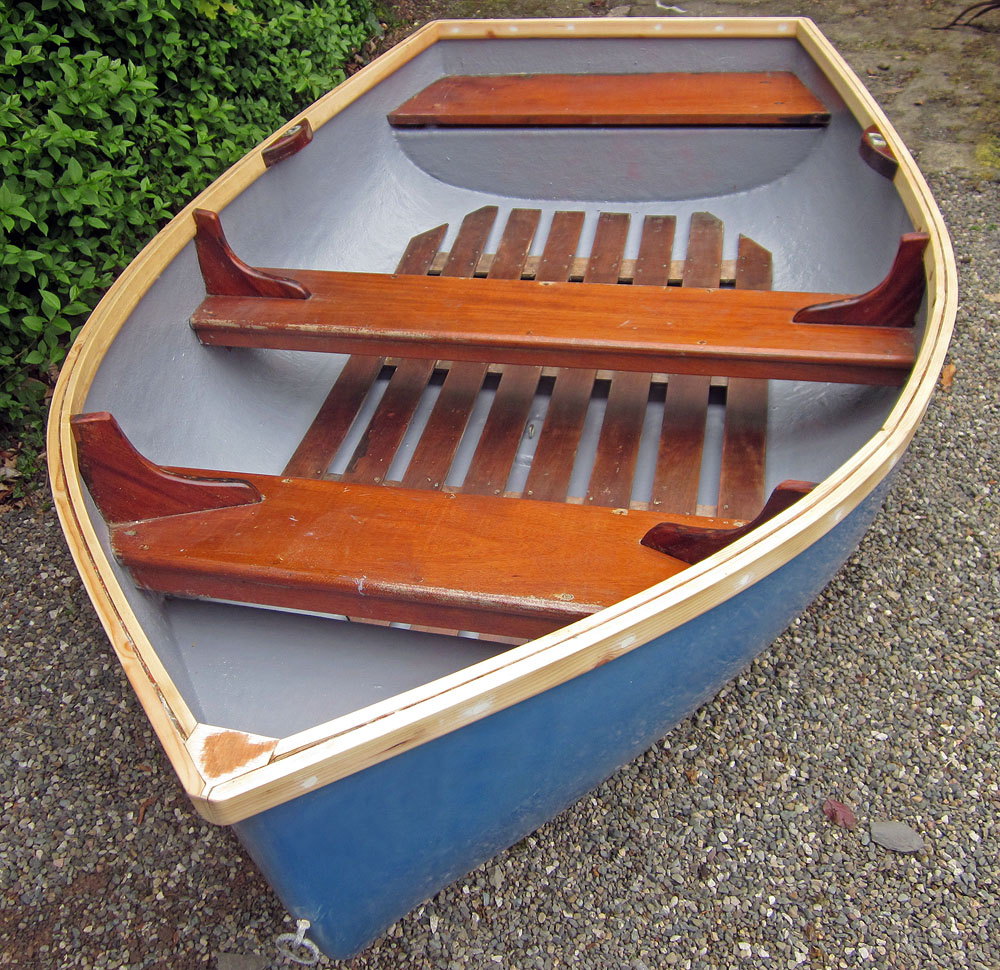
Small dinghy gunwale

PondRower

New Member
Joined
25 May 2020
Messages
2
Visit site
Hi - First time poster, I hope this question isn't too stupid!

We have a small fibre-glass dinghy left behind by the previous owner. It is only used on our pond, mainly for duck-weeding and the like. The wooden gunwale has completely rotted away so there's nowhere to mount the oars..

What wood should I use for the replacement gunwale? Would knot-free DIY shop pine strip wood do the job or would I be better to go for something like ash?

The boat is never going to be anything special but I do like trying to do a job properly, so any advice would be most gratefully received.
 
You could use some really nice hardwood, but then you'd have to look after it.
My Merlin Rocket had gunwhales laminated up from ash and mahogany AFAIK. Nicely varnished and kept indoors whenever possible
My tender for Portsmouth harbour has reclaimed pine glued on with 'no moron thinks this is nails' and coated with wood preserver.
It's more of a rubbing strake as it gets to meet the quay wall.
Did the job for about 2 quid and going strong after 5 years.

Your boat, your standards, so long as it does the job IMHO.
 
Browsing in Covers builders merchants one day, I found that they did mahogany strip about 10 X 30 mm. I think it was for trim around wood replacement double glazed windows. Four lengths of that made very nice gunwales on my old knock-about dinghy. They get a coat of linseed oil once a year.
 
I did mine a few weeks ago - I had some old hardwood from a conservatory, I laminated 45x10mm strips on a temporary jig, with Gorilla glue, fitted nicely and finished with International Woodskin. Hopefully will last several more years.
 
Hi - First time poster, I hope this question isn't too stupid!

We have a small fibre-glass dinghy left behind by the previous owner. It is only used on our pond, mainly for duck-weeding and the like. The wooden gunwale has completely rotted away so there's nowhere to mount the oars..

What wood should I use for the replacement gunwale? Would knot-free DIY shop pine strip wood do the job or would I be better to go for something like ash?

The boat is never going to be anything special but I do like trying to do a job properly, so any advice would be most gratefully received.
DIY shop pine would do the job but better to prime and paint it rather than varnish.. At least 2 coats of primer on the back face where it contacts the grp as that is where water will dwell and start the rot. Round all the sharp edges as paint and varnish does not form adequate film thickness on corners. Ash is not a durable wood although a good bit stronger than the pine. Use whatever wood you can get, provided it will bend round the curve ok. If you want maintenance-free I would use iroko or oak (although bending round the hull not so easy so you may have to use a slightly thinner section or laminate two layers with a good waterproof glue) then you could leave entirely bare with no paint or varnish. It will turn a nice light grey colour and could last 20 years, as long as you have used stainless steel screws, saving lots of time and the cost of lots of paint or varnish.

Www.solocoastalsailing.co.uk
 
DIY shop pine would do the job but better to prime and paint it rather than varnish.. At least 2 coats of primer on the back face where it contacts the grp as that is where water will dwell and start the rot. Round all the sharp edges as paint and varnish does not form adequate film thickness on corners. Ash is not a durable wood although a good bit stronger than the pine. Use whatever wood you can get, provided it will bend round the curve ok. If you want maintenance-free I would use iroko or oak (although bending round the hull not so easy so you may have to use a slightly thinner section or laminate two layers with a good waterproof glue) then you could leave entirely bare with no paint or varnish. It will turn a nice light grey colour and could last 20 years, as long as you have used stainless steel screws, saving lots of time and the cost of lots of paint or varnish.

Www.solocoastalsailing.co.uk
I work for a timber treatment chemical company and second that ash is not a durable species. (This is not uninformed opinion. We have tables of species, durability and treatability, Ash is strong and tough and ideal for axe handles and tillers but not durable!)
Treated pine will be quite good in the application, soft to take bumps, easy to bend and durable. Bond it to the roughened GRP with epoxy resin. Job done!
Top tip: The temptation is to sandwich the fibreglass sides of the dinghy between two gunwhale strips. Better to put the whole gunwhale on the outside, then when you stand the dinghy on its side to drain water out, it all ALL flows out rather than having an internal gunwhale ridge that retains the last few litres...
 
Far easier to fit both sides.
Also protects you from exposed GRP edge. The bit of water trapped in minimal, especially if you rock the boat a bit as you lay it down.

mG6B8ZYA_o.jpg
 
Thank you for all these comments - plenty of food for thought.

The comments about Ash are very helpful - I just happen to have one that came down in the gales earlier this year. I'm intending to turn it into planks that would provide strips for the gunwale, which is why I mentioned it. I'll probably go for pine strip but, when the lock-down permits, I'll check out my favourite timber yard for hardwood strip that could be laminated..

The original gunwale was a sandwich and side of the boat is moulded with a step out to take the inner piece. I'm sure one of the pieces was a J section to cover the fibre-glass edge, but your photo, Caraway, makes me realise it's not necessary - the exposed edge is pretty clean anyway, with no raw fibre showing.

Thanks again, you've been very generous with your advice.
 
Hi I have a Bobbin dinghy which currently has a plastic moulding strip to protect the edges where they are sandwiched together, but it is damaged and I want to fit a timber gunwhale. I have no idea how to do this, please could someone give me a simple sequence of steps to do this in terms of method and materials. It seems the timber needs bending to fit, My DIY skills are reasonable enough.

Many thanks.
 
Much depends on the construction of the gunwhale of the dinghy. (and of course just how diligent you are. If the GRP comes up to just a straight edge then it will need wood front to back preferably on both sides to give support to the hull at gunwhale. (Caraway's beautiful dinghy is of this style) On the other hand many dinghies have a GRP turn over outwards of the hull giving shape support to the hull with out added wood. if that is the case then you can add wood gunwahles or just bolt a block of wood to take a hole for a rowlock. In any case you will need a wide block to take a hole usually about 12mm for your rowlocks. You do have oars and rowlocks I hope. If not worth buying decent oars stops and rowlocks to give real positive motion and control of the dinghy. (even on a pond) https://www.whitworths.com.au/timber-oars-with-stops https://www.whitworths.com.au/galvanised-rowlock Rowing wioth deceent oars can be a real pleasure and excercise. ol'will
 
I have a dingy about that size. Bought for peanuts as pretty beat up. It had a a grp lip where the upper mould joined the lower with a plastic u profile trim. All of it had seen better days and the lip would rub off the lip when the dingy bumped against the hull of the mothership. I fixed this by using 1 inch diameter hemp rope lashed every foot along the lip. Dont use cable ties for lashing as they just break.

I have also used wood trim on various canoes i have made or refurbed. Pine from the hardware store worked well. Make the trim narrower as it curves more at the bow and stern. Seal carefully where at the top to avoid water sitting in the gap and rotting the wood. The inner trim can be padded out to allow draining when the boat is stored upside down.
This isnt a pic of my canoe but it illustrates the point.
2024-05-19 13_30_07-Cedar strip canoe (Walnut, Ash, Cedar) _ Cedar strip canoe, Wood boat buil...png
 
Hi I have a Bobbin dinghy which currently has a plastic moulding strip to protect the edges where they are sandwiched together, but it is damaged and I want to fit a timber gunwhale. I have no idea how to do this, please could someone give me a simple sequence of steps to do this in terms of method and materials. It seems the timber needs bending to fit, My DIY skills are reasonable enough.

Many thanks.
I fitted a new gunwale to a tender some years ago.
It's easier to build up the gunwale from a few thin pieces of wood than to bend a thick single piece.
Some sort of 'no more nails' glue from a mastic gun is great for gluing wood to GRP.
I fitted an 'inwale' as in a strip inside the boat to get the strength I wanted.
The boat was quite floppy with no gunwale, so I decided it was best to work on both sides at once for symmetry.
Luckily I has quite a lot of clamps of various sorts, but I borrowed about a dozen more from mates.
I also put quite a few screws in, most of which I removed before adding the next layer of wood.
None of the strips of wood were full length, I used whatever was lying around, it's a tender not a Merlin Rocket.
I finished it with wood preserver and decking oil or cheap teak oil, as I knew it would get scratched etc.
I sold the boat after about 3 years with no problems.
 
I had a laminated tiller, ash and mahogany(?). Although I never left the tiller exposed in winter, not sure about previous owners, the ash rotted beneath the stainless steel cap at the stock end, discovered when the tiller snapped off. Fortunately not at sea
 
I would suggest you use iroko, at 10 mm thick you won’t have any problem making the bends (just finished a wooden dinghy with iroko gunwales). You can varnish it or just leave it to go grey with weather like teak. It will not rot!

This was mine


1716133823202.jpeg
 
Top