Small boat practical safety gear?

I use a small RIB up to maybe 5 miles offshore. Once you're two miles out, it's all the same.
I will only do that if I totally trust the engine.
When I first got the boat, I would only go out with a mate around in another boat, or I put a 2HP yamaha on the transom.
Powerboats don't row or paddle well. A stout canadian-canoe style paddle is handy for manoeuvring.
I think the OP has most things reasonably covered TBH.
A space blanket could be added to the first aid kit?
A tow line?
Did anyone mention a horn of some sort?
Have all the useful numbers in your phone, make sure someone ashore knows what you're up to.
I like to be able to drain the carb (if there is one) and change a spark plug, so check the tool kit has the right things in it.
Can the engine be manually started?
 
I use a small RIB up to maybe 5 miles offshore. Once you're two miles out, it's all the same.
I will only do that if I totally trust the engine.
When I first got the boat, I would only go out with a mate around in another boat, or I put a 2HP yamaha on the transom.
Powerboats don't row or paddle well. A stout canadian-canoe style paddle is handy for manoeuvring.
I think the OP has most things reasonably covered TBH.
A space blanket could be added to the first aid kit?
A tow line?
Did anyone mention a horn of some sort?
Have all the useful numbers in your phone, make sure someone ashore knows what you're up to.
I like to be able to drain the carb (if there is one) and change a spark plug, so check the tool kit has the right things in it.
Can the engine be manually started?
My engine is electric start only.

I trust it and is in immaculate condition OBVIOUSLY things can and do go wrong when you least expect it and i would NEVER trust any engine 100%.

I always leave a plan on land with a family member and keep in constant contact with conditions and time of arrival and where we intend to be going.

I was thinking of getting an air horn too but i thought they where mainly used in bad viz conditions. I have double and tripple checked my tool bag and everything i need to do basic repairs for my motor is in that bag.

I can take a look at a tow line too. Will need more info on diameter, Type of rope and length etc.

I will keep an eye out for a 2hp motor on marketplace/ebay as it seems like its the preferred backup.
 
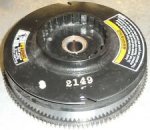
Are you sure it's electric start only ? The flywheel nearly always has notches for a knotted rope to be used as a pull start even when hidden under a plastic cover.
I had one that had butterfly nuts to facilitate easy removal.
I often hand started a v6 2 stoke 200hp due to flat battery.
 
Are you sure it's electric start only ? The flywheel nearly always has notches for a knotted rope to be used as a pull start even when hidden under a plastic cover.
I had one that had butterfly nuts to facilitate easy removal.
I often hand started a v6 2 stoke 200hp due to flat battery.
Wow! Pulling over a 200hp motor by hand? Am i talking to Eddie hall here hahaha

Tbh I've never really looked il take off the flywheel cover tomorrow and take a pic and upload, Hopefully someone can let me know if its suitable for a emergency rope. Cheers
 
This is how they often look. Two cutouts for putting a knot in, two turns around the flywheel and pull !
It's not as hard as you would imagine pulling a 200hp. The more cylinders the easier it is.
A 75hp 4 stroke was a lot harder to pull.
 

Attachments

  • s-l225.jpg
    s-l225.jpg
    11.7 KB · Views: 4
This is how they often look. Two cutouts for putting a knot in, two turns around the flywheel and pull !
It's not as hard as you would imagine pulling a 200hp. The more cylinders the easier it is.
A 75hp 4 stroke was a lot harder to pull.
Ah brill il take a look ? cheers
 
2hp motor was what I had.
The shaft was just long enough to put the prop below the transom, by mounting it right to one side.
We could then sit on that side and well forwards to get the transom pretty much out of the water, and the 2hp would push the boat along OK, or at least a lot better than rowing.
If you have the transom well immersed, 2HP will struggle to make much progress.
The main thing is to trust your main engine. Which is partly about using it often enough.
The bloke I bought my boat from had a little 12V outboard/trolling motor, I think he used to hoon out to the fishing area then potter around with electric.
I think you can get long shaft electric outboards. Maybe that's a get-you-home option. you'd have to think about the battery situation.
There would be nothing worse than a 2HP that didn't start when needed, because it never got used. And 2HP motors attract thieves more than just about anything else!

TBH I'm happier with sails once were out of shouting distance from the harbour!
 
Unusually for me, I haven't bothered to read the entire thread before posting. I suspect that, having asked on a yacht-centred forum, the OP is being weighed down with far more stuff than is practical for a 14-foot dinghy. Not overloading the boat is a safety feature in itself.

It's a cathedral-hull dory, so almost certainly has foam buoyancy and won't sink. Low freeboard, so if you fall overboard when stationary you can climb back up using the (stopped!) outboard as a step (I've done it several times with a Suzuki 40hp and a Tohatsu 50). Falling overboard at speed? Kill cord, obviously, and take it easy in a chop. Is it just the OP on board, or is there someone who could come back and get him if he bounced out at speed and the boat got some distance away before stopping?

Good clothing, something that will keep you warm even when wet, is going to be more use than a lot of the dedicated "emergency" gear. Depends on the conditions, but in winter I wouldn't consider a drysuit overkill in such a small boat. I've also heard of the Fladen closed-cell foam fishing suits, though I've never tried one. If you had a wave come into the boat and soak you to the chest, on a cold day you could go from happy as larry to an imminent casualty in a very short time with the wrong kit.

What seems to me the most likely form of difficulty is something taking out that single engine. Some tools to try to fix it are a good start - I'd also include a can of WD-40 if you haven't already, for chasing water out of the electrics. But if you still can't get it going, you have a choice of whether your plan is to call for help or get yourself back to shore. I feel that small boats should always have oars or paddles, but six miles is a long way to row a heavy, square dory with short emergency oars and it doesn't seem like a practical answer. So it's a spare engine or accepting that you'll be calling for a tow - and that choice probably depends where you are. Where I live the waters are busy, and my dead-engine backup plan in the ZapCat was absolutely to make a non-emergency call for a tow - a couple of times the old Suzuki conked out temporarily and we had other boats come up and proactively offer (fortunately we always got it going again before needing to accept their generosity!). But if you're off some remote part of Scotland where there isn't any passing traffic, you ought to be more prepared to self-rescue. I know I said to avoid overloading the boat, but if I was 6 miles out to sea with nobody else around, a 2.2hp 2-stroke lashed down under the bow dodger would give me a lot of confidence. Mine weighs 12kg...

So, calling for help either because your engine has conked out and you don't have a spare, or because the boat capsized and you can't right it, or something far more unlikely happened (your second fuel can turned out to be full of water, your mate's having a heart attack, you stabbed yourself in the leg while fighting a giant mutant mackerel...). You're going to want to be on the VHF to the Coastguard, anything else is a poor second-best. Oh, and note that you're going to want to be giving them a lat and long, they're no longer very good at dealing with verbal descriptions and they don't have DF capability any more. So a fully-charged good quality VHF, including one you can use while kneeling on your upturned hull. 6 miles should be OK with a handheld, to a Coastguard aerial. One with a GPS in it would be good, for that lat and long - I don't think DSC is of huge benefit here, but that's probably how it'll come, and it doesn't hurt to send off an alert that way. But a scared voice saying "Mayday" is what really gets people going in reality. Inshore, a PLB or EPIRB is really just a more hands-off, slower, less direct way of doing much the same thing - don't hurt to have one, but it wouldn't be my priority. After the VHF, I think I'd want flares rather than additional electronic means. They're unfashionable nowadays, but there's nothing like 'em for attracting attention of anyone in sight who's not listening to a marine radio, and no mistaking what they mean. I have one in my tender just in case, even though that boat goes hardly any distance at all.

Bit of a ramble - but I guess my point is that, rather than just compile a list of every possible thing, think through what could go wrong, how you'd deal with it, and whether there's anything you'd need in that situation that you don't already have on board. And with a boat that size, do your best to keep it light and buoyant :)

Pete
 
Having a secondary means of propulsion is essential IMHO what out at sea, even if its 2 paddles and a bedsheet as a makeshift mast and sail.

I would also rig up an easy way to get back on board on your own if you went over the side.

I also have a rope along the gunnel to hang onto and a motor cutout lanyard attached all the time as a safety harness and line connected to the boat so if you do go overboard when fishing you are still attached to the boat.

I have a 5 meter motor boat with 85hp 2 stroke outboard and a electric outboard which runs of the outboard start battery on a lifting bracket.
 
Having a secondary means of propulsion is essential IMHO what out at sea,
What's your reasoning here? Assuming it's somewhere with a bit of traffic, 6 miles isn't far out and comms will be good. I've driven into the Scottish wilderness without even a bottle of water let alone a spare engine for my car, and the comms there are terrible. There are 40 foot motor boats which have just a single engine - should they also carry a 100HP outboard?
 
What's your reasoning here? Assuming it's somewhere with a bit of traffic, 6 miles isn't far out and comms will be good. I've driven into the Scottish wilderness without even a bottle of water let alone a spare engine for my car, and the comms there are terrible. There are 40 foot motor boats which have just a single engine - should they also carry a 100HP outboard?


One of the reasoning is that when (not if) bad weather comes you need someway of getting home or at least to a safe haven PDQ and if you cannot start your engine you are up a creak without a paddle so to speak.

Where I am located we are not allowed to go to sea with a single means of propulsion but we are more remote than the south coast of the UK

As I say my mobo has a single 85 hp but I am considering changing that to 2 x 40 hp outboards

You may fnd a 40 ft mobo will have at least 2 engines anyway

In Scottish wilderness you can hunker down in your car and find a stream to get a drink. in a small boat out at sea you cannot do that
 
Unusually for me, I haven't bothered to read the entire thread before posting. I suspect that, having asked on a yacht-centred forum, the OP is being weighed down with far more stuff than is practical for a 14-foot dinghy. Not overloading the boat is a safety feature in itself.

It's a cathedral-hull dory, so almost certainly has foam buoyancy and won't sink. Low freeboard, so if you fall overboard when stationary you can climb back up using the (stopped!) outboard as a step (I've done it several times with a Suzuki 40hp and a Tohatsu 50). Falling overboard at speed? Kill cord, obviously, and take it easy in a chop. Is it just the OP on board, or is there someone who could come back and get him if he bounced out at speed and the boat got some distance away before stopping?

Good clothing, something that will keep you warm even when wet, is going to be more use than a lot of the dedicated "emergency" gear. Depends on the conditions, but in winter I wouldn't consider a drysuit overkill in such a small boat. I've also heard of the Fladen closed-cell foam fishing suits, though I've never tried one. If you had a wave come into the boat and soak you to the chest, on a cold day you could go from happy as larry to an imminent casualty in a very short time with the wrong kit.

What seems to me the most likely form of difficulty is something taking out that single engine. Some tools to try to fix it are a good start - I'd also include a can of WD-40 if you haven't already, for chasing water out of the electrics. But if you still can't get it going, you have a choice of whether your plan is to call for help or get yourself back to shore. I feel that small boats should always have oars or paddles, but six miles is a long way to row a heavy, square dory with short emergency oars and it doesn't seem like a practical answer. So it's a spare engine or accepting that you'll be calling for a tow - and that choice probably depends where you are. Where I live the waters are busy, and my dead-engine backup plan in the ZapCat was absolutely to make a non-emergency call for a tow - a couple of times the old Suzuki conked out temporarily and we had other boats come up and proactively offer (fortunately we always got it going again before needing to accept their generosity!). But if you're off some remote part of Scotland where there isn't any passing traffic, you ought to be more prepared to self-rescue. I know I said to avoid overloading the boat, but if I was 6 miles out to sea with nobody else around, a 2.2hp 2-stroke lashed down under the bow dodger would give me a lot of confidence. Mine weighs 12kg...

So, calling for help either because your engine has conked out and you don't have a spare, or because the boat capsized and you can't right it, or something far more unlikely happened (your second fuel can turned out to be full of water, your mate's having a heart attack, you stabbed yourself in the leg while fighting a giant mutant mackerel...). You're going to want to be on the VHF to the Coastguard, anything else is a poor second-best. Oh, and note that you're going to want to be giving them a lat and long, they're no longer very good at dealing with verbal descriptions and they don't have DF capability any more. So a fully-charged good quality VHF, including one you can use while kneeling on your upturned hull. 6 miles should be OK with a handheld, to a Coastguard aerial. One with a GPS in it would be good, for that lat and long - I don't think DSC is of huge benefit here, but that's probably how it'll come, and it doesn't hurt to send off an alert that way. But a scared voice saying "Mayday" is what really gets people going in reality. Inshore, a PLB or EPIRB is really just a more hands-off, slower, less direct way of doing much the same thing - don't hurt to have one, but it wouldn't be my priority. After the VHF, I think I'd want flares rather than additional electronic means. They're unfashionable nowadays, but there's nothing like 'em for attracting attention of anyone in sight who's not listening to a marine radio, and no mistaking what they mean. I have one in my tender just in case, even though that boat goes hardly any distance at all.

Bit of a ramble - but I guess my point is that, rather than just compile a list of every possible thing, think through what could go wrong, how you'd deal with it, and whether there's anything you'd need in that situation that you don't already have on board. And with a boat that size, do your best to keep it light and buoyant :)

Pete
Thanks Pete makes alot of sense. Il keep my eye open for a small LIGHT aux, although being that small i cant see it making much headway with all the weight, Tide and wind.

My old mariner 25hp got a max speed of 9kn with all the gear at WOT! Thats why i now have a 40hp

So a 2hp is questionable if the extra weight and cost will pay off or just make a heavy boat even heavier, unstable and become more of a hazard...but il try it.

I want to do this safely as i can.

I dont want to be a statistic and i am fully open to suggestions and learning.

Too many people skip on safety and im not one of em.

If i need to call for help its because ive explored all other eventualities and covered all PRACTICAL saftey requirements and im in NEED of a recovery as a last resort.

Thats what the CG and RNLI are there for.

The people that go out in the dark, no lights, lifejackets, flares, no idea, 2 crates of forsters and fall overboard and want help dont deserve the help...someone that is trying to ask for knowledge to prevent that in every practical way shouldn't feel embarrassed or guilty to make the call.

At the end of the day thats what the emergency services are there for. Cheers
 
Thanks Pete makes alot of sense. Il keep my eye open for a small LIGHT aux, although being that small i cant see it making much headway with all the weight, Tide and wind.

My old mariner 25hp got a max speed of 9kn with all the gear at WOT! Thats why i now have a 40hp

So a 2hp is questionable if the extra weight and cost will pay off or just make a heavy boat even heavier, unstable and become more of a hazard...but il try it.

I want to do this safely as i can.

I dont want to be a statistic and i am fully open to suggestions and learning.

Too many people skip on safety and im not one of em.

If i need to call for help its because ive explored all other eventualities and covered all PRACTICAL saftey requirements and im in NEED of a recovery as a last resort.

Thats what the CG and RNLI are there for.

The people that go out in the dark, no lights, lifejackets, flares, no idea, 2 crates of forsters and fall overboard and want help dont deserve the help...someone that is trying to ask for knowledge to prevent that in every practical way shouldn't feel embarrassed or guilty to make the call.

At the end of the day thats what the emergency services are there for. Cheers
The very fact you are thinking about it puts you far ahead of many afloat!
 
You may fnd a 40 ft mobo will have at least 2 engines anyway
You may, you may not. I've been on plenty with a single engine, should we condemn them all because of theoretical scenarios? The reality is that almost nobody has suffered ill consequences from having a single engine fail and not being rescued. I'm sure there are a handful of people, but as I said earlier you're more likely to get run over on the way to the boat.
 
Either, change his mind and get a 2hp outboard, or do nothing. The chances of rowing a 14ft Seahog 6nm in a seaway are absolutely zero. It isn't like rowing a tender.

Totally agree. And to be clear, I raised the possibility of a spare engine, but that doesn't mean I think it's mandatory. It depends completely on the location, and if Dan's somewhere that's not too remote, with an engine that he trusts implicitly, the right decision may well be not to carry another.

I've been out in a single-engined small motorboat with a known-to-be-a-bit-dodgy engine, and didn't carry a spare - because we were sticking around the Solent on summer weekends, and had an anchor and a VHF to stay put and call for assistance. Not from the RNLI, but from any of the other boats whizzing around and willing to help. In fact the only time we ever did any towing with that boat, we were on the other end of the rope, recovering a small cabin cruiser that had run out of fuel and taking him back to his marina. He gave us £50 and everyone was happy. But my mate who owned the boat wanted to trailer it to West Wales and head out to sea from there - I told him I wasn't doing that unless it was with a new and proven engine, and that we should have a think about a spare.

Pete
 
You may, you may not. I've been on plenty with a single engine, should we condemn them all because of theoretical scenarios? The reality is that almost nobody has suffered ill consequences from having a single engine fail and not being rescued. I'm sure there are a handful of people, but as I said earlier you're more likely to get run over on the way to the boat.

My last boat was a single engined diesel mobo. To fit an aux outboard was just not practical, it would need to be too big and the amount of fuel to carry would have been stupid.

There are lots and lots of big, single engined mobos out there, several in my home marina. The Europeans seem to build a lot of them, Elling, Nimbus et al

I have suggested the OP considers a small aux for two reasons, firstly, because it's noot totally impractical, he already carried the fuel it will need and secondly, it's a small boat, if it breaks down in a lumpy sea, at least the little aux should keep it pointing into the weather.

That said, what size aux outboard would you fit to this single engined mobo and how much petrol would you carry:

2020 Elling E4 Power New and Used Boats for Sale - www.yachtworld.co.uk
 
Top