Sleeping whilst at anchor?

Beautiful! Looks like you are somewhere in the Mediterranean! But in which country?
On the fabulous Côté dAzur
I wish I could describe it for you. I have just been on deck, the night is fragrant and very still. The only sound is the occasional small wave on the sand. We are in barely two metres of water which is so clear and the moon so bright that I can see my anchor on the bottom as if it were on deck. And it’s nearly midnight.
 
To drift the thread a bit more, those who use a snubber bridle, do you just thread it through the chain and then back to the boat? One end going through the port fairlead, one end going through the starboard one? Or do you hook/tie the middle of the bridle on?

Bridle usually terminates at a common shackle or ring, Each arm might have separate splices (at both ends). Where the two arms are joined you can use a single chain hook, or a soft shackle. We use a bridle plate. I don't recommend claws they can be difficult to take off under tension, they can be very well made and match the chain perfectly but that means you need to orientate the chain to release. A common hook is easier.

If you have a bobstay you can set up a standard bridle, running though each fairlead, run to the chain and then back to a common termination at the bob stay. This gives you 2 triangles - the normal 'horizontal' one that manages veering and a 'vertical' one that manages chop. There is another advantage as this set up 'improves' scope.

If you want more detail on this latter send me an email address by PM and I'll send you a pdf..

There is an article scheduled in YM for June.

Jonathan
 
Bouba

I assume you commence your bridle at the bow cleats. If you commenced your bridle at the transom, or further aft, you would enjoy much more elasticity.

Again if you want details send me an email address and I'll send you a pdf.

Jonathan
 
What is one going to tie the bridle to that is further aft than the transom? :unsure:

Richard

Poor use of English, it is a forum, it is the internet - I'll re-write that for you Richard :)

'If you commence your bridle at the transom, or further aft (than the bow cleats, I was thinking of amidship cleats) you would enjoy much more elasticity'.

Jonathan
 
Ok, this is me right now! I’m at anchor in shallow water. There is my stubber, it’s a chain hook on a bridle with dog bones. And you can see my 20 kg Rocna. I hope to sleep well tonight, if I don’t, no problem, because we are the only ones here in this beautiful bay on this beautiful evening and it is a full moon. Should you really sleep through it ??‍♂️????


I'm sure it is calm, but that anchor photo does not calm me at all. The anchor drags in from the bottom left, indicating it has been scraping but not going deeper. The suggestion is that the sand may be over hard pan (flat rock) and the holding power is probably not more than the sand in front of the anchor, maybe a few hundred pounds. Heck, the back of the fluke is not even flush with the sand. Was it power set? Was the boat motionless for a time period or still creeping backwards?

Not confidence inspiring. Alarm bells if any wind is expected. But maybe there will be no wind.
 
I'm sure it is calm, but that anchor photo does not calm me at all. The anchor drags in from the bottom left, indicating it has been scraping but not going deeper. The suggestion is that the sand may be over hard pan (flat rock) and the holding power is probably not more than the sand in front of the anchor, maybe a few hundred pounds. Heck, the back of the fluke is not even flush with the sand. Was it power set? Was the boat motionless for a time period or still creeping backwards?

Not confidence inspiring. Alarm bells if any wind is expected. But maybe there will be no wind.
It was power set but not a great deal of power. I also think that a lot of sand here is over rock. But, except on the internet I have never seen the Rocna bury very deep. But it does hold, that furrow in front of the anchor is from the setting. It then stopped the boat reversing.
And yes, there is no wind? in fact we have spent most of the time with the anchor beside the boat
 
It was power set but not a great deal of power. I also think that a lot of sand here is over rock. But, except on the internet I have never seen the Rocna bury very deep. But it does hold, that furrow in front of the anchor is from the setting. It then stopped the boat reversing.
And yes, there is no wind? in fact we have spent most of the time with the anchor beside the boat

I'd bet dinner it caught on a lump of underlying rock.

No, that trench is NOT from the setting process. That is dragging until it hook.

This is representative of an anchor placement that you can get away with 95% of the time. It will probably only release if the wind swings >60 degrees, and even then, it would likely re-hook on something else and you would never know what happened. This is why dragging is so rare; it takes a considerable change in weather to cause a release, and even then, it is likely to catch again without the owner even noticing.

I've tested in places just like that. One of them, very near my home marina, I had anchored countless times for lunch and swim breaks before I got into testing, and I never noticed the trap until I started diving on anchors and testing under high load. And now I now why boats occationally dragged from there during storms; It looks like perfect sand, but the sand is variable from several feet to only 6 inches.
 
Last edited:
Anchoring and sailing have always been synonymous for me. In fact, until I had my own first boat, which I kept in a marina, I had never slept on a boat that was not at anchor and even then, whenever I went cruising, I only once stayed in a marina and that was for the sole convenience of picking up friends. I simply did not know it any differently. We did not fret about anchors either; my Dad's boats all had Danforths of indeterminate sizes with a chain leader and line, the ones that are regularly rubbished in the new-gen anchor tests. It was what I used (at first) as well. We dragged, occasionally. It happens, nothing dramatic, reset and have another go. Anchor alarms? "Yah, sure, keep an eye on that tree, boy, and let me know if it moves."

When I sailed from Europe to the Canada's West Coast, the times I tied up in a marina in the Med I can count on a single hand and after the Canaries, other than for bunkering fuel and water, the boat never touched dry land until we reached San Diego. We dragged only once the entire voyage. It was in the Med. Right at the outset and first time we dropped the hook, in Calvi and it was blowing some 40kts. Fortunately it was during the day time, but it did smarten up my technique something wonderful.

Cruising Europe in our current boat, we still anchor a lot. When conditions warrant, I get up at night to check the plumbing and to see if that red marker is still where it was last, but other than that we do not give it all that much thought. We still use no anchor alarm. In the Dutch Waddenzee we rode out a F8 over night, on the old CQR that came with the boat; we slept, mostly; I did occasional checks, as there was a lot of current as well and I was concerned we might shift over a drying bank. According to what you read these days we should have woken up in America, but the way my missus set that hook I'm sure it must have shifted the continental shelf.

My take: you do not have to start your anchoring career in 40kt winds, pick some mild weather, a good bottom, set that hook proper and enjoy. Nothing short of sailing itself can give you that sense of independence, even if they seem to like to charge you for the privilege of wetting your own hook on the South Coast.

Just for your sense of comfort: calculate the actual wind loads and if you like, the expected tidal force for your boat. Compare that with the break out loads for your favourite anchor from the numerous tests that have been done. I did, quite recently, and found that even in a 50 kt breeze I would still have a 50% safety margin.
And with that I wish you a good night and a sound sleep.
 
'BUMKIN, or Boomkin, boute-lof, a short boom or bar of timber, projecting from each bow of a ship, to extend the lower-edge of the fore-sail to windward; for which purpose there is a large block fixed on its outer end, through which the rope is passed that is fastened to the lower-corner of the sail to windward, called the tack; and this being drawn tight down, brings the corner of the sail close to the block, which being performed, the tack is said to be aboard.

The bumkin is secured by a strong rope which confines it downward to the ship’s bow, to counter-act the strain it bears from the fore-sail above, dragging it upwards.'


The Project Gutenberg eBook of An Universal Dictionary of the Marine, by William Falconer

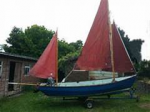
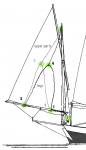
But in the case of small craft it also refers to a fixed spar projecting aft from the stern

1617041442597.png1617041552897.png
 
Last edited:
Anchoring and sailing have always been synonymous for me. In fact, until I had my own first boat, which I kept in a marina, I had never slept on a boat that was not at anchor and even then, whenever I went cruising, I only once stayed in a marina and that was for the sole convenience of picking up friends. I simply did not know it any differently. We did not fret about anchors either; my Dad's boats all had Danforths of indeterminate sizes with a chain leader and line, the ones that are regularly rubbished in the new-gen anchor tests. It was what I used (at first) as well. We dragged, occasionally. It happens, nothing dramatic, reset and have another go. Anchor alarms? "Yah, sure, keep an eye on that tree, boy, and let me know if it moves."

When I sailed from Europe to the Canada's West Coast, the times I tied up in a marina in the Med I can count on a single hand and after the Canaries, other than for bunkering fuel and water, the boat never touched dry land until we reached San Diego. We dragged only once the entire voyage. It was in the Med. Right at the outset and first time we dropped the hook, in Calvi and it was blowing some 40kts. Fortunately it was during the day time, but it did smarten up my technique something wonderful.

Cruising Europe in our current boat, we still anchor a lot. When conditions warrant, I get up at night to check the plumbing and to see if that red marker is still where it was last, but other than that we do not give it all that much thought. We still use no anchor alarm. In the Dutch Waddenzee we rode out a F8 over night, on the old CQR that came with the boat; we slept, mostly; I did occasional checks, as there was a lot of current as well and I was concerned we might shift over a drying bank. According to what you read these days we should have woken up in America, but the way my missus set that hook I'm sure it must have shifted the continental shelf.

My take: you do not have to start your anchoring career in 40kt winds, pick some mild weather, a good bottom, set that hook proper and enjoy. Nothing short of sailing itself can give you that sense of independence, even if they seem to like to charge you for the privilege of wetting your own hook on the South Coast.

Just for your sense of comfort: calculate the actual wind loads and if you like, the expected tidal force for your boat. Compare that with the break out loads for your favourite anchor from the numerous tests that have been done. I did, quite recently, and found that even in a 50 kt breeze I would still have a 50% safety margin.
And with that I wish you a good night and a sound sleep.
I couldnt agree more. We dont fret at anchor and dont set an alarm. Hundreds of nights at anchor in a typical season and plenty of good sleep. We are similar in that we never go in to a marina except at the end of the season when we lift out. Typical normal non-covid season is 9 month all at anchor?
 
If you search on the word as spelled, you should get a result that is meaningful in context ?

a. I was just havin' a bit of fun.
b. If you type "bumkin" into search engines you get definitions for "bumpkin."
c. If you type "bumkin" into the OED Learners Dictionary it redirects you to "bumpkin."

It was the redirects that caught me funny. Yes, I knew the difference. I though the whole line of discussion, based on Neeves casual mis-speak, was funny.

or the standard teacher's bumper sticker:

"Let's eat grandma"
(punctuation saves lives)
 
We had an anchor watch last August - only time I remember having one in last 15 years. Mainly because the tide outside Minehead had about a 10m fall and high speed. With 50m chain out at high tide, on arrival, we realised that nearly 40m would be mostly horizontal by low tide. In the small anchorage that might mean that we would have swung shorewards enough to have touched by low tide (I know this!!!). We took it in turns to either doze or sleep - worked well.

To put this in context, we were seeing out the foul tide, overnight. It was blowing F6-7 and Minehead is well sheltered if poor holding. With calmer weather we would have stopped at the excellent holding Blue Anchor Bay just the other side of Minehead.

Like Laminar, we see marinas as somewhere unusual to stop, although we are more frequent visitors than he/she is to them.
 
Top