Skipping the metalwork in the sails. Switching to webbing for easy home construction?

pperrin

New Member
Joined
25 Jun 2019
Messages
12
Visit site
I am pretty new to this, but have a sail that needs some work (reefing points)... I am pretty handy and am used to hand sewing heavy material (leather)... What I don't have is large heavy duty punch/setting equipment.

So rather than putting metal grommets/eyes in to the sail, I am looking at just adding webbing straps/loops (with reinforcement panels), then having metal shackles/horns etc directly through the webbing loops. This way I don't need any new equipment, just a bit of sailcloth, webbing, thread and hefty needles.

So reefing pennants would be a strap sewn to either side of the sail, no hole through needed. The reefing clew and tack just a loop of webbing (without without a metal ring using a cow hitch or piwitch knot, which could be put on/removed as required, so not flapping around when not in use). I woudn't fancy running rope through a webbing loop, so would use rings if it wasn't going over a metal horn or similar).

Good idea? Bad Idea? Old hat(!)?.
 
Good idea? Bad Idea? Old hat(!)?.

Old hat. Our offshore main doesn't have metal grommets for the reef points, just webbing, pretty much as you suggest. I'd be more concerned about whether the part of the sail you are attaching them to has been beefed up to take the loads of a tack or a clew.
 
Pressed-in eyes are cheap and cheerful.

But they're not ultimately durable and are very difficult to repair in remote places.

Therefore more rugged alternatives can be constructed with rings and tape (plus enough reinforcing material in the construction of the sail itself).

Alternatively if you like hand sewing, you can construct proper sewn cringles.

The "Sailmaker's Apprentice" by Emiliano Marino is all the info you need.
 
I bought a simple 'hammer' eyelet 'crimping tool' and a pack of stainless steel eyelets from Kayospruce several years ago, used for all sorts of canvas work since, been very useful for all sorts of projects both on and off the boat. 1/2" grommets from memory. You need a large hammer & firm base for the stainless eyelets, I bought a set of punches for punching the hole in the canvas/sailcloth. You will need a stainless ring in your webbing loops if you run rope thro' them. OR, get your local sailmaker to fit the required eyelets? assuming he won't charge too much.
I did my reefing tacks with a spectacle, stainless rings both side joined by a hand sewn piece of doubled up polyester webbing(don't use polypropylene - it's not strong enough and degrades rapidly in sunlight).
 
As yourself why sailmakers do what they do.

Because, if you have the machinery, pressing in a ring is much quicker and therefore cheaper than sewing. So it's a reasonable choice for a sailmaking business, but that doesn't mean it's inherently superior.

I can't see anything wrong with the OP's approach, done with proper reinforcing etc. I'd probably be inclined to thread a stainless ring onto the webbing for tacks that go onto gooseneck horns, just to help find and manipulate the thing when reefing, and avoid having to poke a horn through a loop of webbing that might have got flattened.

Pete
 
Agree with Flaming my last 4 mainsails have had webbing loops for reefing - it's just seen as standard on a racing sail. However when a sailmaker designs a sail they increase the weight of the sail cloth not just around the reefing points but for all of the sail above that point hence a sail with 3 reefs is normally a fair bit more expensive and heavier than a sail only designed with 2 reefs in it. So you might get away with it but after you have used the new reef a few times you might find that the leach of the sail above the reef may end up being stretched.
 
Wow, what an amazing response is such a short time! So much quality input, freely given!

A few votes for 'bad', most for 'good', and some for 'old hat' :)

I want to do the work, because I want to get some experience before having to buy a new sail, while knowing nothing about what I might want(!). If it is a disaster, then I'll have to buy the new sail a bit sooner than I wanted - but I may have some practical experience of the boat/sails in use to base that on.

I have sewn heavy leather, and sewn some webbing for climbing with rings, knots etc. So am quite happy with that - from the comments, it seems suitable reinforcement beyond the webbing will be the main issue.

Flamings video was great - Motor_sailors 'sew your own cringles' is possible, but if I am sewing why not simple webbing sewn through rather then fancy holes? - PetiteFleur and Sandy, the setting tool (die/anvil) is over £60, there are so many expenses on getting this yacht sailing, I just don't want to 'waste' any cash, and this may be a tool that I only use on one or two sails! - prv, ingwe, webbing it is... see how it goes(!).

Cheers guys :)
 
This detail might give you an idea of size and number of reinforcement panels.
It shows the first reef point (of three) in a 17 sqm FB tri-radial dacron mainsail made by North about five years ago.

reef%20point.jpg
 
Not an expert, but I'm sure it's a practical method of doing it and I know it works well. An Oyster 55 ketch with older Dolphin sails I've learnt on was doing fine with this sort of setup and it lasted (with the usual maintenance sails need) until the fabric was too tired and the sails were replaced.

The pressed ring is simply a labour-saving method, once you have the machinery, it's a lot quicker to do than sewing on a bunch of webbing. I think a good webbing layout distributes the loads a lot better into the fabric than a pressed in ring can.

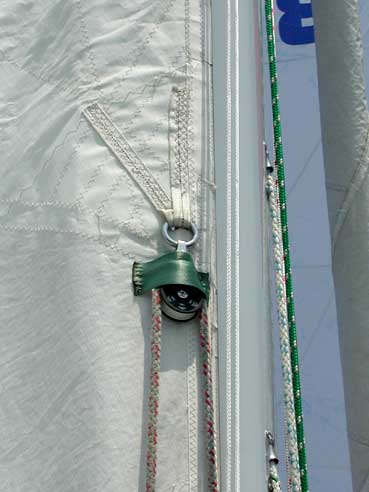
Here's an example of what the Dolphin sail had (ignore the retrofitted block):
TackBlock.jpg


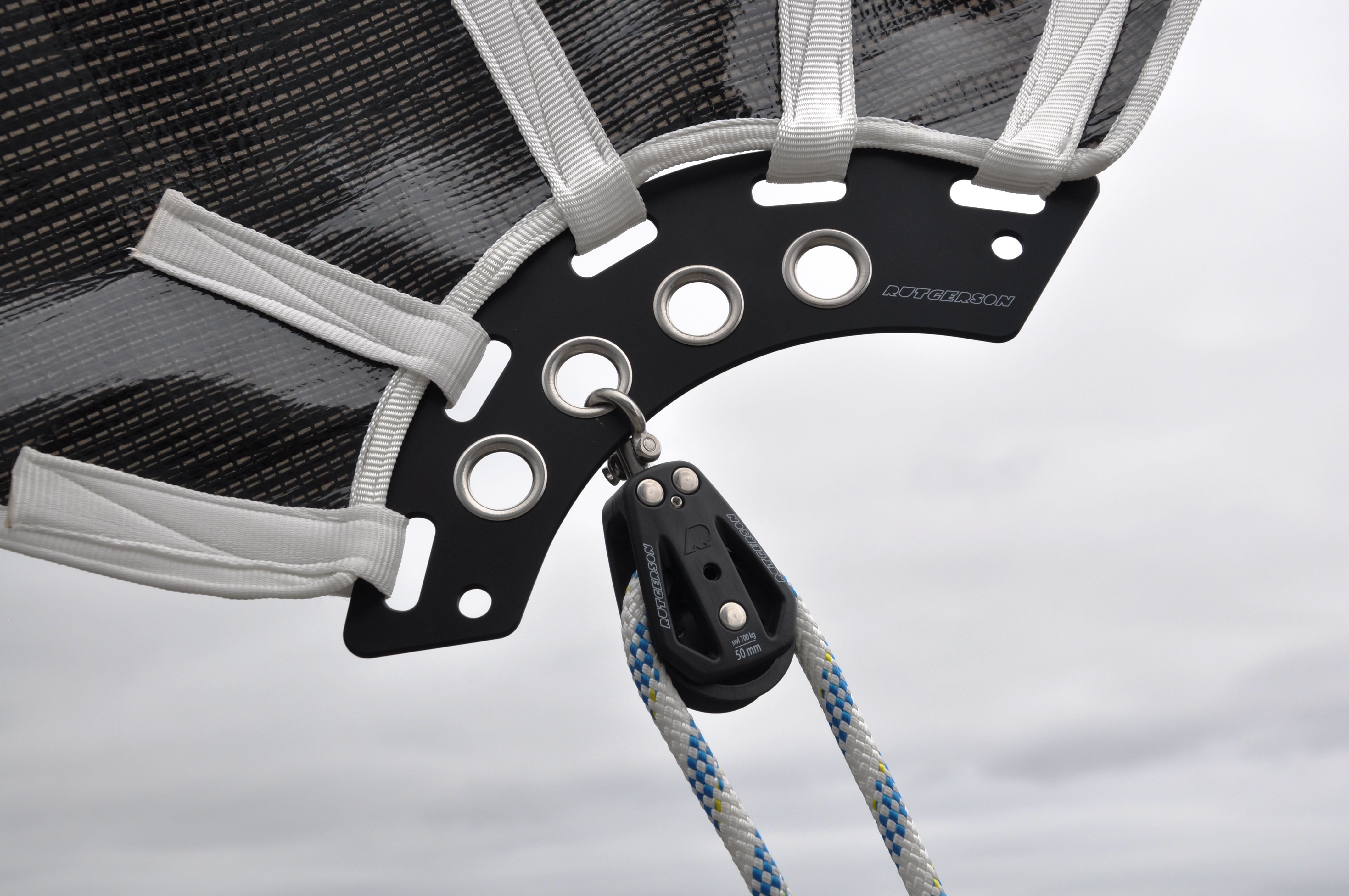
And on fancy modern sails (and in-mast furling) the clew board is typically attached with webbing too:
dsc-0248.jpg


Sailrite has a how-to video for a webbed clew ring:
https://www.youtube.com/watch?v=w_Vob8D0RWs
 
I am pretty new to this, but have a sail that needs some work (reefing points)... I am pretty handy and am used to hand sewing heavy material (leather)... What I don't have is large heavy duty punch/setting equipment.

So rather than putting metal grommets/eyes in to the sail, I am looking at just adding webbing straps/loops (with reinforcement panels), then having metal shackles/horns etc directly through the webbing loops. This way I don't need any new equipment, just a bit of sailcloth, webbing, thread and hefty needles.

So reefing pennants would be a strap sewn to either side of the sail, no hole through needed. The reefing clew and tack just a loop of webbing (without without a metal ring using a cow hitch or piwitch knot, which could be put on/removed as required, so not flapping around when not in use). I woudn't fancy running rope through a webbing loop, so would use rings if it wasn't going over a metal horn or similar).

Good idea? Bad Idea? Old hat(!)?.

Good IF the sail is reinforced properly
 
Does anyone else look at that photo and immediately think, “That reefing pennant needs tightening!”

Nope. But the photo does demonstrate why the fixed end of the reefing line is best looped around the entire boom and bowlines back onto itself. The example in the photo will cause a lot of twisting force on the gooseneck, potentially breaking it, as well as side load on the plastic fitting (less serious). The boom already appears to be rotated from its correct position.
 
Nope. But the photo does demonstrate why the fixed end of the reefing line is best looped around the entire boom and bowlines back onto itself. The example in the photo will cause a lot of twisting force on the gooseneck, potentially breaking it, as well as side load on the plastic fitting (less serious). The boom already appears to be rotated from its correct position.

That as well: but the reef needs to pull the sail flat as well as down. It could certainly pull it flatter if it was tighter.
 
That as well: but the reef needs to pull the sail flat as well as down. It could certainly pull it flatter if it was tighter.

Looks flat enough to me...

Agree that running bowline round the boom is going to be a better solution than those plastic stops though. Recently I came across what I now consider to be the absolute Rolls Royce of reefing line to boom solutions on a sistership to us. Essentially canvas strops to spread the load along the boom, especially good with carbon booms. You can see them in this photo. (Along with webbing reefing cringles)

802021.jpg
 
Looks flat enough to me...

Agree that running bowline round the boom is going to be a better solution than those plastic stops though. Recently I came across what I now consider to be the absolute Rolls Royce of reefing line to boom solutions on a sistership to us. Essentially canvas strops to spread the load along the boom, especially good with carbon booms. You can see them in this photo. (Along with webbing reefing cringles)

802021.jpg

They do look good. I didn't like the way that the sail was so proud of the boom - perhaps it is the way I am seeing it, but it didn't look as flat as it might be. However, we're not in the cockpit looking at it.
 
Does anyone else look at that photo and immediately think, “That reefing pennant needs tightening!”

Nope. But the photo does demonstrate why the fixed end of the reefing line is best looped around the entire boom and bowlines back onto itself. The example in the photo will cause a lot of twisting force on the gooseneck, potentially breaking it, as well as side load on the plastic fitting (less serious). The boom already appears to be rotated from its correct position.

That as well: but the reef needs to pull the sail flat as well as down. It could certainly pull it flatter if it was tighter.

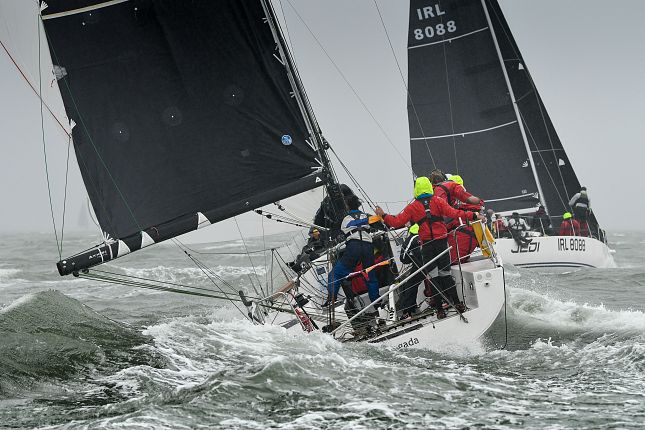
To determine whether the sail needs to be flattened or not, I would suggest look at the sail rather than at the pennant. Seeing below 'the whole picture', do you still judge this sail should be flatter?

Regarding attachment of the reefing line to the boom: I am aware that what you suggest is the current recommendation, but I very much doubt there will be any serious twisting force from the attachment point being a few centimeters off centre. Compare for instance with an accidental gybe, where there might be a twisting force due to the attachment of the main sheet being off centre at the under side of the boom.

And no, the boom is not rotated out of position, it is the boat that is heeled. :)

reefed.jpg
 
Top