Skipping the metalwork in the sails. Switching to webbing for easy home construction?

To determine whether the sail needs to be flattened or not, I would suggest look at the sail rather than at the pennant. Seeing below 'the whole picture', do you still judge this sail should be flatter?

Regarding attachment of the reefing line to the boom: I am aware that what you suggest is the current recommendation, but I very much doubt there will be any serious twisting force from the attachment point being a few centimeters off centre. Compare for instance with an accidental gybe, where there might be a twisting force due to the attachment of the main sheet being off centre at the under side of the boom.

And no, the boom is not rotated out of position, it is the boat that is heeled. :)

reefed.jpg

If it's your sail and you are sailing, then it's your choice.

I disagree about your interpretation of the turning moment of the reefing pennant on the plastic chock, but it's a free world and again it's your boat.

PS Do you really have your mainsheet fastened to one side of the boom?
 
They do look good. I didn't like the way that the sail was so proud of the boom - perhaps it is the way I am seeing it, but it didn't look as flat as it might be. However, we're not in the cockpit looking at it.

As the boat does not appear to be on its ear, one might think the main is not too full.
I've been in the situation of having reefed prudently, but the wind eased a little and we could cope with a little more power to drive through the chop. Easing the reef a little to give a little more fullness works a treat, a better idea than shaking out the reef only to put it back in again.
 
As the boat does not appear to be on its ear, one might think the main is not too full.
I've been in the situation of having reefed prudently, but the wind eased a little and we could cope with a little more power to drive through the chop. Easing the reef a little to give a little more fullness works a treat, a better idea than shaking out the reef only to put it back in again.

That's a lot of second guessing. In truth we've not much idea of how the boat was behaving. How much helm, whether the photo was taken at a different point in the roll or in a gust or in a lull? Hence my saying that at the end of the day, it's the helm and skipper on board to judge. My original comment was that I immediately thought it looked a bit slack. I still do.

As a general rule, I still think lots of people don't pull their reefs in tight enough to flatten the main sail adequately.
 
To determine whether the sail needs to be flattened or not, I would suggest look at the sail rather than at the pennant. Seeing below 'the whole picture', do you still judge this sail should be flatter?

That's really very flat indeed. Foot is easily within the footprint of the boom, first batten looks practically straight but with a nice looking return at the leach, draft looks to be in the 1st 1/3 of the sail. From that view I cannot imagine that were I to be dropped into the cockpit I'd change anything.
 
As a general rule, I still think lots of people don't pull their reefs in tight enough to flatten the main sail adequately.

True. And I think the main culprit is often single line reefing.

However I also think that a lot of people generally sail around with the outhaul much too tight. That sail looks very well set up for upwind work to my eyes.
 
If it's your sail and you are sailing, then it's your choice.

I disagree about your interpretation of the turning moment of the reefing pennant on the plastic chock, but it's a free world and again it's your boat.

PS Do you really have your mainsheet fastened to one side of the boom?

BabaYaga I do think there is a lot of twisting effort put in by the offset reefing line. We had reef 1 then 2 in yesterday, and to get as tight as your reef line we winched to full force on the reef line - then cranked the mainsheet on very hard. The force on that reef line can be enormous.
A reef line round the boom costs nothing, removes two potential points of failure (attachment bracket and gooseneck) and allows removal of fittings on the side of the boom, which can cause serious point impact injury if hits a head. Your boat your call, but a simple free triple improvement.
 
That's a lot of second guessing. In truth we've not much idea of how the boat was behaving. How much helm, whether the photo was taken at a different point in the roll or in a gust or in a lull? Hence my saying that at the end of the day, it's the helm and skipper on board to judge. My original comment was that I immediately thought it looked a bit slack. I still do.

As a general rule, I still think lots of people don't pull their reefs in tight enough to flatten the main sail adequately.

The bigger picture shows that main is pretty flat.
That is partly due to the anchorages of the reefing pennants being fixed a bit behind the reef eye.
As opposed to a free-sliding arrangement.
So as you tension the sheet, the leach tension puts a lot of tension in the pennant.
The only downside is the boom has dropped a little.
 
The bigger picture shows that main is pretty flat.
That is partly due to the anchorages of the reefing pennants being fixed a bit behind the reef eye.
As opposed to a free-sliding arrangement.
So as you tension the sheet, the leach tension puts a lot of tension in the pennant.
The only downside is the boom has dropped a little.

I agree that now we can see the whole of the mainsail that it is pretty flat. I didn't see it that way before and I'm happy to be corrected.
I'm not sure whether you are saying that a free sliding arrangement doesn't get it as flat or not. (I think it does)

I agree that as you tension the sheet, you certainly do put a lot of tension in the reefing pennant, but that happens no matter how the pennant is rigged.
 
Pressed-in eyes are cheap and cheerful.

But they're not ultimately durable and are very difficult to repair in remote places.

Therefore more rugged alternatives can be constructed with rings and tape (plus enough reinforcing material in the construction of the sail itself).

Alternatively if you like hand sewing, you can construct proper sewn cringles.

The "Sailmaker's Apprentice" by Emiliano Marino is all the info you need.

Going back to the OP's question..

Plus several about the book. I built my sails from scratch using it and they set very well. Covers old tech methods and hand sewing along with modern double sided tape and machine stitching. If you need bigger eyes, then get them done. I have a No.2 kit to press the smaller ones, but bigger it is cheaper to find someone else.
Webbing does make it easier for the home sewer to spread loads.
 
There's a series of video blogs by "How to Sail Oceans", Kevin Boothby (Youtube) I think. He seems to demonstrate something along these lines when one of the holes in the sail (i.e. one of the rings wore off) began to tear. Could be worth a watch. Can't for the life of me remember which run he did though :/.
 
I picked up a copy of the book and am progressing through it!

In the short term I found an inexpensive second hand sail on ebay - a bit smaller than the original that (I hope) will get me going for now!

Cheers
 
Not an expert, but I'm sure it's a practical method of doing it and I know it works well. An Oyster 55 ketch with older Dolphin sails I've learnt on was doing fine with this sort of setup and it lasted (with the usual maintenance sails need) until the fabric was too tired and the sails were replaced.

The pressed ring is simply a labour-saving method, once you have the machinery, it's a lot quicker to do than sewing on a bunch of webbing. I think a good webbing layout distributes the loads a lot better into the fabric than a pressed in ring can.

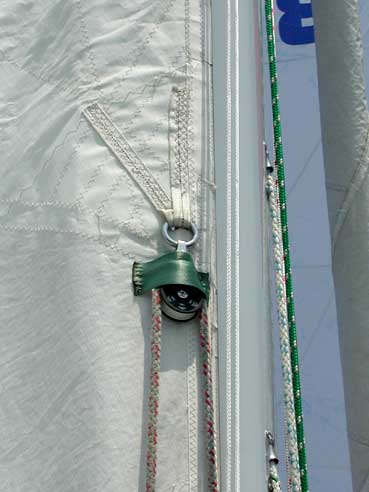
Here's an example of what the Dolphin sail had (ignore the retrofitted block):
TackBlock.jpg


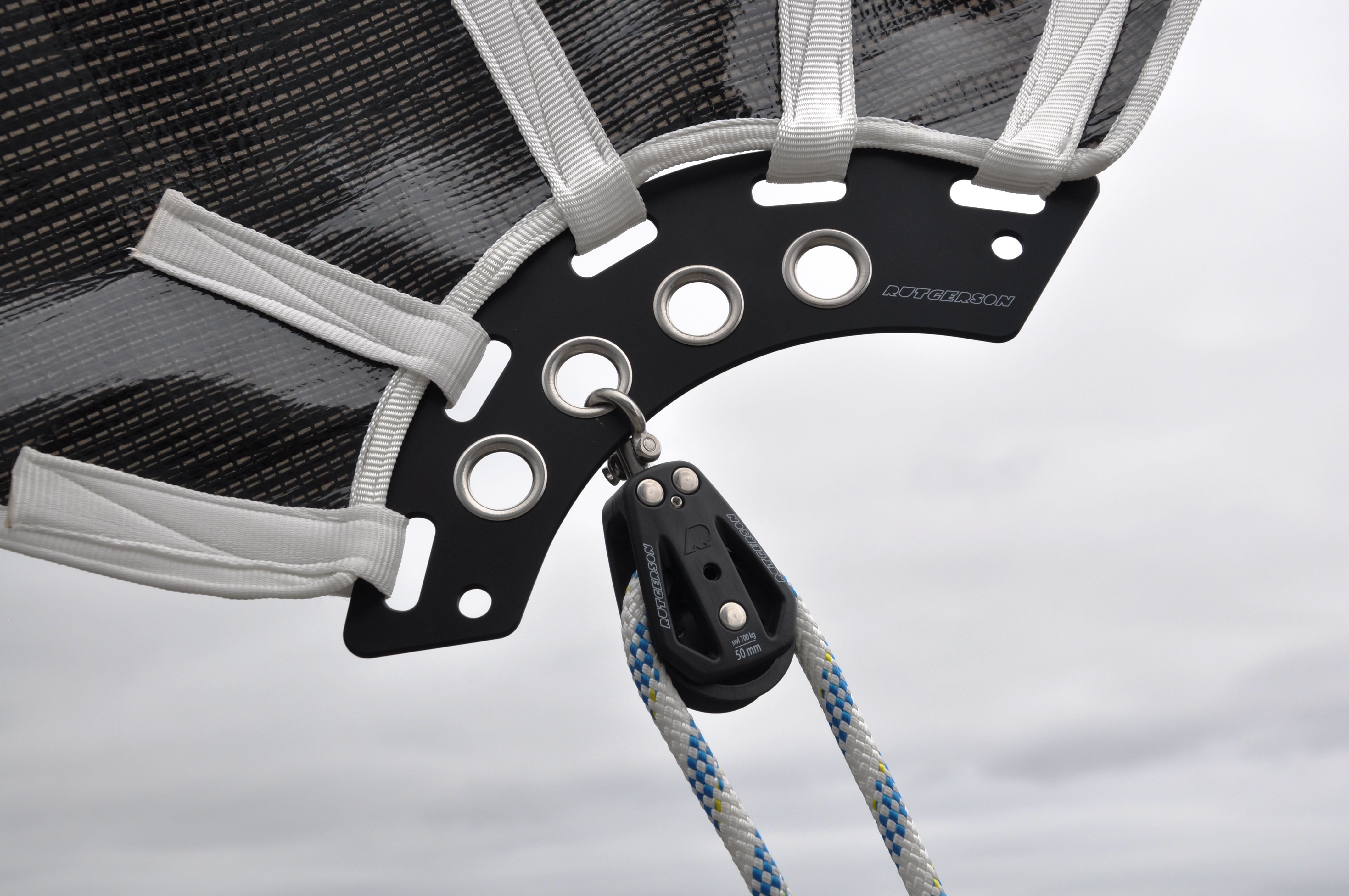
And on fancy modern sails (and in-mast furling) the clew board is typically attached with webbing too:
dsc-0248.jpg


Sailrite has a how-to video for a webbed clew ring:
https://www.youtube.com/watch?v=w_Vob8D0RWs

Nice -- full of confidence now :)
 
Top