Skeg Shoe Bearing?

Tim Good

Well-Known Member
Joined
26 Feb 2010
Messages
2,888
Location
Bristol
Visit site
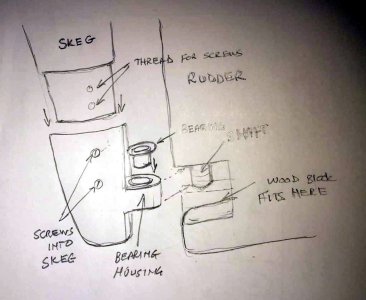
I’ve removed my rudder and assessing the bearings which are in good condition after 25 years and the tolerances are still acceptable. Shaft is 2 inch with 0.22mm bearing clearance.

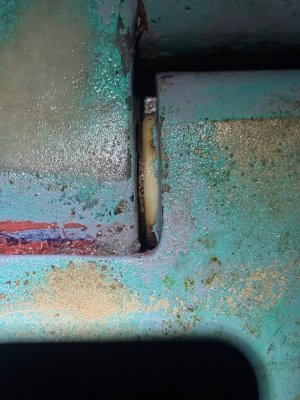
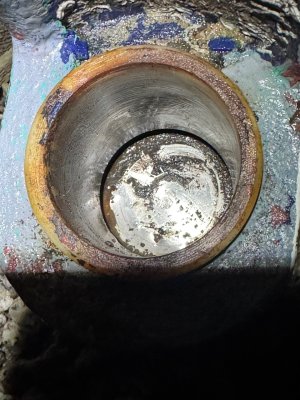
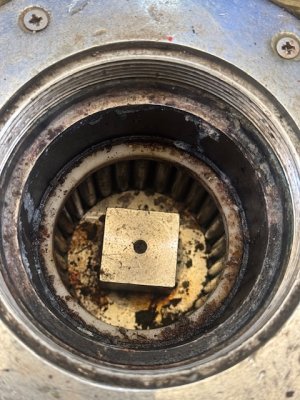
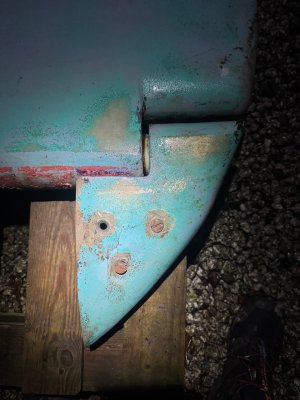
However when I look down into the shoe I see only a bearing on the outside without a base.

When full inserted, as though the weight of the skeg is resting on the shoe, as it should, then the stainless rudder shaft is simply sitting on what appears to be a stainless plate. Is that right?

Or should there be a delrin base to the bearing? Or is that stainless base some kind of stainless thrust bearing that I can see fully?
IMG_5316.jpeg

IMG_5317.jpeg

IMG_5315.jpeg
 
You often see either a T shaped lower bearing where the flange acts as a support for the weight of the rudder or a disc in the bottom, again to support the weight

It may be that, as it very common, your top bush is a T shape and the flange there takes the weight of the rudder
 
Agree. No need for a top hat bearing to take the weight as the upper bearing does that. I have used a top hat bearing for the lower pintle when the upper bearing was plain. On my current boat which has a transom hung rudder the two upper bearings both have Delrin washers to take the weight and the heel pintle just sits in a hole with a stainless plate to take any wear - which is negligible after45 years!
 
My rudder has a lower bearing where the shaft locates in a stainless socket like yours with no delrin or bushes. No play, 35 yrs old, The weight is taken from the top with two delrin bearings (and a grease point). I think a rudder supported at the bottom like this will wear bushes or sockets far less than an unsupported spade.

Exactly as Tranona just said!
 
@Tranona @Supertramp @DinghyMan

Sorry guys I’m not following. There are three bearings in my setup and non is taking the load.

At the cockpit is where the rudder shaft ends with a roller bearing. Then where the shaft enters the rudder tube in the lazarette is a kid of seal. There is a bearing at the top of the rudder where shaft exits the hull and then another in the actual shoe of the skeg. But nothing in that system allows for the shaft weight to be taken on the bearing.

I attached an image from Vyv Cox’s site. Are you suggesting that the lower top hat bearing in the skeg takes the load and rotates within the shoes? Mine isn’t like that.
 

Attachments

  • IMG_5318.jpeg
    IMG_5318.jpeg
    359.6 KB · Views: 11
There has to be a thrust bearing to carry the rudder weight somewhere, it doesn't really matter where. It can be a top hat combined with the radial bearing or a simple washer. I think that there was originally one on mine above the shoe, other 34s have them, but mine had gone. It was more convenient for me to design a top hat as the shoe was being bored and bushed anyway.
 
The question as well is whether your rudder floats or sinks. I think mine floats so it is pushing up not down at rest. But I have a horizontal plate that joins the shaft to rudder and allows the rudder blade to be separated from the shaft and removed (shown in the picture).Screenshot_20250215_093214_Gallery.jpg The shaft does not drop out as the load is taken by the quadrant and bush at the top of the shaft. When reassembled the rudder lifts off the bottom pivot by a tiny fraction - like a mm or two.
 
Last edited:
@Tranona @Supertramp @DinghyMan

Sorry guys I’m not following. There are three bearings in my setup and non is taking the load.

At the cockpit is where the rudder shaft ends with a roller bearing. Then where the shaft enters the rudder tube in the lazarette is a kid of seal. There is a bearing at the top of the rudder where shaft exits the hull and then another in the actual shoe of the skeg. But nothing in that system allows for the shaft weight to be taken on the bearing.

I attached an image from Vyv Cox’s site. Are you suggesting that the lower top hat bearing in the skeg takes the load and rotates within the shoes? Mine isn’t like that.
OK. I mIsunderstood. That is similar to the one I described earlier where the Delrin top hat bearing in the skeg takes the load. It does not need to have a base. The load is taken by the top of the bearing which seems to have plenty of meat left. The one I made showed no wear in the 20+ years I had the boat. As Supertramp says you may well find that when it is all assembled there is clearance between the rudder and the top hat.
 
OK. I mIsunderstood. That is similar to the one I described earlier where the Delrin top hat bearing in the skeg takes the load. It does not need to have a base. The load is taken by the top of the bearing which seems to have plenty of meat left. The one I made showed no wear in the 20+ years I had the boat. As Supertramp says you may well find that when it is all assembled there is clearance between the rudder and the top hat.
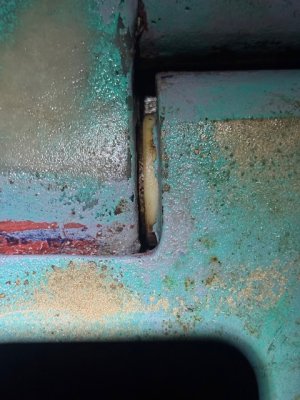
I can see your point but on this image is when the shoe is full inserted and the shaft is sitting against the bottom of the shoe. There is still a significant gap between the rudder and the bearing. So it’s not taking any weight. It’s also not a top hat. It’s just the top of the bearing sticking out.

does that make sense?
 

Attachments

  • IMG_5317.jpeg
    IMG_5317.jpeg
    534.8 KB · Views: 4
  • IMG_5315.jpeg
    IMG_5315.jpeg
    497.2 KB · Views: 5
Nobody would design a rudder in which the stainless steel stock is in contact with stainless steel (?) base of the shoe in what appears to be the current situation. Scuffing and seizure would be inevitable. There has to be recognised bearing material somewhere. I can only assume that it has worn/fractured and fallen out, as mine did.
 
Nobody would design a rudder in which the stainless steel stock is in contact with stainless steel (?) base of the shoe in what appears to be the current situation. Scuffing and seizure would be inevitable. There has to be recognised bearing material somewhere. I can only assume that it has worn/fractured and fallen out, as mine did.

I’m inclined to agree but before it was dismantled there wasn’t really any space for something of any thickness to go in there as that would raise the entire rudder. So for example the gap between the top of the rudder and hull is already small and then the top of the rudder, at the cockpit level goes into a roller bearing and all very well aligned. 🤔
 
I can see your point but on this image is when the shoe is full inserted and the shaft is sitting against the bottom of the shoe. There is still a significant gap between the rudder and the bearing. So it’s not taking any weight. It’s also not a top hat. It’s just the top of the bearing sticking out.

does that make sense?
That looks similar to my bottom bearing. It does not look excessively worn.

Are you sure it's not meant to be like that with the insert stopping side to side play rather than supporting the vertical weight of the rudder (which assuming it's hollow will not be much when afloat). I still think that a rudder supported at the top and bottom will be much less prone to bearing and sleeve wear.
 
That looks similar to my bottom bearing. It does not look excessively worn.

Are you sure it's not meant to be like that with the insert stopping side to side play rather than supporting the vertical weight of the rudder (which assuming it's hollow will not be much when afloat). I still think that a rudder supported at the top and bottom will be much less prone to bearing and sleeve wear.
It might well be that. Neutrally buoyant and so supported from side to side movement in 4 places with nothing particularly taking the weight.
 
I don't think it would have no axial thrust in a seaway. A rudder has considerable mass and therefore momentum.
In the context of a rudder that is neutrally buoyant what do you mean? Are you saying that it is unlikely to be neutrally buoyant since it would cause too much axial thrust and so there still need to be a bearing at the bottom and top accommodate it?
 
It may well be neutrally buoyant, some are, but if the boat is pitching the rudder will be thrown up and down with considerable force. I am guessing that mine weighs 25 or 30 kg, yours may well be more, which as direction reverses will need to be arrested by something.
 
It may well be neutrally buoyant, some are, but if the boat is pitching the rudder will be thrown up and down with considerable force. I am guessing that mine weighs 25 or 30 kg, yours may well be more, which as direction reverses will need to be arrested by something.

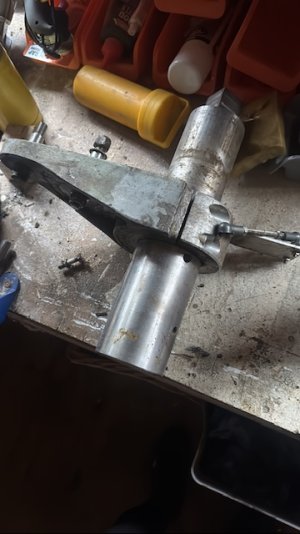
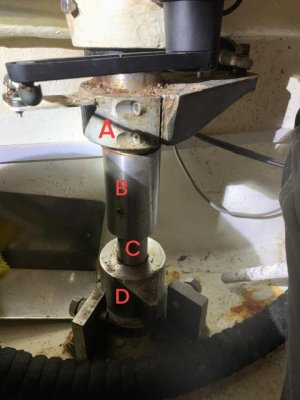
It’s hard to say. The shaft goes up through the hull and into this large section (B on the photo) fixed only with a vertical key. But it’s not fixed into it. This larger diameter section holds the quadrant and then goes up into the cockpit with a roller bearing at the top (photo shows the bearing once that larger section has dropped down.

Likewise this large section isn’t fixed by anything. It just sits on top of the rudder shaft. So if the rudder was thrown upwards then logic would say it would force this piece upwards also.
 

Attachments

  • 859FBDF2-9051-412F-AFFE-4C4D857D559D.jpeg
    859FBDF2-9051-412F-AFFE-4C4D857D559D.jpeg
    67.6 KB · Views: 3
  • IMG_4540.jpeg
    IMG_4540.jpeg
    80.3 KB · Views: 2
  • IMG_5253.jpeg
    IMG_5253.jpeg
    190.3 KB · Views: 3
Top