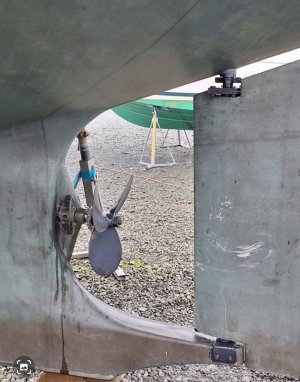
Skeg Shoe Bearing?

I assume that is the emergency steering and the shaft simply passes up through the roller bearing without reaching a limit.

I think yours is similar to mine. It has some small vertical "float" and is restricted by the skeg (downwards limit) and the rudder meeting the hull bearing or perhaps in your case the top bearing. The movement will be minimal but present. I have never been aware of any vertical movement in the shaft while in rough weather. My rudder is probably smaller than yours and weighs about 50 kg and I suspect sits supported by the skeg In my case. I don't see a problem with this - the underwater bearings are delrin/metal and metal/metal in my case with the third upper bearing another delrin/metal but with a grease point to stop any water passing.
 
I assume that is the emergency steering and the shaft simply passes up through the roller bearing without reaching a limit.

I think yours is similar to mine. It has some small vertical "float" and is restricted by the skeg (downwards limit) and the rudder meeting the hull bearing or perhaps in your case the top bearing. The movement will be minimal but present. I have never been aware of any vertical movement in the shaft while in rough weather. My rudder is probably smaller than yours and weighs about 50 kg and I suspect sits supported by the skeg In my case. I don't see a problem with this - the underwater bearings are delrin/metal and metal/metal in my case with the third upper bearing another delrin/metal but with a grease point to stop any water passing.
Thanks.

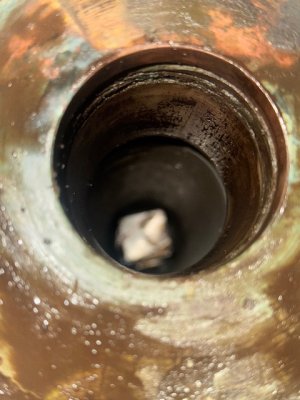
So in your skeg shoe what does the rudder shaft sit on? Metal to metal the same as mine?

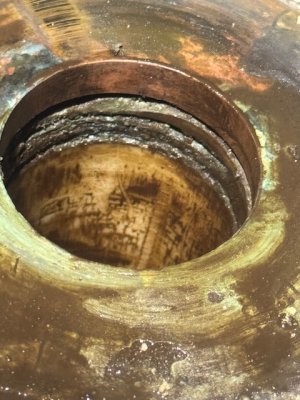
The other thing I’m slightly unsure of is a bronze plate that the shaft passes up through when entering the lazarette. It has groove inside which almost look thread like. No nipple or way to inject grease into these grooves. You can see one is uneven which is strange given how little wear there is anywhere else in the system.
 

Attachments

  • IMG_5267.jpeg
    IMG_5267.jpeg
    145.7 KB · Views: 1
  • IMG_5265.jpeg
    IMG_5265.jpeg
    172.8 KB · Views: 1
My boat is a Cromarty 36, long keel, built 1989 by Blondicell in Lymington. The skeg is substantial, extending aft of the propellor aperture. But the lower bearing is similar to yours - an inverted stainless steel top hat. It is fabricated into a stainless steel bracket which bolts to the top and sides of the skeg. The stainless steel rudder shaft emerging from the base of the rudder locates into it with about an inch of insert depth.
Screenshot_20250216_092321_Gallery.jpg
There is no bushing or space for any and the surfaces (sides and base) are clean and smooth. There is no play evident when assembled. You have to lift the rudder (and upper shaft) to remove it. A stainless collar bolts to the gap between the top of the the rudder and the hull aperture to limit vertical play. It's different to yours but the design elements are similar.

When I first removed the rudder I thought it strangely simple but having examined numerous other skegs and rudders it is simple and nicely engineered.

The upper bearing in your picture looks like it has some sort of water sealing rings or lips under the top brass cylinder presumably to stop water working up and out the top seal?
 
Yeah I think it must but it just looks strange rather than clean rings into which you could insert o rings or some other seal. There’s not scraping or wear in the shaft at that point so it must be very well aligned.

Perhaps I’ll just try and insert and we’ll lubricated O ring and if I can’t find someone who knows exactly how it was intended to be maintained.
 
I've had quite a few "voyages of discovery" with bits of the boat. I usually research, carefully dismantle, repair or not, reassemble and then have the confidence that it's good to go for another decade or two with the bonus of knowing how it works.

Which is I think what you're doing.

Good luck.
 
I've had quite a few "voyages of discovery" with bits of the boat. I usually research, carefully dismantle, repair or not, reassemble and then have the confidence that it's good to go for another decade or two with the bonus of knowing how it works.

Which is I think what you're doing.

Good luck.
Yes indeed. Heading for Patagonia so want to be sure 👌
 
Top