Sizing and characterisctics of RCBOs & MBCs for 230V installation

Lomax

Well-Known Member
Joined
22 Sep 2016
Messages
375
Visit site
I have a 3600W (16A) Victron isolation transformer, and a 2200W (10A) Mastervolt charger/inverter. The inverter has two 230V outputs; one which is only active when shore power is available and can provide up to 16A, the other ("short break") is always active and draws power from the inverter when shore power is not available (max 10A). I'm planning to connect this up as follows:

Code:
                  shore intake
                        |
              isolation transformer
                        |
                 16A 30mA RCBO(B)
                        |
                Mastervolt Combi
                        |
       |----power out-------short break----|
       |                                   |
   16A MCB(B)                       10A 30mA RCBO(C)
       |                                   |
   16A socket                   |---------------------|
                                |                     |
                             6A MCB(C)             6A MCB(C)
                                |                     |
                            Aft sockets           Fwd sockets

Curve characteristics (B/C) shown in brackets. I have chosen "C" types on the inverter outputs since it is able to provide up to 4000W for short periods, and "B" types on the "power" output as I do not want to trip the shore fuse unnecessarily. As I'm about to order the consumer cabinet parts for this, at considerable cost, I thought I'd check with the forum if anyone can see any obvious problem with this layout?
 
Last edited:
When I fit isolation transformers, usually big bastards to small commercial vessels, I put an overcurrent and RCD both sides of the isolation transformer as if you plug into shore with no protection shoreside and someone working on the transformer does something and causes a fault or there is indeeed a fault, you’ll want to protect that side of it as well as as the isolation transformer.
 
Many thanks Matthew! I have increased the two MCBs on the right hand leg to 10A (also type C), but given the high cost I am reluctant to add a third RCBO or RCD. The cable from the shore intake goes straight to the transformer and is only about a metre long - and it is a shielded mains cable (as is all mains cabling throughout). How important is this RCD in my situation?
 
On a new craft

The RCD is required, according to my understanding. I tend to deal in "used" vessels. In a domestic setting and if you thought of your craft as like a bathroom, the RCD would be required. This is a simplistic explanation. So, not compulsory, but an additional safety feature on top of your MCB over/under current devices.
 
Many thanks Matthew! I have increased the two MCBs on the right hand leg to 10A (also type C), but given the high cost I am reluctant to add a third RCBO or RCD. The cable from the shore intake goes straight to the transformer and is only about a metre long - and it is a shielded mains cable (as is all mains cabling throughout). How important is this RCD in my situation?

You should be able to get an RCBO for £30. In fact I've one surplus to requirements after fitting a new one before removing the old one during a bit of a re-wire last year. It's a Type B, 16 Amps, bought in 2010. I'd sell it for a tenner plus postage.
 
Must be something you arent telling us here..
Why have an RCxx after an isolation transformer? If the transformer is to float the supply then that feature is void when you earth a leg or centre in order that the RCxx will function...
 
Must be something you arent telling us here..
Why have an RCxx after an isolation transformer? If the transformer is to float the supply then that feature is void when you earth a leg or centre in order that the RCxx will function...

RCDs & RCBOs work on their being an imbalance between the incoming and outgoing current, you don't need an Earth for them to function.
 
It would go around the circuit if all was functioning OK, or if it leaked to somewhere else (whether at E potentional or at +1000V) the RCD or RCBO would trip.

I know precisely how and why RCxx devices work. You seem to be missing the point that a floating supply, a from an isolation transformer requires TWO external connections for current to flow out of the circuit*. So, there is the fault that the RCxx is designed to detect and....? Yes, an earth connection.

* Except for very rare large transient situations which are not faults.
 
The isolation transformer means the RCD can only pop if one side of the isolation transformer output is earthed to the boat, before the RCD.
Otherwise you could have a latent fault between N and say 12V -ve to sea potential, then touch live and you'd get a shock.

There are several possible ways to safely use an isolation transformer, this does not look like one of them.
Do not pick and mix between systems!
 
The isolation transformer means the RCD can only pop if one side of the isolation transformer output is earthed to the boat, before the RCD.

Of course. I don't understand how you got the impression that the virtual earth provided by the isolation transformer would not be connected to the (steel) hull - that's the point of having one, no? My question was not about how to use an isolation transformer, in fact it was barely a question at all; I just wanted a quick double check of my parts list before I spent ~£100 on RCBOs & MCBs - which was kindly provided by @matthewriches (although I've chosen to ignore his suggestion of a third RCBO/RCD before the isolation transformer).
 
Of course. I don't understand how you got the impression that the virtual earth provided by the isolation transformer would not be connected to the (steel) hull - that's the point of having one, no? My question was not about how to use an isolation transformer, in fact it was barely a question at all; I just wanted a quick double check of my parts list before I spent ~£100 on RCBOs & MCBs - which was kindly provided by @matthewriches (although I've chosen to ignore his suggestion of a third RCBO/RCD before the isolation transformer).

Your diagram does not show any earth connection.
I'm not sure you really understand what a 'virtual earth' is. It's not the same as grounding a centre tap.
If there is any 'virtual earth' associated with the incoming 'land' earth, you may not want that 'earthed' to the hull as your anodes will have a short time.
In my trade, the point of an isolating transformer is to isolate. The clue is in the name.
This is a typical electrics thread where the OP gives half the story then gets conflicting advice because different people fill in the gaps in different ways.
It's clear that some people in the thread don't really understand how a residual current device works, or that there are various earthing strategies that should not be randomly mixed.
 
When I fit isolation transformers, usually big bastards to small commercial vessels, I put an overcurrent and RCD both sides of the isolation transformer as if you plug into shore with no protection shoreside and someone working on the transformer does something and causes a fault or there is indeeed a fault, you’ll want to protect that side of it as well as as the isolation transformer.

:encouragement: As far as i'm concerned the first thing the shore power meets when it gets onboard is the RCD, to do otherwise is foolish, you're relying on the shore side installation to protect stuff otherwise.
 
It would be normal practice to connect one side of the secondary to the earth chassis of the transformer, forming a Grounded Conductor aka Neutral, this is not the same as a grounding conductor or Protective Earth (PE). This ties one side of the transformer output to earth potential and also gives a return route for any earthed equipment thus allowing the RCD devices to work. I note you have two RCD devices after the isolation transformer - Why ? I would place one on the primary side and another on the secondary side after the Combi.

I would also question the value of a schematic that does not properly show the layout of both sides of the supply Live & Neutral.
 
It would be normal practice to connect one side of the secondary to the earth chassis of the transformer, forming a Grounded Conductor aka Neutral, this is not the same as a grounding conductor or Protective Earth (PE). This ties one side of the transformer output to earth potential and also gives a return route for any earthed equipment thus allowing the RCD devices to work.

Indeed.

I note you have two RCD devices after the isolation transformer - Why ? I would place one on the primary side and another on the secondary side after the Combi.

The second RCBO is to protect the inverter output, and that's how Mastervolt want their "Combi" units to be installed. I would not argue with them.

Screenshot_2018-05-04_07-38-53.pngScreenshot_2018-05-04_07-43-30.png

I would also question the value of a schematic that does not properly show the layout of both sides of the supply Live & Neutral.

Oooh, are you questioning my two-minute ASCII diagram!? :D Good thing I wasn't asking how to wire things up then - I think it works ok as a quick block diagram to illustrate the question that was actually asked though.
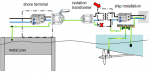
 
Last edited:
I have a 3600W (16A) Victron isolation transformer, and a 2200W (10A) Mastervolt charger/inverter. The inverter has two 230V outputs; one which is only active when shore power is available and can provide up to 16A, the other ("short break") is always active and draws power from the inverter when shore power is not available (max 10A). I'm planning to connect this up as follows:

Code:
                  shore intake
                        |
              isolation transformer
                        |
                 16A 30mA RCBO(B)
                        |
                Mastervolt Combi
                        |
       |----power out-------short break----|
       |                                   |
   16A MCB(B)                       10A 30mA RCBO(C)
       |                                   |
   16A socket                   |---------------------|
                                |                     |
                             6A MCB(C)             6A MCB(C)
                                |                     |
                            Aft sockets           Fwd sockets

Curve characteristics (B/C) shown in brackets. I have chosen "C" types on the inverter outputs since it is able to provide up to 4000W for short periods, and "B" types on the "power" output as I do not want to trip the shore fuse unnecessarily. As I'm about to order the consumer cabinet parts for this, at considerable cost, I thought I'd check with the forum if anyone can see any obvious problem with this layout?

As already said, you have provided no circuit protection or RCD prior to the isolation transformer. If this was a new boat you'd be falling foul of ISO 13297 and some other stuff, with relies on the ISO. None of which you are directly required to follow, but common sense dictates that it would be good practice to do so. As industry professionals neither myself or Mathew are required to follow the ISO in many of our installations, but again, common sense and "best practice" dictate the we should. If we didn't and something happened that resulted in injury or loss of life i'm pretty sure we'd be in court facing some extremely serious charges. I'd venture a guess that even a private individual would be in serious trouble.

7.2.3 Overcurrent protection shall be provided for isolation and polarization transformers, including a bank of transformers operating as a unit. Each transformer shall be protected by an individual overcurrent device on the primary side, rated at not more than 125 % of the rated primary current of the transformer.

Furthermore, you have not included any overcurrent protection with your first RCD. Your entire installation therefore has no overcurrent protection between the shore power supply and your distribution boards. The above ISO and even the Mastervolt instructions all dictate otherwise.
 
As already said, you have provided no circuit protection or RCD prior to the isolation transformer.

Thanks for the lecture. I'll take my chances. Here's how Victron themselves think it should be done:

victron isolation transformer.png

Furthermore, you have not included any overcurrent protection with your first RCD. Your entire installation therefore has no overcurrent protection between the shore power supply and your distribution boards. The above ISO and even the Mastervolt instructions all dictate otherwise.

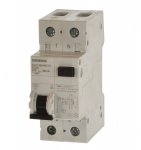
Look again - that's an RCBO, not an RCD. A Siemens 5SU1 354-6KK16 in fact.

I18654_Siemens_5SU1_356-6KK10_Fi_LS_Schalter_B10_30mA_.jpg
 
Top