Single reefing lines?

what happens with single line reefing, even if one eases the halyard, is that the tack gets tight before the clew...,and then the whole thing binds up and you never get the clew satisfactorily tight because there is too much friction.

The only reliable way to avoid this is to reduce the friction by some combination of blocks, rings, and tapered dyneema reefing line.

by "tapered" i mean that you start with a double braid dyneema core line and strip the cover off so that you have uncovered dyneema in the areas prone to friction, but have cover remaining on the line where it goes to the clutch.
I am afraid that i am going to argue with you here. What you are suggesting is due to wrong technique.
Your tapered lines are totally unnecessary. Actually, I doubt if it would work because the braided part would be so far through the system that it would still involve friction. then when easing off the thickened part would have to run back through the blocks & boom. Once reefed the length of line actually working on the reef is quite small , as can be seen by the large coil of rope at the clutch when reefed.
Of course friction should be addressed & i do not refute that. But tapered dynema reef lines on a yacht below 45 ft- no.
I suggested in my earlier post not letting lots of halyard going at once & that is part of the reason you cannot get a tight clew. As the reef comes near to its completion one stops off the halyard & keeps pulling in the reef line. The luff is restricted from dropping by the now locked halyard so the clew is automatically tightened& the boom raises up a little. Let the vang off at the start. Then over tighten the topping lift & take the weight off the clew. Once the clew is tight the last piece of luff can be hauled in & the halyard eased as one goes.
It takes a bit of practice but 2 attempts in light weather was all it took me. I have a 28m2 mainsail so no blocks inside the boom- which i would avoid at all costs - but that is another subject for deep debate.
 
Last edited:
the third reef on most boats is not used very often. certainly on my boat I would not need it until well into F8 & beginning to look at F9. I have only sailed in F9 twice in my sailing career since the 70s. One should be able to avoid it in a small boat doing 25 hour sailing trips which is the norm maximum for most.
But in any event the 3rd reef needs to be easy to fit & bomb proof. One does not need lots of excess line up the clew all the time because one hoists the sail many many times & that set of lines will always be a nuisance & possibly never used.
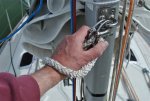
My solution is to resort to a 2 point fixing. The clew uses a strop & a dedicated line but one can easily transfer the clew outhaul if one has enough length & not enough pullies in the boom. The strop can lay inside the sail cover, one end going under the boom ready with a stopper to prevent it falling back out .. As i have a dedicated line it is already attached but as I said i would use the clew outhaul which returns to a cabin mounted winch.At the luff I have a strop that hangs permanently on the spinnaker ring. It doubles as a hand hold when i am at the mast as can be seen in the picture, In use it clips to the spectacles & passes under the ring so the halyard can tension against it. As it does so it holds the luff in

All this does mean that i have to drop the boom into the cockpit but that is safe. But it does mean I have to go forward to hook the strop on, which I dislike. However once hoisted it is a pretty bombproof system & has the advantage that I can use it on any other reef point if the first or second reef lines were to fail
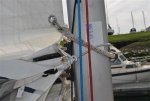
This is the strop
No A (600 x 402).jpg
The strop in position with it hooked under the spinnaker ring at the front of the mast
Note that there is room for the sail stacked below the luff
No B (600 x 402).jpg
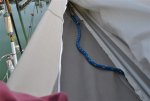
the clew strop laying in the sail bag
No C (600 x 402).jpg
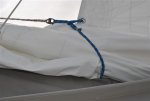
the clew strop set up just prior to tensioning. One can see that it pulls down & out as it is tightened
No D (600 x 402).jpg
 
Last edited:
Looks an excellent system DB, but when the winds up, really up, I would rather not be going forward to sort the luff reef line out OR trying to connect the out haul to the clew reef line with a mainsail flapping around. I have permanent third reef lines in but I admit that’s a lot of line to sort out. I also admit to being the sort of sailor that puts the reefs in AFTER, not before, I should have. I dare say your system works for you because you sail with a bit more foresight than me.
 
That's an improvement on what I've seen an awful lot of boats that have no string for the third reef, the idea being to rethread the first reef. This strikes me as a bit of a pain to do. As a result, at best, it's going to happen when it's blowy and bumpy enough to need the second reef, which isn't really a good time to be on deck, at worst, especially on a marina-hopper that almost never uses it, the rethreading is going to happen when that third reef should have gone in half an hour ago, at precisely the time one doesn't want to be up on top of the saloon, faffing around with lines and knots that have pulled themselves tight. Somehow that doesn't strike me as conducive to a long and healthy life...
 
Why a fiddle block and not just a small normal block?
Of course you're right.
On the other hand. one block only caters for the first reef, There will be a second and perhaps a third, which will also require lines led through blocks. If the first is on the starboard side and the second is on port, a fiddle block on the starboard could be used if there is a third.
 
Of course you're right.
On the other hand. one block only caters for the first reef, There will be a second and perhaps a third, which will also require lines led through blocks. If the first is on the starboard side and the second is on port, a fiddle block on the starboard could be used if there is a third.
I will only have 2 reefs, both coming down to the mast base blocks from the port side, so yes a fiddle block is a good idea, and have a few of them on the self!
 
I think that you will find the sail settles down better if you pull one reef down one side & the next one down on the other side.Where the lines go once they reach the deck is another matter, of course.
Where the lines exit the boom at the gooseneck for the second reef needs a clean run & this will be obstructed by the folded sail of the first reef.
 
the third reef on most boats is not used very often. certainly on my boat I would not need it until well into F8 & beginning to look at F9. I have only sailed in F9 twice in my sailing career since the 70s. One should be able to avoid it in a small boat doing 25 hour sailing trips which is the norm maximum for most.
But in any event the 3rd reef needs to be easy to fit & bomb proof. One does not need lots of excess line up the clew all the time because one hoists the sail many many times & that set of lines will always be a nuisance & possibly never used.
My solution is to resort to a 2 point fixing. The clew uses a strop & a dedicated line but one can easily transfer the clew outhaul if one has enough length & not enough pullies in the boom. The strop can lay inside the sail cover, one end going under the boom ready with a stopper to prevent it falling back out .. As i have a dedicated line it is already attached but as I said i would use the clew outhaul which returns to a cabin mounted winch.At the luff I have a strop that hangs permanently on the spinnaker ring. It doubles as a hand hold when i am at the mast as can be seen in the picture, In use it clips to the spectacles & passes under the ring so the halyard can tension against it. As it does so it holds the luff in

All this does mean that i have to drop the boom into the cockpit but that is safe. But it does mean I have to go forward to hook the strop on, which I dislike. However once hoisted it is a pretty bombproof system & has the advantage that I can use it on any other reef point if the first or second reef lines were to fail
This is the strop

The strop in position with it hooked under the spinnaker ring at the front of the mast
Note that there is room for the sail stacked below the luff

the clew strop laying in the sail bag

the clew strop set up just prior to tensioning. One can see that it pulls down & out as it is tightened
Coincidently the Bali catamaran had the 3rd reef with only a clew line and just a cringle where we simply looped a rope to the most convenient mast cleat. That was a brand new boat from the yard. At least it should have a hook on the mast.

As i see, some setups pull the clew from one side of the mast. Will pulling from both sides worth the extra hardware ? ( for example, your 3rd reef strop pulls from both sides of the mast forcing the luff to be pulled towards the center of the mast, which is ideal. If let's say a block is on the 1st reef cringle starboard side, it will be pulled slightly to that side. Can we assume this "off-center " clew pulling insignificant?
 
I think that you will find the sail settles down better if you pull one reef down one side & the next one down on the other side.Where the lines go once they reach the deck is another matter, of course.
Where the lines exit the boom at the gooseneck for the second reef needs a clean run & this will be obstructed by the folded sail of the first reef.
Ok just saw your new message! thanks
 
Hi!
I am about to make a single reefing line system but not sure whether the pad eyes should go on the mast or the boom. On the mast, the pulling angle should be much better but thinking it might stress on tacks. Opinions, please? I d like to do something as in the pic.
View attachment 110987
Perhaps you could rig a low-friction ring there, on the mast. That's how I did it, works great. The down haul on my F-24 (full sail and all reefs) rigs through LFRs on the mast. As others have said, ball bearing blocks are good, but they must be very high load or you can crush them, particulary at the clew end (I've done that).

You really do need the forward pull. If the reefing tack cannot take that the sail was built wrong. It should be reinforced like any tack.
 
The single reef project is part of the bigger project, bringing all ropes to the cockpit. As I am overthinking about it, i notice that i may have to install all high load lines port side as the organizer is well aft on the coachroof, giving a good 135-degree angle for the lines coming from the mast base and back to the clutches.

The cabin hatch though is on the starboard coachroof side, forcing me to install the starboard organizer much forward , thus the lines will exit widthwise and then with a 90 degree turn back to the cockpit. Ideally, i would like the main halyard to pull from the port side, and the reefs from the starboard so the loads are equally distributed. Due to the bad position of the starboard organizer making it weaker I am puzzled as to which side to set the reefs.

1) Use the stronger portside organizer for both the main halyard and reefs?
2) Set the halyard portside and reef lines on the "weaker" starboard organizer?
 
Put the halyard for jib & main on the strongest organiser as it is the most used.
Kicker on halyard side as constantly loaded
Do you have one winch or two. If two, put the reefs on one winch & the halyards( Main & Jib) on the other, using the organisers to suit.
Spinnaker halyard on the same side as reefs as you probably will not use spinnaker when reefed. Clew outhaul with reefs as you will not need it when reefed
the weaker organiser will only have one reef line or the clew or the spinnaker halyard loaded at once so less weight on the organiser
 
Last edited:
Put the halyard for jib & main on the strongest organiser as it is the most used.
Kicker on halyard side as constantly loaded
Do you have one winch or two. If two, put the reefs on one winch & the halyards( Main & Jib) on the other, using the organisers to suit.
Spinnaker halyard on the same side as reefs as you probably will not use spinnaker when reefed. Clew outhaul with reefs as you will not need it when reefed
the weaker organiser will only have one reef line or the clew or the spinnaker halyard loaded at once so less weight on the organiser
Thank's ! thats a good plan:)
 
Top