Single line reefing woes!

emandvee44

Well-Known Member
Joined
29 Nov 2008
Messages
1,256
Location
From: Plymouth, living in Europe Mainland
Visit site
Recently we had to reef, initially first reef then second reef when the wind increased. With the luff reefing point hauled down to the goose neck, the clew was still some distance from the boom, but we were able to sail. The second reef was worse, the clew being so far above the boom that the sail was extremely baggy, and in fact the pressure ripped open the lazy bag over 3m or so.
Any pointers on how to adjust the system (Selden)? I have looked at the Selden description of how to rig the single line reefing, but it does not make much sense to me?
Thanks,
M
 
Make sure that your reefing line comes from the end of the boom, through the eye on the mainsail and then vertically back down and secures around the boom (assuming a loose foot main). That way, when you tighten it, you will pull the new reefed clew down to the boom properly.
 
There are probably bits inside the boom that you can't get at without dismantling, but the first thing I'd do is to give all the places - blocks and so on - that you can get at a good squirt of PTFE dry lubricant. Then see how it works in calm conditions and what's causing the unwanted friction.
 
There are 'carriages' within the boom for each reef. If the reefing lines aren't set up correctly the carriage will get to the end of the boom before the sail has been fully reefed. Try shortening the line to the luff of the sail - this will cause the carriage to be pulled forward away from the boom end.
 
The reefing line should come out at the clew, through a cringle on the leech, and down to the boom where it should pass round the boom and be attached to itself with a bowline, forming a slip knot. If this knot is tightened around the boom it should be set at a point a little aft of where the new clew is, ie where the cringle gets to. The line should then both tension the foot of the sail and pull it right down to the boom.
 
I suspect not the right answer, nor even the best, but it worked for our Selden boom across two oceans and the bits inbetween:
Ease the halyard & vang, haul the reefing line tight, then before re-tensioning the halyard and vang, loop a lashing ( two or three wraps) over both the boom and reef/outhaul line and tie it off under the boom - we can reach to do this just by standing up in the cockpit - as near to the clew as possible; the line will now run nearer to parallel along the top of the boom and hold the clew down, tighter to the boom top.
 
The Selden single line system actually has two lines! I have not used it but from diagrams I have seen it is the luff that is pulled down by the car going aft in the boom, and the leech is pulled down directly by the line going to the cockpit (after it has pulled the car back. So if the OP's luff is pulled down OK, but the leech is not, then the internal car must be moving OK, and it seems the options are that he is not pulling hard enough, there is too much friction in the blocks, or the mainsheet and/or vang are not being released enough to put in the reef.

PS - or it has been rigged internally the wrong way around maybe?
 
Thanks for all your replies. Perhaps I did not explain clearly enough so here goes?
Friction is not an issue ; the reefing lines wind in no problem, but the first reef tack cringle reaches the boom and leaves some distance to go at the clew end. (Same for second reef)
There is a good diagram of the boom internal workings on the Selden site.
I believe it is a matter of correct positioning of the internal cars, as has been pointed out. I need a calm day! ?
 
That doesn’t sound right. With my Selden system I normally pull the clew line out until the full amount is out as judged at the clutch and then pull out the tack until the cars clunk at the end. When reefing the tack is soon tightened down and then the rest is a matter of tensioning the clew, but I have not noticed that the car position is critical.
 
That doesn’t sound right. With my Selden system I normally pull the clew line out until the full amount is out as judged at the clutch and then pull out the tack until the cars clunk at the end. When reefing the tack is soon tightened down and then the rest is a matter of tensioning the clew, but I have not noticed that the car position is critical.
I thought the whole idea was to have the 1 &(2)
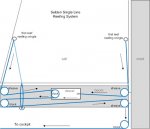
(SSRS.jpg reefing lines rigged all the time. I.e. luff line attached to first reef luff cringle, etc., and clew line through the first reef leach cringle, then theoretically you wind in the reef line and the two cringles should arrive at the boom at the same time? The diagram above is exactly what we have .
Edit. I see that when the tack clew reaches the boom it should be possible to carry on heaving in the reef line until the clew is down to the boom.?
 
Last edited:
I would initially say you are letting the halyard drop to much .The balancing block inside the boom will be up the wrong end and not allow reef tension to pull thru to the luff before taking up the strain.
Tip the boom so the block is forward,sail hoisted .Slacking up the leach lines all the way .The leech cringle should just have enough line to go up and back down Take up around 20 to 30 cm on the luff tail .Let go the halyard until reef cringle is around 20cm above the boom and try the reef again .This around 20cm of height at the luff end (luff reef eye should )to allow the line to reeve taut .
Hoist sail fully to check that the luff goes tight after ,in case you need to adjust the reef pennant the other way .
 
Do what everyone else finally does with such devil's spawn systems.
Disconnect the downhaul from it's cringle on the luff and stopper-knot it.
Then use it as a conventional and practical reefing system that requires a quick trip to the ram's horns to secure the foot of the main.
It still leaves you with vastly more friction than a proper reefing system has, but it'll be far, far better than it was before.
 
Perhaps you could consider chucking that car system away, it just creates friction.

If you want to keep the car system then i suggest that the Selden drawing (is that an old out of date one?)is wrong as it should be rigged as per the Cox drawing. I wonder if the OP has the correct car setup

I have no idea why one would want the car. I set up a set of lines ( as per Cox) in my garage to settle a dispute some years ago. I placed a fishing scale at various points to prove that it does NOT provide additional purchase power. It does reduce the amount of line in the cockpit but what is an extra couple of coils when stowing. In addition the chances of a problem are much greater.
One can easily control which end of the sail comes in first by taking some load off the boom with the topping lift with the halyard, if one has one. I do not release the halyard to the full extent until the clew is almost fully in. Then I tighten down against the halyard tension to get everything nice & tight rather than tighten the halyard last.
I know how far to slowly release the halyard as I pull in the reef, because I have a piece of tape on the mast which aligns with the batten car when reefed .
Obviously others will disagree. My main is 29M2 & it works for me. hence I have thrown it in the mix. :unsure:
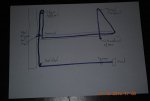
If you are having problems it is probably the car at fault so before changing the car just try it rigged as below before spending lots of cash on 2 new cars. You are going to have to buy new reef lines anyway.


single line reefing.jpg
 
Last edited:
The Selden drawing is not out of date, isn't wrong and can't be set up as per Cox drawing as there is only one block on the carriage. I had the same problem because the line to the leech cringle was too long which caused the carriage to jam at the end of the boom jamming the line to the luff cringle before fully reefed. When correctly set, with the sail fully out the carriage should be near the front of the boom. I find this a great system with little friction and can reef in seconds from the cockpit
 
The Selden drawing is not out of date, isn't wrong and can't be set up as per Cox drawing as there is only one block on the carriage. I had the same problem because the line to the leech cringle was too long which caused the carriage to jam at the end of the boom jamming the line to the luff cringle before fully reefed. When correctly set, with the sail fully out the carriage should be near the front of the boom. I find this a great system with little friction and can reef in seconds from the cockpit
The diagram in #10 is topologically correct but doesn’t show how the system looks in action. The car will be further forward than shown, but this is determined by the lengths of line. The loop should be attached to the boom slightly aft of the sail crinkle so that it can pull the sail both down and aft.
 
The Selden drawing is not out of date, isn't wrong and can't be set up as per Cox drawing as there is only one block on the carriage. I had the same problem because the line to the leech cringle was too long
But when one gets to the second reef the line required is much longer . What happens if the boom is a short one & the leech line has to be long enough for the second reef? The leech line cannot be shortened & the travel of the car cannot be lengthened. Will the second car ( one needs 2, one for each reef) have enough travel.
Then one might ask if one really insists on having cars, why not drill a hole in the leading edge of the car & shackle a block on to imitate Cox's system. provided the tracks were mounted in such a way that prevented clashing of the cars or the shackles( could use metal straps & side mounted blocks) were rigid to hold the blocks straight in line that might work.
 
Last edited:
If you need to get inside the boom to have a look ours is accessed most easily from the aft end - and you take the aluminium casting off - but you need fancy security alan keys to release (or ours does), so check before you get started. Ours are 'sort of' star shaped recessed heads. Its best disassembled on a nice dry sunny day with lots of patience.

We replaced our Seldom single line system for reefs 2 and 3 with one identical to that drawn by Daydream. We have small blocks for each crinkle. You end up with lots of string - but - so what. Our main is 45^2 m and our third reef reduces the sail area by 75%. Most of the 3rd reefing line is 6mm dyneema - because it is never under much tension - we have spliced in 10mm dyneema for the working portion (which is still a lot of string). We use the 3rd reef frequently.

Jonathan
 
Top