Single line reefing woes!

One benefit of the system that I have shown is that it would be easier to repair at sea. i damaged a reef line when it caught on a sharp edge of the mast aligner & ripped the outer covering off. I had to replace it. To make matters worse I accidentally pulled it out of the boom.
I taped a thin line to the other reef line & pulled it through. Then using a wire coat hanger & swapped it to the required blocks each end of the boom. Then i pulled the new line through. It was a faff & involved some rude language but I did not have to remove any boom fittings or cars. That would have involved drilling out pop rivets etc & re rivetting. A process that one does not really want on the end of the boom, as it wears on the holes.
 
Last edited:
But when one gets to the second reef the line required is much longer . What happens if the boom is a short one & the leech line has to be long enough for the second reef? The leech line cannot be shortened & the travel of the car cannot be lengthened. Will the second car ( one needs 2, one for each reef) have enough travel.
Then one might ask if one really insists on having cars, why not drill a hole in the leading edge of the car & shackle a block on to imitate Cox's system. provided the tracks were mounted in such a way that prevented clashing of the cars or the shackles( could use metal straps & side mounted blocks) were rigid to hold the blocks straight in line that might work.
I agree that this system wouldn't work with a short boom but Selden designed this system for their booms which are long enough. The boom end fitting can be taken off by removing 4 star headed machine screws to get access to the carriages. The only tricky bit is keeping the 4 little wheels that just slot into place.
 
Thank you all for your replies. Lots of useful information.
I said earlier that friction was not an issue, but as all our reefing lines are 14mm, and I struggle to close the stoppers on them, and they look too big on the boom sheaves, I plan to downsize to 12mm. I will start with the leach/reef lines as these are easy to pull through with a largish (8mm) mouse line. Once I have the lengths I can buy colour coded new ones, blue fleck, red fleck and no. 3 plain white. Changing the tack section is problematical as the access through the boom inner end fitting is limited and I do not want to drill out the rivets, yet.
Then, when I have the lazy bag back from the repairers, and installed, I need a calm day to hoist the main and try the reef lines, particularly as in post 13.
IMG-20210808-WA0001.jpg
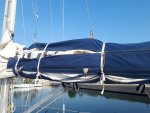
Our re-modelled lazy bag on arrival!
M.
 
Why did the cover rip all the way along? surely it would only have torn in the small area where the reef line went through the cover to the boom. Even though the clew never came right down it should have still been in roughly the correct place.
As for reef lines, one would have thought a 10mm diam dynema would be best for your set up
 
Last edited:
Why did the cover rip all the way along? surely it would only have torn in the small area where the reef line went through the cover to the boom. Even though the clew never came right down it should have still been in roughly the correct place.
As for reef lines, one would have thought a 10mm diam dynema would be best for your set up
When we had trouble reefing, not getting the clew down to the boom, there was a big bag in the foot area of the main and this pressured the bag until it ripped. We were a bit busy to do anything but sail on, and not too familiar with the reefing system ( experts now?). Point taken about the dyneema - our stoppers can handle 10mm.
M.
 
You are always going to get the sail bunched up into the sail bag when reefed. That should never cause that sort of damage. That is regardless of whether the reef is fully down or not. The sailbag is designed to take the complete sail , not just a reefed portion.
Have you adjusted your lazy jacks correctly to allow the sailbag to expand outwards & to allow the boom to drop down a bit?. If the boom had drooped a bit due to a bad reef it could be that the real problem was that the weight of the boom was on the lazy lines which was then pulling up on the sail bag. That is what the tear suggests in the picture.
The lines do not have to be tight, In fact they are better being a bit slack to stop them rubbing hard on the sail & making it easier to hoist the sail between them. They only need to be tight enough to stop the sail bag drooping below the boom when sailing.
The ones that are still connected do seem very tight.
 
Last edited:
I always thought that with conventional reefing, one should loosen the halyard, pull the tack down onto the ram's horn, tighten the luff using the halyard, then secure the clew to the boom before tightening the sheet.

Translating this method to single - line reefing: loosen the halyard and pull the reefing line until the tack is hard down at the gooseneck, tighten the halyard, then continue to pull on the reef line, to pull the boom up to the clew, then tighten the sheet.

The in-boom car configuration in the diagram in a previous post above facilitates this sequence. It sounds like you didn't know how it works inside the boom and stopped pulling on the reef line when the tack was all the way down - now you know you can keep pulling to bring the boom up to the clew.
 
Translating this method to single - line reefing: loosen the halyard and pull the reefing line until the tack is hard down at the gooseneck, tighten the halyard, then continue to pull on the reef line, to pull the boom up to the clew, then tighten the sheet.
I , personally do not do that because the reef lines can bunch at the clew & twist & jam. I slip the halyard clutch a bit for the last 3 feet of the drop. This keeps the luff part of the line up a bit & running without a tangle. It also means that one can get the clew in first to get the boom up rather than let it droop. Once again, if the line at the clew is allowed to flap free sods law dictates that it can twist & jam. The trick is to play the 2 ends but get the clew in first with the final ft coming in at the luff against the halyard. With the halyard, always keep a bit of tension so the reef has to pull it down , That way all the lines come in without slack portions that can tangle.
At the same time- if it is the first reef- I pull in free lengths of the second reef line as I go so that loops of that line do not get tangled in the gooseneck or clew etc.
 
Top